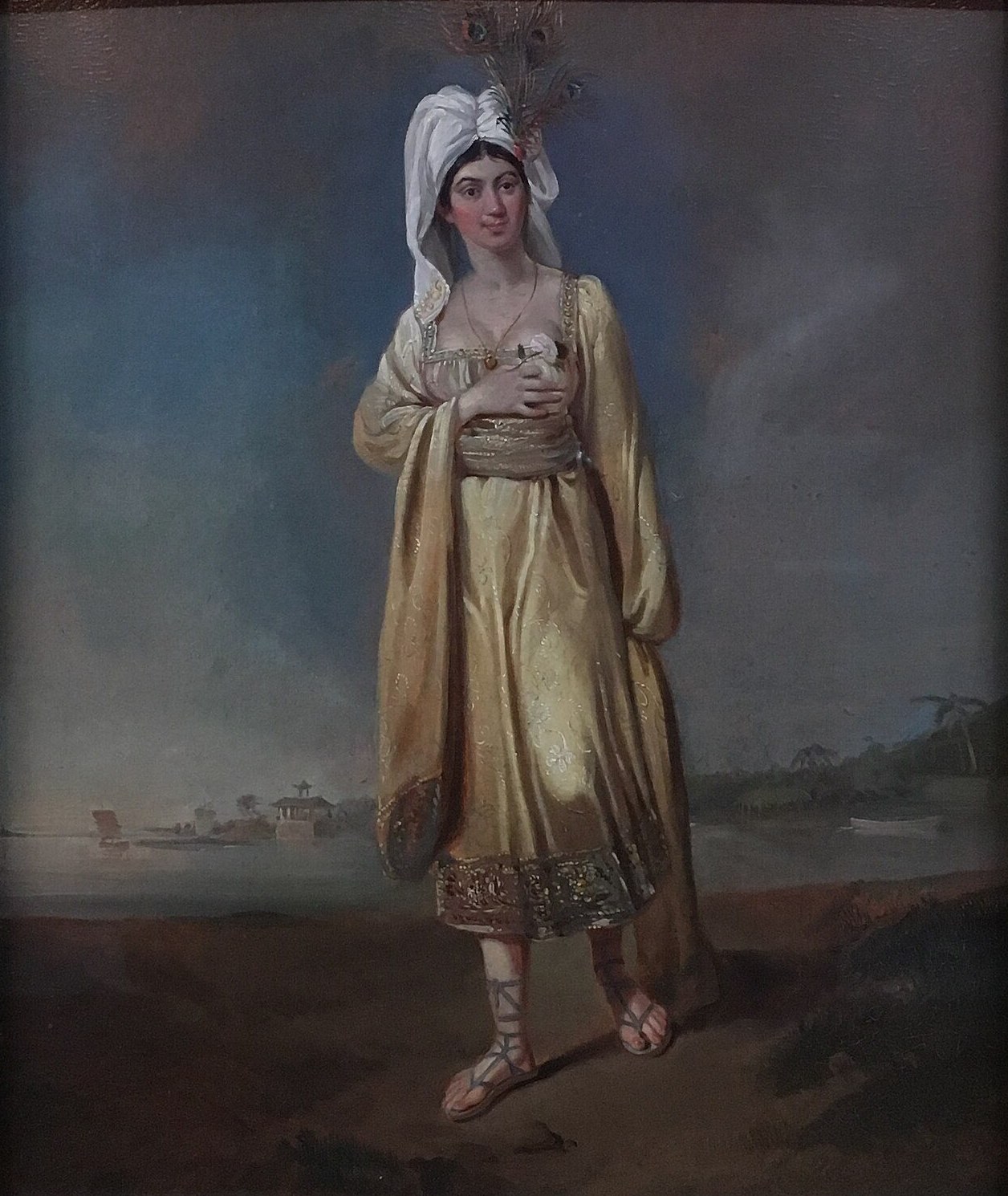
Painting: Edward Bird, 1817, Bristol Museum and Art Gallery; photo by No Swan So Fine, CC BY-SA 4.0, via Wikimedia Commons
On the evening of Thursday 3 April 1817 a young woman knocked at a cottage door in Almondsbury, a village a few miles north of Bristol, and asked, by signs, for something to eat. She was perhaps twenty-five, with dark hair under a black turban and a black shawl over a plain dress. The cobbler who answered the door could not understand a word she said. Neither could his wife, nor the overseer of the poor to whom they took her, nor the clergyman he fetched, nor the county magistrate, Samuel Worrall, who lived up the hill at Knole Park and was the last resort for strangers in the parish.
The wife of the magistrate, Elizabeth Worrall, was an American by birth, curious and kind, and she took the girl in. That decision gave the newspapers one of the best stories of the year.
Nanas
The first night at Knole the visitor would not sleep in a bed. She lay on the floor. Shown pictures, she took an interest in a Chinese scene, and when someone sketched a pineapple she said "nanas", which happens to be close to the Malay word, and which a visitor with a little Eastern learning was quick to notice. She said "Caraboo" and pointed to herself. Beyond that, nothing. She refused meat, prayed at sunrise and sunset to a god she called Allah-Talla, and when the household tried her with the languages it had, French, a little Greek, some Portuguese, she met every one with the same blank courtesy.
Mr Worrall, a practical man, concluded she was a beggar and sent her to Bristol to be dealt with as a vagrant. There, in the magistrates' lock-up, the story took its turn.
The sailor who understood her
A Portuguese sailor named Manuel Eynesso, or Enes in some accounts, came forward and said he understood the language. He translated her story. She was Caraboo, a princess of the island of Javasu in the Indian Ocean. Pirates had carried her off, sold her, and brought her by ship towards England, and when the vessel reached the Bristol Channel she had jumped overboard and swum ashore. From that point everything she did was read in that light. Nobody asked how a Portuguese sailor came to speak the language of an island nobody could find on a map.
Mrs Worrall brought her back to Knole, and for ten weeks Princess Caraboo was the most visited person in Gloucestershire. She fenced with a sword from the hall, shot with a bow and arrow, climbed trees, danced in a style of her own invention and, on one well-attested occasion, swam in the lake while the household looked away. A Bath physician, Dr Wilkinson, examined her, consulted a learned book of alphabets, decided her written characters were genuine and announced that the marks on the back of her head had been made by oriental surgeons. He wrote to the papers. The papers printed her portrait.
What Mrs Neale read in the newspaper
The portrait is what ended it. In early June a Bristol boarding-house keeper named Mrs Neale read the description in the Bristol Journal and recognised a lodger who had stayed with her the previous year and amused her daughters by talking a made-up language. She went to Knole. Confronted, the princess held out for a while and then confessed, in a Devon accent, to Mrs Worrall.
Her name was Mary Willcocks, though she is usually remembered by her later married name, Mary Baker. She had been born in Witheridge, in north Devon, in the early 1790s, the daughter of a cobbler named Thomas Willcocks, which makes it a nice touch that the first door she knocked on in Almondsbury was a cobbler's. She had been in service in several houses, had wandered, had been ill in a London workhouse infirmary, where the scars on her head came from a crude cupping treatment, and had, by her own account, travelled with gypsies, from whom she borrowed some of the words in her language. The rest she made up as she went along, and kept consistent, which is the hard part.
The Portuguese sailor had simply decided to improve the story. Dr Wilkinson's book of alphabets had been no help to anyone but himself.
Ten weeks of good acting
What strikes me about the case is not that the gentry were fooled but how much work it took to fool them. For ten weeks, in a house full of guests, she never once answered to English spoken behind her back, never laughed at the wrong moment, never slept in a bed. The published account of the affair, written that same year by John Matthew Gutch, a Bristol newspaper owner, records the tests the household set her and her passing every one. Some of the learned visitors concluded that she must at least have been to the East. She had never been out of England.
The newspapers, which had printed the princess with enthusiasm, printed the exposure with more. The joke was on the magistrate, the doctor and the county, and it ran for months. In September the Bristol Journal even carried a letter, supposedly from Napoleon's jailer on St Helena, claiming that Caraboo had been shipwrecked there and that the emperor wanted to marry her. Nobody has ever found a reason to believe it was anything but a Bristol wit's addition.
Philadelphia
Mrs Worrall, who comes out of the story better than anyone, did not prosecute. She paid the girl's passage to Philadelphia, and on 28 June 1817 Mary Willcocks sailed, less than three months after she had knocked on the cobbler's door. In America she tried being Princess Caraboo on stage, at Washington Hall in Philadelphia, and the Americans were not much interested. A letter to the Worralls from New York that November complained that she was tired of being famous.
She stayed seven years. When she came back to England in 1824 she tried the act once more, exhibiting herself in New Bond Street in London for a fee, and it failed again; by then everyone who read a newspaper knew who the woman in the turban was.
The leech seller of Bedminster
So she stopped. By 1828 she was living in Bedminster, on the south side of Bristol, as a widow, under a cousin's name, and that year she married a man called Richard Baker and had a daughter. By 1839 she was in a trade that the city's records describe plainly: she sold leeches to the Bristol Infirmary, which used them by the thousand. It was steady work. She did it for a quarter of a century.
Mary Baker died on 24 December 1864, aged about 72, after a fall at her house in Mill Street, and was buried in the cemetery at Hebron Road in Bedminster, where the grave is unmarked. Her daughter carried on the leech business and lived alone with a great many cats until a house fire killed her in 1900. The Branwhite engraving of the princess in her turban is still the picture everyone uses; a film with Phoebe Cates in the part came out in 1994 and improved the story in the usual ways.
Almondsbury is a commuter village now, beside the junction where the M4 meets the M5, and Knole, as far as I can tell, is still a private house. Which cottage she knocked at, nobody recorded. Mrs Worrall's good nature cost her the passage to Philadelphia and a certain amount of laughter at dinner parties. The Bristol Infirmary, for its part, got twenty-five years of reliable leeches out of the affair, which is a better return than most hoaxes pay.
Enjoyed this story?Get a new one every day on social.