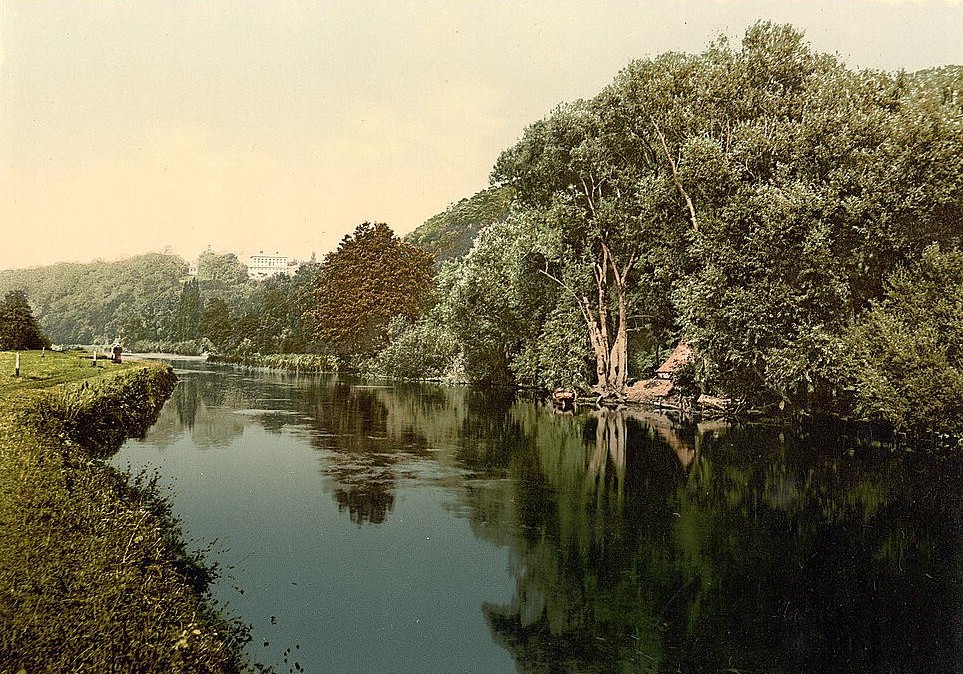
Photochrom print, c. 1890 to 1900, Library of Congress Prints & Photographs Division, no known restrictions
"There was no impropriety whatsoever in my acquaintanceship with Miss Keeler." That sentence went into Hansard on the morning of 22 March 1963, spoken by John Profumo, Secretary of State for War, in a personal statement to the House of Commons. He added that he would not hesitate to sue anyone who repeated the rumours outside the chamber. Ten weeks later he admitted it was untrue and resigned.
On Monday a press release from Santa Clara turned on the very quality Profumo lacked that morning. Nvidia's board announced that Jensen Huang, who resigned as chief executive on 12 November and whom the same board said on 17 November it did not intend to reinstate, was back as president, CEO and director with immediate effect. The board said it was "satisfied with respect to Mr. Huang's candor and ability to lead NVIDIA," that it had received "input from senior levels of the United States government," and that it was confident his return posed no national security risk. The release mentions "recent reporting that Mr. Huang has been the target of a foreign intelligence effort." The New York Times has reported that the reporting involves a woman US intelligence officials say was recruited by China's spy agency; NPR, among others, says it has not confirmed that. Huang himself has said only that he made "serious mistakes" in his personal life.
The obvious comparison is 1963, and it is worth getting right, because Profumo's case is often remembered as a sex scandal that cost a minister his job. It was not quite that.
A weekend at Cliveden
In July 1961 Profumo and his wife, the actress Valerie Hobson, were guests of Lord Astor at Cliveden, the family's mansion above the Thames in Buckinghamshire. On the estate stood a cottage rented by Stephen Ward, a fashionable osteopath and portrait artist with a wide circle of friends. One of them was Christine Keeler, then 19, who was swimming in the Cliveden pool when Profumo and Astor walked by after dinner. Another of Ward's friends was Captain Yevgeny Ivanov, assistant naval attaché at the Soviet embassy and, as British intelligence already believed, an officer of the GRU, Soviet military intelligence. Ivanov came down to the cottage that weekend too.
Profumo began an affair with Keeler that lasted a matter of weeks, perhaps a few months; accounts differ and I would not trust any of them to the day. What is documented is that in August 1961 the Cabinet Secretary, Sir Norman Brook, spoke to Profumo on behalf of the security service about Ward's circle and Ivanov, and even asked whether Profumo might help persuade the Russian to defect. Profumo said no. On 9 August he wrote Keeler a note cancelling a meeting. It began "Darling."
How a shooting in Marylebone reopened it
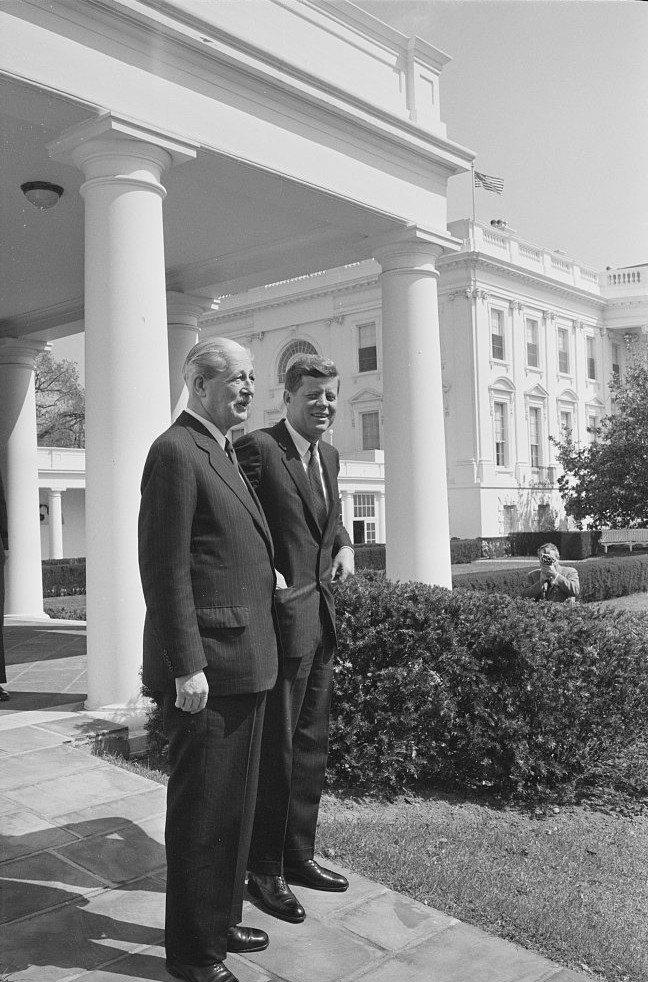
Harold Macmillan (left) with President John F. Kennedy outside the White House on 5 April 1961. Photo: Warren K. Leffler, Library of Congress Prints & Photographs Division, no known restrictions
The affair was over by the end of 1961, and it might have stayed buried had a former boyfriend of Keeler's not fired shots at the door of Ward's London flat in December 1962. The trial put Keeler's name in the papers. She talked to reporters, and the Sunday Pictorial bought her story along with the "Darling" letter, though it held off printing it. Ivanov was recalled to Moscow in January 1963. By March the rumours were all over Westminster, and on 21 March the Labour MP George Wigg raised them in the Commons, where parliamentary privilege protected him from libel.
Profumo's statement the next morning was agreed in advance with senior ministers who had questioned him in the small hours. They believed him, or decided to. Harold Macmillan, the Prime Minister, seems not to have pressed him personally, which his critics never let him forget.
The lie, not the affair
On 4 June 1963 Profumo, back from a short holiday in Venice, told the government whips that his statement to the House had been false. He resigned as minister, as an MP and from the Privy Council. His letter to Macmillan put it plainly: he had misled the Prime Minister, his colleagues and the House.
That was the offence. British politicians had survived affairs before and would again. Lying to the House of Commons in a personal statement was treated as something different, and no one in 1963 argued that Profumo could stay once he admitted it. The security question, which was the reason the story mattered to a government in the middle of the Cold War, turned out to be much smaller. Lord Denning, the judge Macmillan appointed to investigate, reported in September 1963 that he had found no evidence that any secret had leaked. His report sold in huge numbers, mostly, one suspects, for reasons other than its conclusions on national security.
What it did to Macmillan
The damage to the government was real. In the Commons debate on 17 June, 27 Conservative MPs abstained. Macmillan, whose authority had been draining since a brutal cabinet purge the year before, resigned in October 1963 on medical advice after prostate surgery. Historians still argue about how much the scandal had to do with it; he himself later blamed his health. Alec Douglas-Home succeeded him and lost the general election of October 1964 to Harold Wilson, whose Labour Party won a majority of four.
Profumo went to work as a volunteer at Toynbee Hall, a charity in the East End of London, starting with the washing-up, and stayed for about forty years. He was made a CBE in 1975 for that work and died in 2006. As far as anyone has found, he never spoke publicly about 1963 again.
Candor as a job requirement
The two cases do not line up neatly, and they should not be made to. Profumo was the minister responsible for the British Army, with access to defence secrets; Huang runs a listed company, however strategic its chips. Nobody has suggested Huang lied to anyone, and Nvidia's independent directors say their investigation will continue. He and Nvidia's general counsel are due to answer questions from House committees behind closed doors on 1 and 2 December.
What strikes me is how the institutions framed it. In 1963 the question that decided Profumo's fate was whether he had told the truth to the people he answered to, and the answer was no. In 2026 Nvidia's board chose the same test and, after a week of meetings, says the answer was yes. It also had input from Washington, which no British minister in trouble in 1963 would have wanted, let alone asked for.
Profumo's own rehabilitation, such as it was, took twelve years and arrived by way of the honours list, which is slower than a board meeting.
Enjoyed this story?Get a new one every day on social.