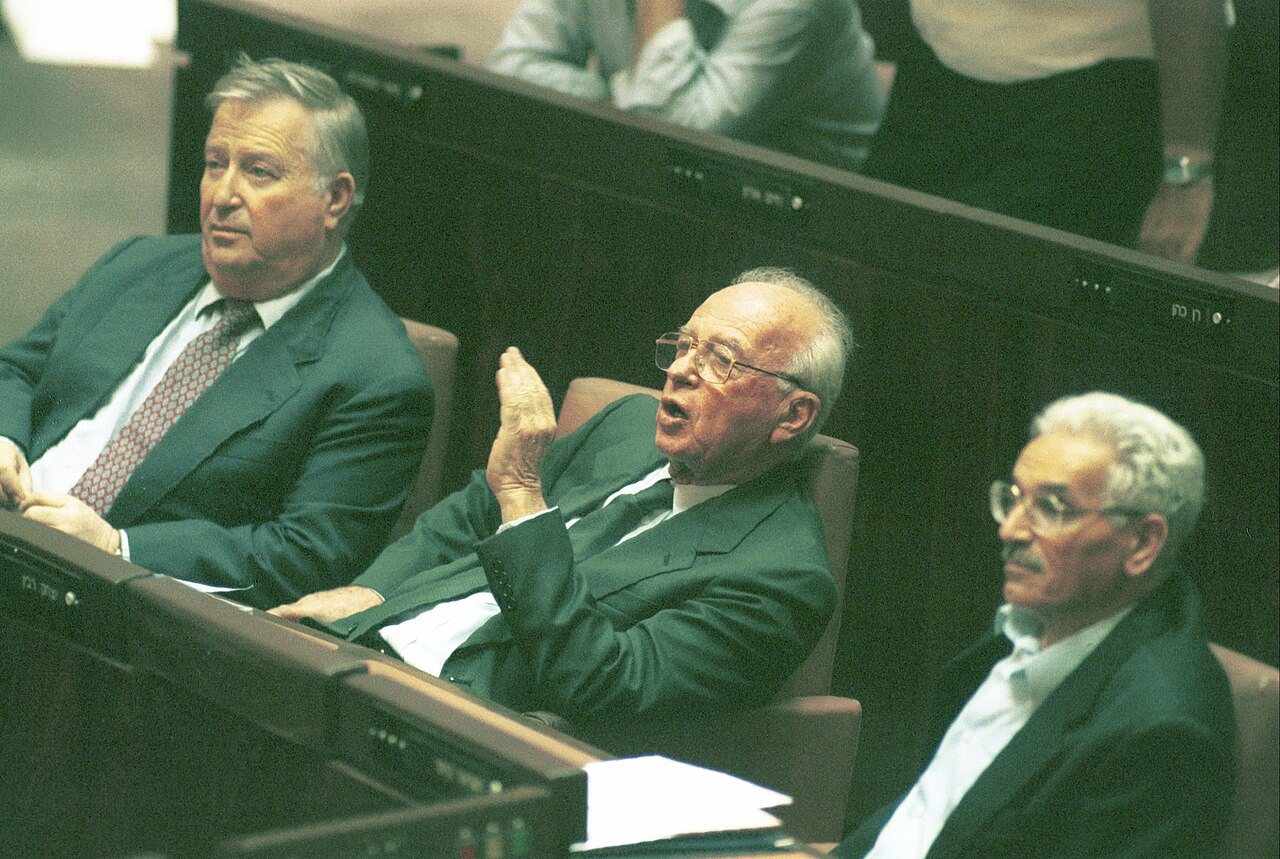
Yitzhak Rabin in the Knesset debate on the Oslo B agreement, 1995, Gideon Markowiz, Dan Hadani Archive, CC BY 4.0, via Wikimedia Commons
On Saturday night Isaac Herzog announced that he would give Gadi Eisenkot the first chance to form Israel's next government. Factions holding 67 of the Knesset's 120 seats had recommended the former army chief, against 46 for Benjamin Netanyahu. Nineteen of those 67 came from two Arab lists, the Joint List and Ra'am, and that detail was the one Netanyahu's camp seized on within minutes.
Eisenkot now has 28 days, with a possible 14-day extension, to turn recommendations into a coalition. Some of the parties he needs have said they will not sit in a government that depends on Arab votes. The argument is not new, and it is close to word for word the one that followed Yitzhak Rabin from the summer of 1992 to the night he was shot.
The arithmetic of June 1992
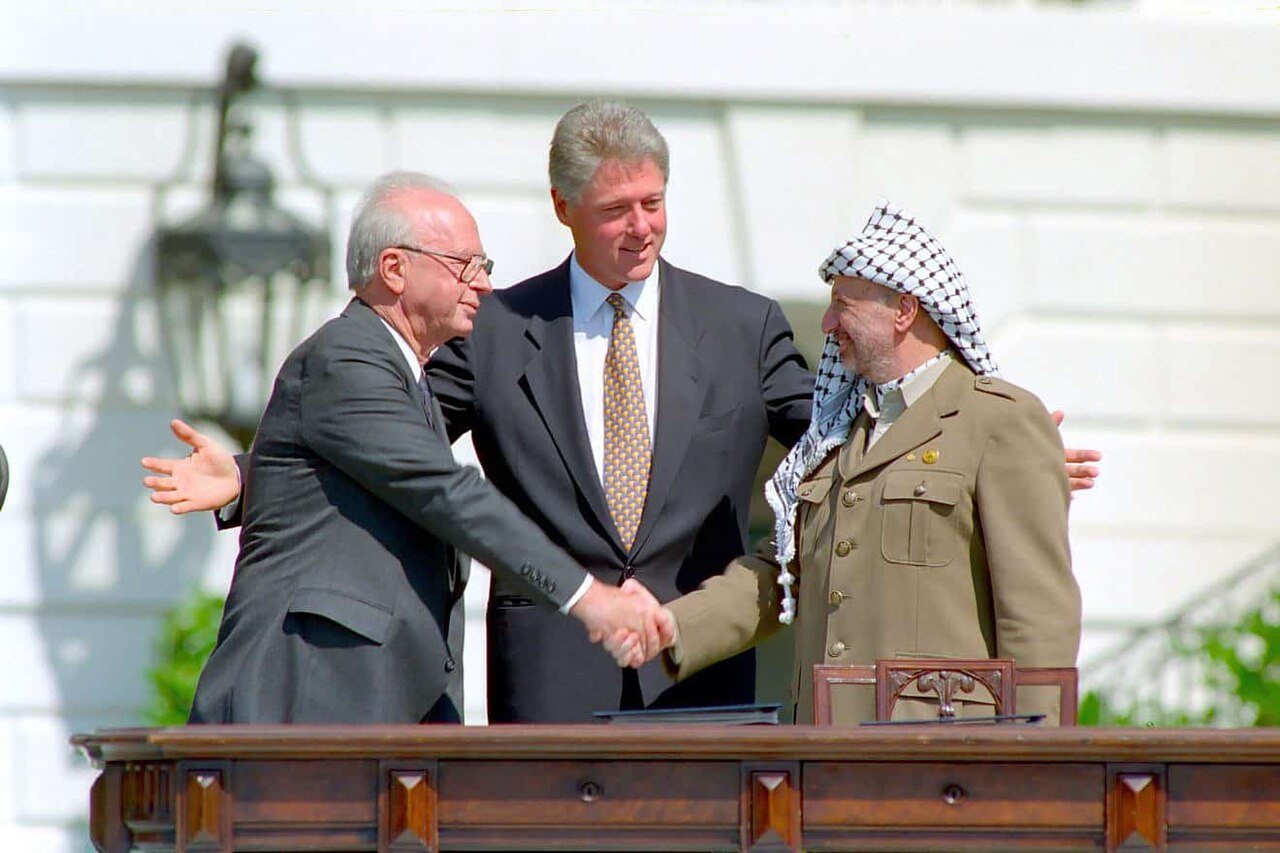
Colour photograph of Yitzhak Rabin and Yasser Arafat shaking hands as Bill Clinton stands between them with his arms spread, on the White House lawn
Rabin's Labor party won 44 seats in the election of 23 June 1992, its best result in years. Meretz, the secular left, won 12. Together they had 56, five short of a majority.
The missing five sat on the benches of two Arab-backed parties: Hadash, the Communist-led list, with three seats, and the Arab Democratic Party of Abdulwahab Darawshe with two. Neither was invited into the cabinet. Neither asked to be. What they offered was a promise to vote against any government led by the Likud, which meant that Yitzhak Shamir could not put together a majority however he tried. Israeli political writers called it the "blocking bloc", and it is the reason Rabin, not Shamir, was asked to form the government.
Rabin did bring in a third partner with a seat at the table: Shas, the Sephardi religious party, with six. That gave him 62 on paper and a cabinet with no Arab ministers, which suited everyone involved in a slightly embarrassed way.
Rabin, Clinton and Arafat at the White House, 13 September 1993, Vince Musi / The White House, public domain, via Wikimedia Commons
Oslo, and the vote that counted twice
The handshake on the White House lawn in September 1993 had to come back to the Knesset. On 23 September the house voted on the agreement, and it passed 61 to 50, with eight abstentions. The six Shas members were among those who abstained, on the instruction of their spiritual leader, Rabbi Ovadia Yosef, who told them not to vote against a deal that held out the promise of peace but stopped short of telling them to vote for it.
Count the 61 and you find the Arab members inside it. Count Rabin's Jewish supporters on their own and you do not reach a majority. Within days the opposition had a phrase for this, "no Jewish majority", and it appeared on placards, in Knesset speeches and in the newspapers of the right for the next two years. The claim was that a decision about the land of Israel taken with Arab votes was legally valid but morally void. Rabin's answer, more or less, was that a Knesset member was a Knesset member. He did not make the case with much warmth, and I am not sure he believed it would persuade anyone who was not already persuaded.
Shas drifted out of the government after its leader, Aryeh Deri, was forced to resign from the cabinet over corruption charges. For most of the rest of the term Rabin ran a minority cabinet, kept alive by the five outside votes.
A Mitsubishi and 61 to 59
By the autumn of 1995 the numbers were thinner still. The second Oslo agreement, which handed the main Palestinian cities of the West Bank to the Palestinian Authority, went to the Knesset in early October. It passed 61 to 59.
The two votes that got it over the line belonged to Alex Goldfarb and Gonen Segev, who had been elected for the right-wing Tzomet party in 1992 and had broken away in 1994 to form a small faction called Yi'ud. Segev became minister of energy and infrastructure. Goldfarb became deputy housing minister, and according to an account published years later in Haaretz, his support came with a Mitsubishi and a driver. The car became a national joke and a lasting shorthand for the price of a Knesset vote. For the right, it was proof that the agreement had been bought twice, once with Arab votes and once with a company car.
What the slogan did
The "no Jewish majority" line was not the only thing in the air in the autumn of 1995. There were posters of Rabin in a keffiyeh, and rallies at which he was called a traitor. On 4 November 1995, after a peace rally in Tel Aviv's Kings of Israel Square, he was shot dead by Yigal Amir, a law student who opposed the agreements. How much weight any one slogan carries in a murder is a question historians and the Israeli courts have both declined to answer precisely, and I won't pretend to settle it here.
What can be said is that the idea outlived him. For a generation afterwards, no Israeli government relied on Arab parties to govern. The taboo held until 2021, when Ra'am, led by Mansour Abbas, joined the coalition of Naftali Bennett and Yair Lapid, the first time an Arab party had been a formal partner in an Israeli government. That coalition collapsed after a year.
The same question, thirty-four years on
Eisenkot is in a different position from Rabin. He has more recommendations than he needs, Ra'am has already served in a government, and the Joint List is backing him from outside, much as Hadash did in 1992. But the question his would-be partners are asking each other this week is the one Rabin's partners asked: whether a majority that includes Arab citizens' votes is a majority the rest of the country will accept.
Rabin's government survived on that basis for three years and passed two peace agreements with it. Whether Eisenkot's lasts long enough to be sworn in is something the next 28 days will tell us.
Enjoyed this story?Get a new one every day on social.