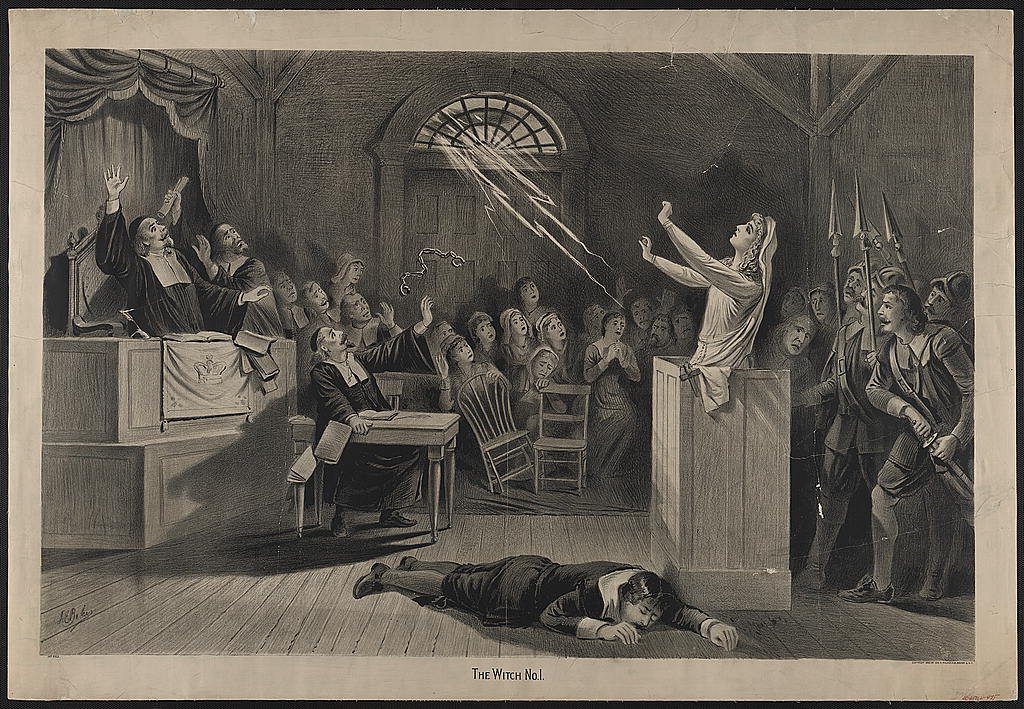
Lithograph: Joseph E. Baker, The Witch No. 1, 1892, Library of Congress Prints & Photographs Division, no known restrictions
On a Sunday in August 1706, a woman of twenty-six stood up in her pew in the Salem Village meeting house and stayed standing while the minister read out a paper she had signed. Her name was Ann Putnam, and fourteen years earlier, at twelve, she had been the most active of the "afflicted girls" whose fits and visions sent nineteen people to the gallows. The paper said she had been deluded by Satan, that she had caused innocent blood to be shed, and that she asked forgiveness of God and of all those whose relations she had helped to kill. Some of those relations were sitting in the room.
People go to Salem in October for the beginning of this story. I am more interested in the end of it, because it is one of the very few times a government, a court and the witnesses themselves all said, in writing, that they had been wrong.
What had to be taken back
Between February and October 1692, about two hundred people in Essex County, Massachusetts, were accused of witchcraft. Nineteen were hanged on a ledge outside Salem town, fourteen women and five men. Giles Corey, who refused to enter a plea, was pressed to death under stones. At least five more died in jail, where the accused were held in irons and charged for their keep. Two dogs were put to death as well, which tells you something about the state of the evidence.
The court that did this, a special Court of Oyer and Terminer set up by Governor William Phips, accepted "spectral evidence": a witness saying that the accused's shape had appeared to her and pinched or choked her, which the accused could neither see nor disprove. Once the ministers of Boston, led by Increase Mather, said publicly in October that spectral evidence should not be enough to hang anyone, the thing collapsed. Phips dissolved the court, a new one met in January 1693 without that evidence and acquitted nearly everyone it tried, and by May he had released the rest.
That left a colony full of people who had sworn, convicted, hanged and buried on the strength of something they now agreed was worthless.
The fast day of 1697
The Massachusetts General Court set aside 14 January 1697 as a day of fasting and prayer for what had been done "in the late tragedy raised among us by Satan." On that day Samuel Sewall, one of the judges who had signed the death warrants, stood in his pew at the Old South meeting house in Boston while the minister read a statement he had written. He said he was "sensible" of his share of the blame and asked pardon of God and men. He did it alone; none of the other judges followed him, and the chief judge, William Stoughton, is said to have been annoyed about it. Sewall kept the fast every year for the rest of his life.
Around the same time twelve of the men who had sat as jurors signed a paper of their own. They said they had been "under the power of a strong and general delusion," had not been able "to withstand the mysterious delusions of the powers of darkness," and had "brought upon ourselves and this people of the Lord the guilt of innocent blood." They asked the survivors and the families to forgive them, "as we would do ourselves were we in their place." It was printed, which is why we still have the wording.
Ann Putnam's turn came nine years later. Her parents, who had driven many of the accusations, were both dead by 1699, and she was left raising her younger brothers and sisters. In 1706 she asked to join the Salem Village church, and the new minister, Joseph Green, who had spent his ministry trying to put the village back together, required the confession as a condition. He read it from the pulpit on 25 August. She was the only one of the afflicted girls who ever did this.
The paperwork
An apology was one thing; the families wanted the convictions gone and their property back, since the sheriff had seized the goods of several of the condemned. In 1702 the General Court declared the 1692 trials unlawful. In 1711 it passed an act reversing the attainders of twenty-two of the people who had been convicted, and voted £578 and twelve shillings in compensation, divided among the families in sums that ranged from a few pounds to more than £150 for the Proctor family. Not everyone was covered, because not every family had petitioned, and some of those who had been hanged were simply left off the list.
That omission lasted a remarkably long time. Massachusetts passed a resolution in 1957 that was meant to clear the remaining names but managed to mention only one of them by name. The legislature went back and added five more in 2001. The last person convicted of witchcraft in Massachusetts to have her name formally cleared was Elizabeth Johnson Jr., who had been sentenced to death in 1693 and reprieved; she was missed by every previous act because she had no descendants to ask. A middle-school civics class in North Andover took up her case, and the state exonerated her in 2022, 329 years after her conviction.
What Salem does with it now
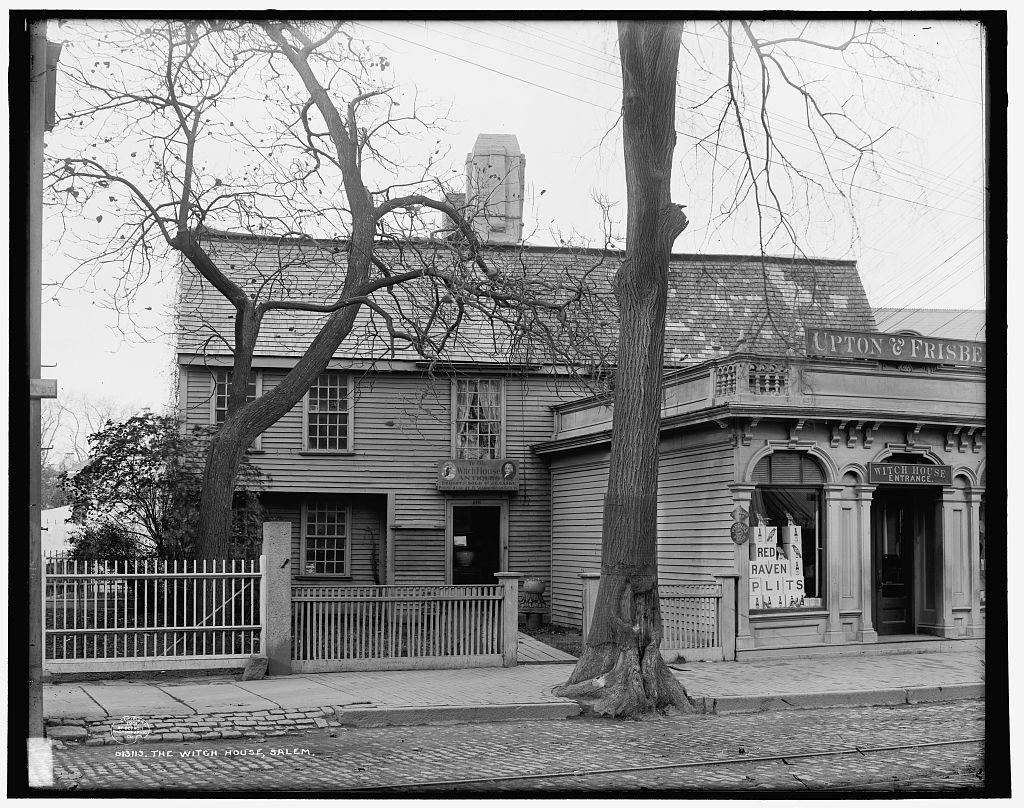
Photo: The Witch House, Salem, Detroit Publishing Co., c. 1901, Library of Congress Prints & Photographs Division, no known restrictions
Salem has made its peace with the trials by turning them into October. By the city's own estimates it draws somewhere around a million visitors over the Halloween season, with the crowd peaking on the last weekend, and the old Witch House on Essex Street, the one surviving building with a direct link to the trials (Judge Jonathan Corwin lived there), is a museum. The memorial, twenty granite benches in a low wall beside the old burying ground, is a short walk from the shops selling broomsticks.
The hanging ledge, Proctor's Ledge, was only identified for certain in 2016 and got its own small memorial in 2017, at the end of a residential street, behind a Walgreens. Ann Putnam died in 1716, at thirty-seven, and was buried with her parents. The grave is unmarked, which, given what she had to say about them in 1706, may be the one piece of this story that she would have arranged herself.
Enjoyed this story?Get a new one every day on social.