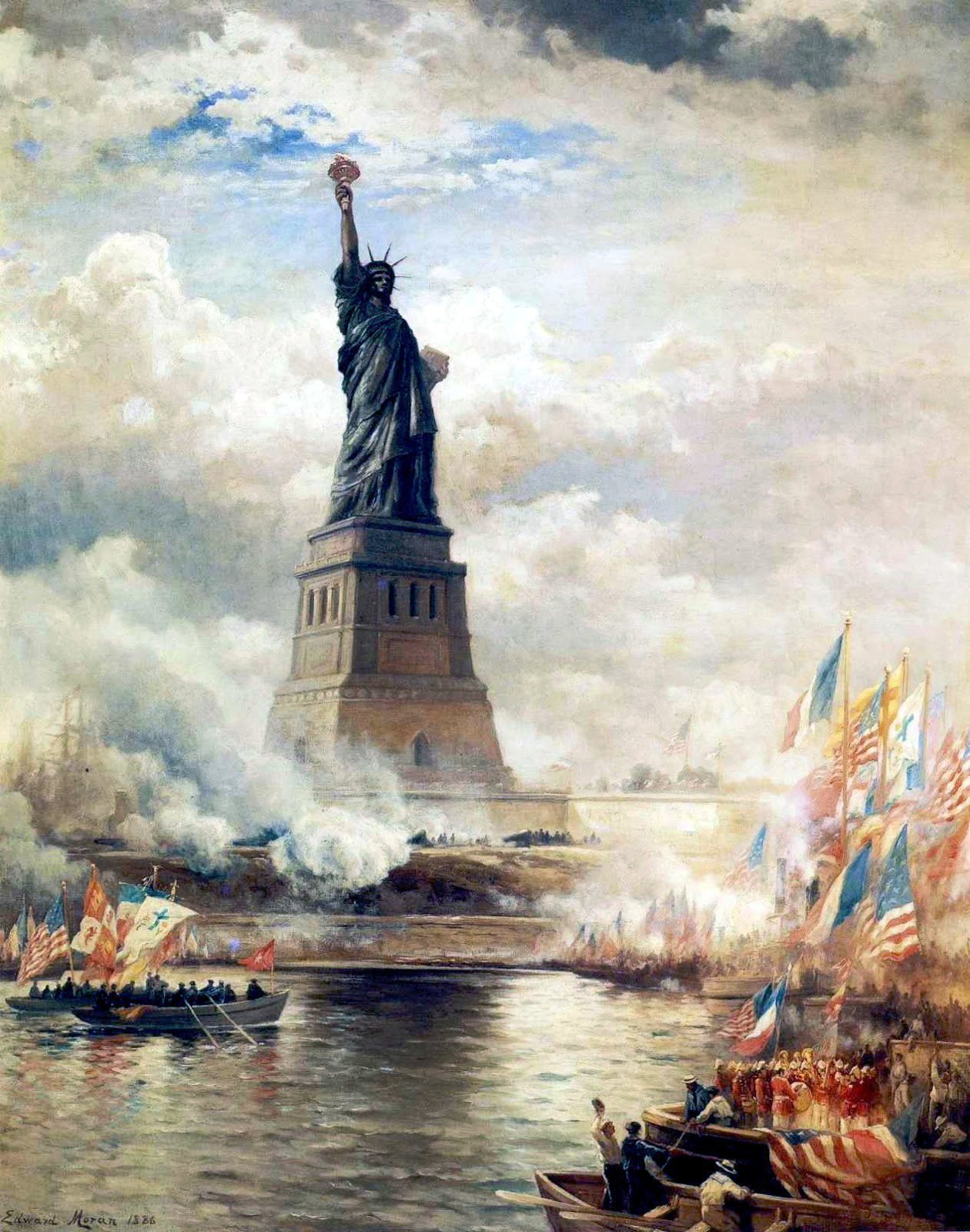
Painting: Edward Moran, Unveiling the Statue of Liberty (1886), public domain, via Wikimedia Commons
It rained on New York all morning on Thursday, 28 October 1886, and by the time the parade reached the Battery the fog on the harbour was so thick that the people lining the shore could not see the thing they had come to see. Somewhere out on Bedloe's Island, under a French flag draped across her face, stood a copper woman 151 feet tall. The ships of the naval review fired their salutes into grey nothing, and the papers the next morning agreed that the statue had spent most of the day appearing and disappearing in the mist.
The city had a holiday anyway. Something like a million people (a newspaper estimate, and newspapers in 1886 were not shy) stood along Fifth Avenue and Broadway to watch 20,000 marchers go past in the drizzle. As the parade passed the Stock Exchange, the clerks inside, who had been told to keep working, started throwing ticker tape out of the windows. That is where the ticker-tape parade comes from. Nobody planned it.
The gift that took twenty-one years to deliver
The idea dates to 1865 and a dinner near Versailles given by Édouard de Laboulaye, a French law professor who admired the United States and disliked his own emperor. The sculptor at the table, Frédéric Auguste Bartholdi, visited New York in 1871, picked out the island on the way into the harbour, and then spent years raising money in France. The deal, such as it was: France would pay for the statue, America would pay for the pedestal.
France kept its side. Bartholdi built the statue in sections in a Paris workshop, hammering copper sheets about as thick as two pennies over wooden forms. When his first engineer, Eugène Viollet-le-Duc, died in 1879, the skeleton was handed to Gustave Eiffel, who had not yet built his tower and designed an iron pylon with a flexible armature so the skin could move in the wind. The right arm and torch were shown at the Centennial Exposition in Philadelphia in 1876 and then stood in Madison Square Park for six years, where fifty cents bought you a climb up a ladder into the torch. The finished statue stood over the rooftops of the 17th arrondissement for a year, was taken apart, packed into 214 crates and shipped across the Atlantic aboard the frigate Isère in the spring of 1885.
The pedestal nobody would pay for
The American half went badly. The pedestal, designed by Richard Morris Hunt, was going to cost about $250,000, and the rich men of New York did not want to pay for it. Congress declined. The New York legislature voted $50,000 and the governor vetoed it as an improper use of public money. The governor was Grover Cleveland, who two years later would preside over the dedication as president of the United States, which he managed without visible embarrassment.
By early 1885 the pedestal was half built and the money was gone, and Boston and Philadelphia had both offered to take the statue off New York's hands.
Joseph Pulitzer, who owned the New York World and needed readers, announced in March 1885 that the World would raise the money itself, and that every donor would have their name printed in the paper no matter how small the gift. Children sent coins. A kindergarten class in Iowa sent $1.35. In five months about 120,000 people gave a little over $100,000, most of them less than a dollar each, and the World's circulation roughly doubled, which Pulitzer will not have minded. The pedestal was finished in April 1886 and the statue went up on top of it over the summer.
The day itself
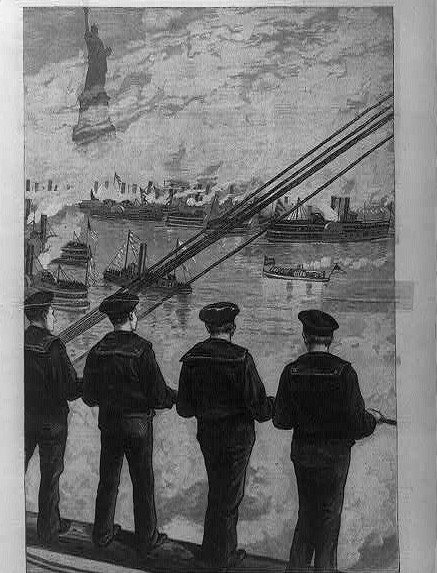
Engraving from Frank Leslie's Illustrated Newspaper of sailors watching President Cleveland's launch pass through the fleet on dedication day, 28 October 1886, with the statue in the fog behind. Library of Congress, no known restrictions
Cleveland came down the harbour in a launch through the anchored fleet and landed on the island early in the afternoon. The ceremony was for invited men: officials, officers, and the French delegation led by Ferdinand de Lesseps, who had built the Suez Canal and was at that moment failing to build one at Panama. Two women were on the island, by the usual account: Bartholdi's wife and de Lesseps's young granddaughter. The New York State Woman Suffrage Association, refused tickets, hired a boat and circled the island making speeches about dedicating a female figure to liberty in a country where women could not vote. Nobody could hear them over the whistles.
The plan was that Senator William Evarts would make the presentation speech, and at the end of it a boy would signal to Bartholdi, who was up in the statue's head, to pull the cord and drop the French flag from the face. Evarts paused for breath in the middle of his speech. The boy took the pause for the end, waved, and Bartholdi pulled. The flag fell, every ship in the harbour fired its guns and blew its whistle, the band played, and for about a quarter of an hour it was impossible to hear anything. Evarts, to his credit, waited and then finished. Cleveland spoke after him, briefly, and said the statue's light would pierce "the darkness of ignorance and man's oppression" until liberty enlightened the world. The fireworks were cancelled because of the rain and set off on the Monday.
A lighthouse that did not work
For its first sixteen years the statue belonged to the Lighthouse Board and was officially a lighthouse. It was a bad one. The torch was lit on the night of 1 November and ships' captains reported that they could not see it from a few miles out. In 1901 the War Department took it over, and in 1933 the National Park Service.
The copper was the colour of a new penny on dedication day. It was fully green by about 1920, and in 1906 the government looked into painting it back and dropped the idea after the newspapers reported the public reaction. The green is a layer of copper salts a fraction of a millimetre thick, and it is the reason the skin underneath has barely corroded in 140 years.
The poem came later
The words most people associate with the statue were not read at the dedication and were not on it. Emma Lazarus wrote "The New Colossus" in 1883 for an auction to raise pedestal money, and it was mostly forgotten by the time she died in 1887. A friend campaigned to have it put on a bronze plaque inside the pedestal, which happened in 1903. The "huddled masses" line became the statue's meaning only in the 1930s, when the country was arguing with itself about refugees from Europe; the immigrants of the 1890s who saw it from the deck of a ship would not have known the poem. Ellis Island opened in 1892, half a mile away.
What is on the island now
Bedloe's Island was renamed Liberty Island in 1956. The 1886 torch is in the museum on the island; it was replaced in the 1984 to 1986 restoration with a copper torch covered in gold leaf, which is roughly what Bartholdi wanted in the first place. The only authorised ferry leaves from the Battery and from Liberty State Park in New Jersey.
You can still climb to the crown, which I did once and would not describe as restful. There are 162 steps up a narrow double spiral inside Eiffel's iron frame, no lift, a limit of ten minutes at the top, and a rule that each person may book one crown ticket in any six-month period. The windows in the crown face the harbour, not the city. On a clear day you can see roughly what Cleveland could not.
Enjoyed this story?Get a new one every day on social.