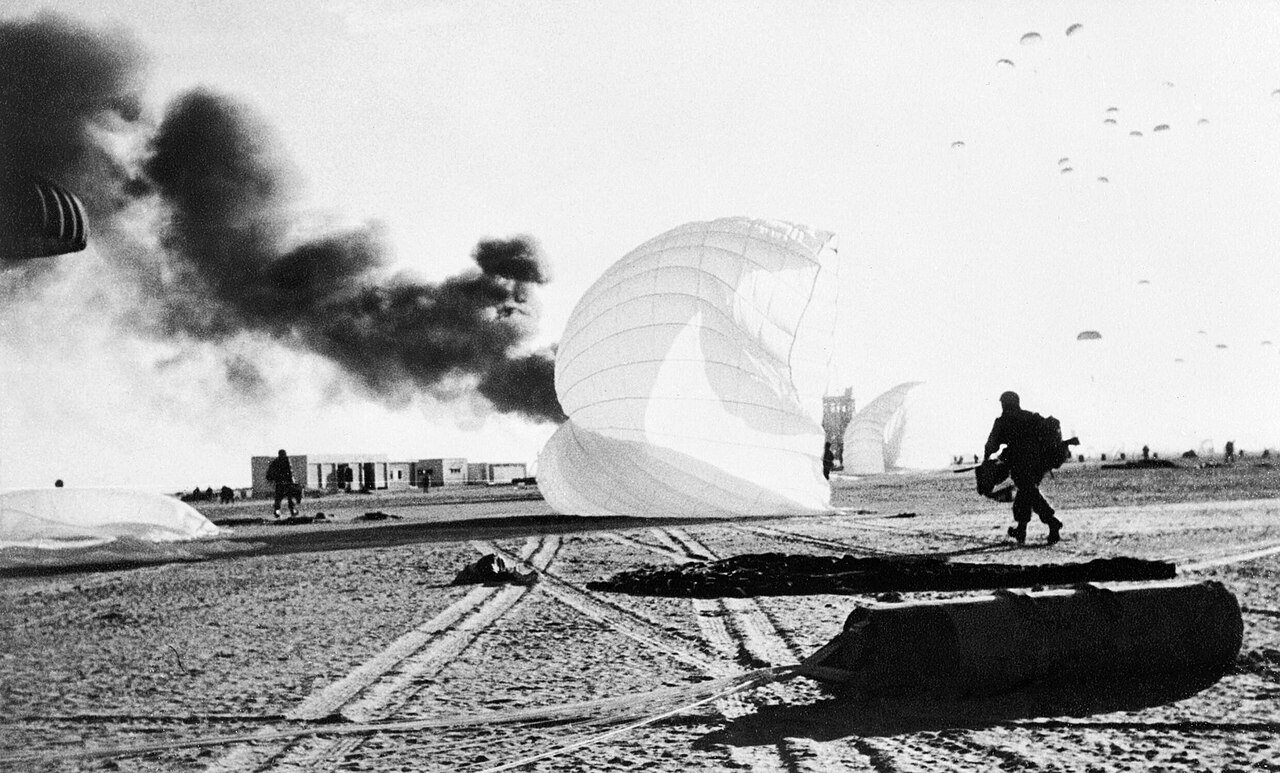
Photo: British official photographer, Port Said, November 1956, public domain, via Wikimedia Commons
Shortly after dark on 31 October 1956, Canberra and Valiant bombers of the Royal Air Force came in over the Nile delta from Cyprus and Malta and began dropping bombs on Egyptian airfields. Almaza and Inchas outside Cairo were hit, then Abu Sueir and Kabrit along the canal. The raid on Cairo West was called off at the last minute because American civilians were being evacuated along the road beneath it, and nobody in London wanted to explain a dead American to Dwight Eisenhower.
It was the opening of what the planners had named Operation Musketeer. The two oldest colonial powers in Europe had set out to take back a canal and bring down the man who had taken it. Six days later they were accepting a ceasefire they did not want, and the world had drawn the opposite lesson.
A speech in Alexandria
The canal had been run since 1869 by the Suez Canal Company, a Paris firm in which the British government had held the largest block of shares since Disraeli bought out the Khedive in 1875. It carried much of Western Europe's oil, and the concession ran until 1968.
On 26 July 1956, Gamal Abdel Nasser gave a long speech in Alexandria. When he said the name "de Lesseps", the engineer who had built the canal, it was the signal for Egyptian troops to walk into the company's offices. He was nationalising it, he told the crowd, and would use the tolls to pay for the Aswan dam, which Washington and London had just refused to finance.
Anthony Eden, prime minister for little more than a year, took it personally. In private he compared Nasser to Mussolini and said he wanted him "destroyed". The French government of Guy Mollet, fighting a war in Algeria that it believed Cairo was arming, needed no persuading.
The secret at Sèvres
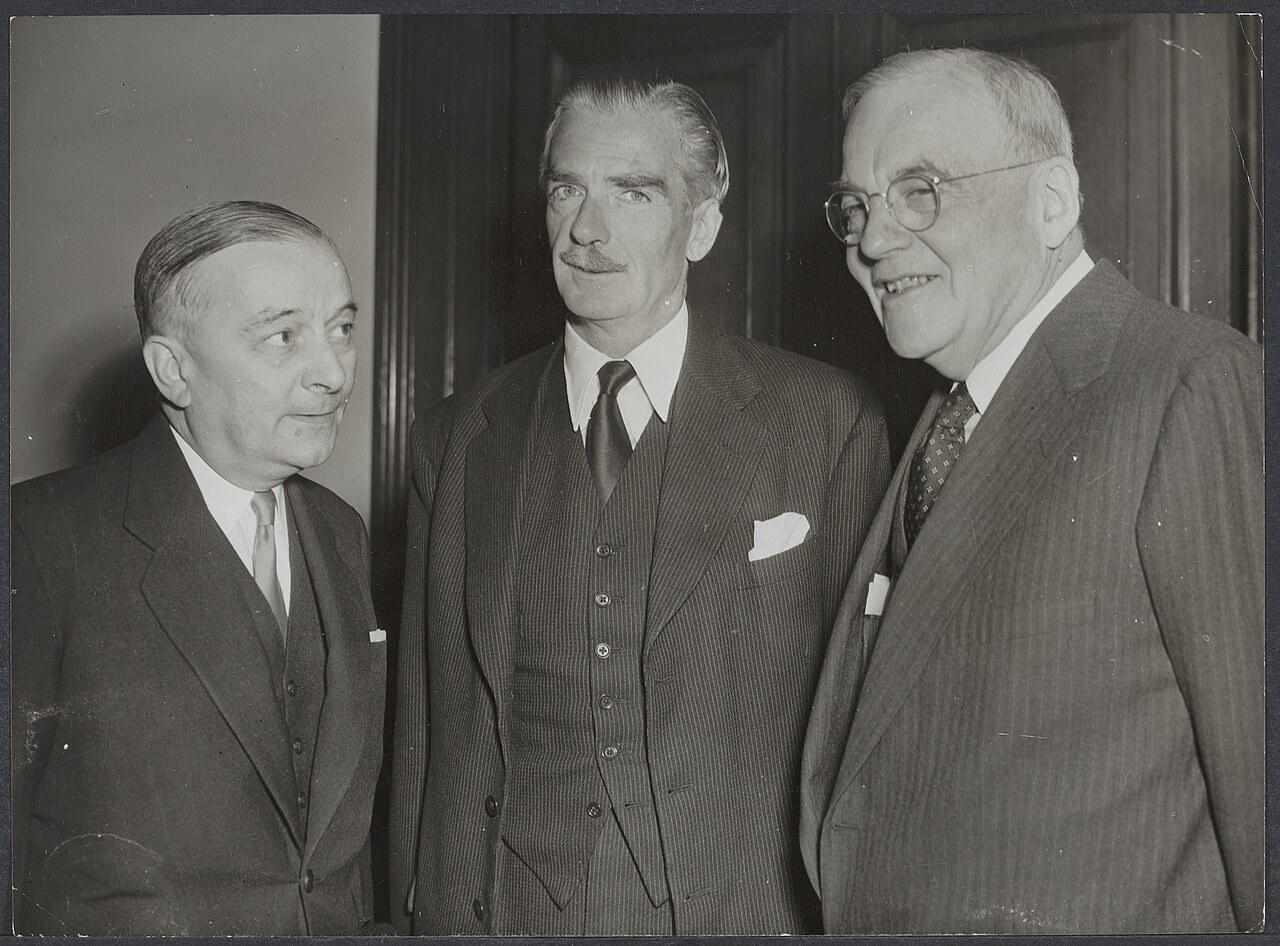
Photo: Georges Bidault, Anthony Eden and John Foster Dulles in the mid 1950s. Eden was Foreign Secretary before he was prime minister, and Dulles was the American who would not back him. Anefo, Nationaal Archief, CC0, via Wikimedia Commons
Three months of conferences moved Nasser not at all. On 22 October British, French and Israeli representatives met in a villa at Sèvres, outside Paris, and over three days wrote down a plan. Israel would attack Egypt across the Sinai. Britain and France would then issue an ultimatum to both sides to pull back from the canal. Egypt would refuse, and the two powers would intervene "to separate the combatants" and occupy the canal zone.
Eden was so alarmed by the existence of a written record that he had the British copy destroyed. The Israelis kept theirs, which is how we know exactly what was agreed. On 20 December he told the Commons there had been no foreknowledge of the Israeli attack, which was a lie.
Israel attacked on 29 October. The ultimatum went out on the 30th, giving both sides twelve hours. Cairo rejected it, and on the evening of the 31st the bombers went in.
Six days
The air campaign did what it was meant to. Over the following days the Egyptian air force was mostly destroyed on the ground or flown out to Syria and Saudi Arabia. Two other things mattered more. Nasser had ships sunk in the canal, around forty of them in the end, which blocked it completely, and Syrian engineers blew up the pumping stations on the Iraq Petroleum Company pipeline. The two powers had gone to war to secure Europe's oil and had, within a week, cut it off.
The ground assault took far too long to arrive. The invasion fleet had to come from Malta, and it was not until 5 November that British paratroopers dropped on Gamil airfield at Port Said (that is them in the photograph above) and French ones took the bridges at Raswa and the town of Port Fuad. The seaborne landing came on the 6th, with Royal Marines coming ashore from helicopters, the first time that had been done in a war. By midnight the British column had got about 23 miles down the canal, to El Cap, and stopped. Sixteen British and ten French servicemen were killed. Egyptian dead ran into the thousands by most estimates, among them several hundred civilians in Port Said.
They stopped because London had ordered a ceasefire, and London had ordered it because of what was happening to the pound.
Eisenhower's week
Eisenhower had told Eden all summer that the United States would not support force. He learned of the attack from the news, in the last days of his own re-election campaign, and he was furious in a way his staff had rarely seen. On 2 November the United States took a ceasefire resolution to the General Assembly, where it passed 64 to 5.
Then came the money. Sterling had been under pressure since the summer, and in the first week of November it was being sold hard. Harold Macmillan, Eden's Chancellor and until that week one of the loudest hawks in the Cabinet, told his colleagues that the reserves had lost something like $280 million in November, about an eighth of the total. He may have overstated it (historians have been arguing about that ever since), but the effect was the same. Britain needed to draw on the International Monetary Fund, and the Americans made clear that nothing would be allowed until the shooting stopped. Macmillan, as Harold Wilson put it afterwards, was first in and first out. The ceasefire took effect at midnight on 6 November.
What was left
Lester Pearson, Canada's external affairs minister, had spent those days at the UN drafting the thing that let everyone climb down: a United Nations Emergency Force to stand between the armies, the first of its kind. The resolution passed on 4 November, and Pearson got the Nobel Peace Prize the following year. The British and French were out of Port Said by 22 December. Israel left the Sinai in March 1957. The canal reopened in April 1957.
Eden, ill and finished, resigned on 9 January 1957 and Macmillan took his place. Nasser, who had lost his air force and a good part of his army's equipment, came out of it the most popular man in the Arab world, and stayed that way until 1967.
The canal today
Britain drew its own conclusion from the week of 31 October 1956, and Macmillan spent the rest of his premiership acting on it: never again get on the wrong side of Washington. France drew the opposite one, and within two years had a president who meant to make sure it never had to ask anyone's permission again.
The canal itself is Egyptian in a way nobody argues about any more, and it has had a rough few years for reasons that would have been familiar in 1956: the trouble is in the region, not the waterway. Attacks on shipping in the Red Sea from late 2023 sent much of the world's container traffic around the Cape of Good Hope instead, and the canal's income fell by more than half. Egypt's statistics agency put revenue for April to June 2026 at about $1.26 billion, up 13 per cent on the previous quarter, with 3,580 ships passing through. That is still roughly half the pre-crisis level, and the container ships have mostly not come back yet.
Enjoyed this story?Get a new one every day on social.