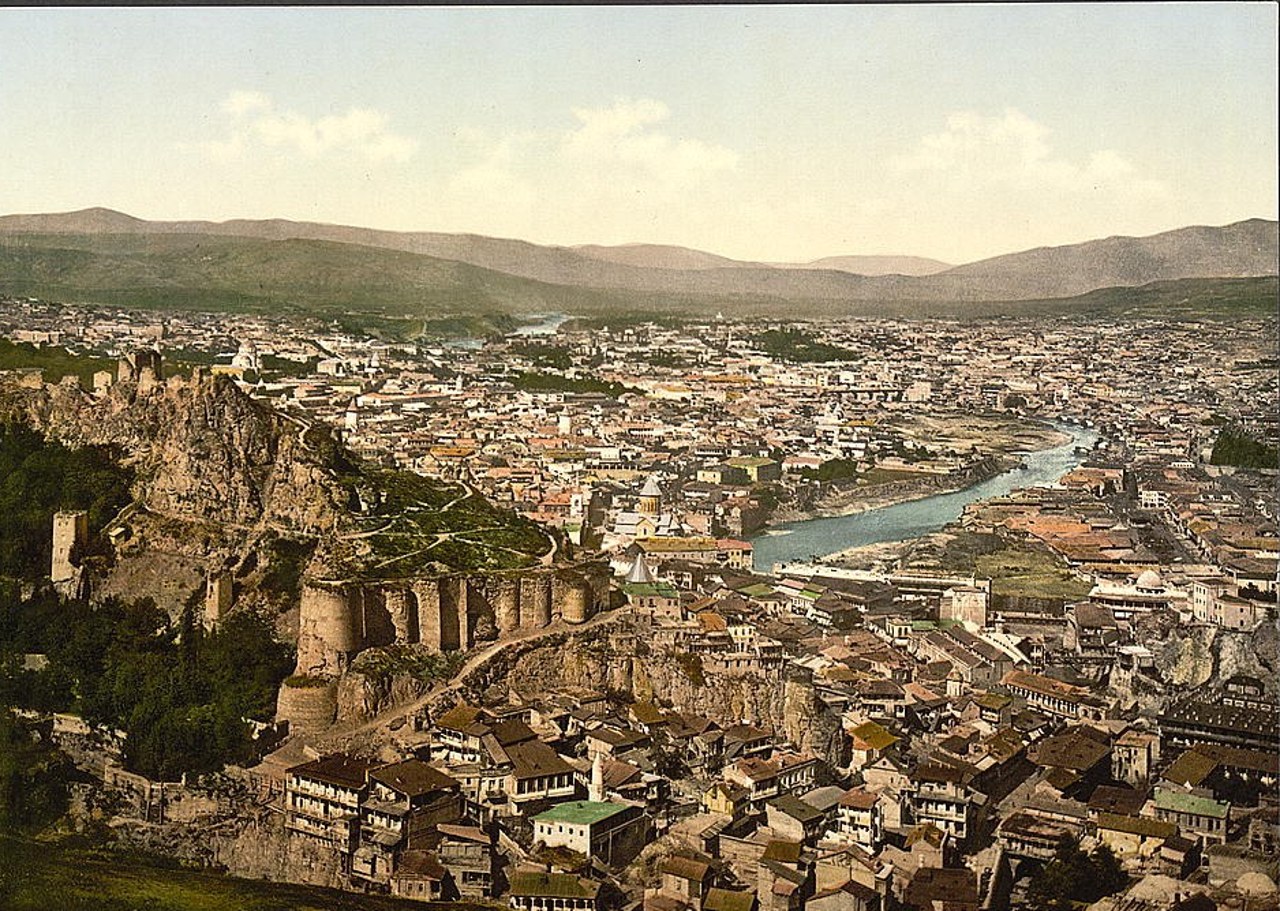
Photochrom print: Tiflis, the fortress and the town, c. 1890-1900, Library of Congress Prints & Photographs Division, no known restrictions
On Thursday evening somebody moved about $6.36 billion out of Binance, the world's largest cryptocurrency exchange, in roughly twenty minutes. The blockchain analysts at TRM Labs say with high confidence that it was TraderTraitor, a North Korean hacking unit, and that this is the largest theft of any kind of money ever recorded, around four times the $1.5 billion taken from Bybit last year. Binance has said customer funds are safe and had not, as of Friday, said how it happened.
A state that pays its bills by robbing banks sounds like a modern invention, and it is not. The best documented early case is from the summer of 1907, when a party that would run the largest country on earth within ten years decided to steal a quarter of a million roubles from the Russian State Bank in broad daylight, and sent the man Lenin called "our Caucasian bandit" to do it.
Ten thirty in the morning, Erivansky Square
Tiflis, now Tbilisi, was the administrative capital of the Russian Caucasus. Its central square, named for the city of Erivan, held the Tilipuchuri tavern, the military governor's headquarters and the local branch of the State Bank. On the morning of 26 June 1907 (13 June in the Russian calendar of the time), two horse-drawn carriages left the post office carrying cash for the bank, escorted by Cossacks and police.
About twenty people were waiting for them. Some were inside the tavern, drinking. As the convoy came in, around half past ten, they threw bombs from several directions and opened fire with revolvers. The horses bolted with the money still on board. A man in the uniform of a cavalry officer, who had driven into the square in a phaeton, chased the carriage down, threw another bomb and took the bags. The whole thing lasted a few minutes.
The official count was forty dead and about fifty injured, most of them passers-by, policemen and the escort. The robbers took around 241,000 roubles by the official figure; some accounts say more. A Tiflis worker earned perhaps twenty or thirty roubles a month.
The cavalry officer
The man in the uniform was Simon Ter-Petrosian, an Armenian from Gori who went by the name Kamo. He was 25 and had a talent for disguise and for surviving things that should have killed him. He had learned to make bombs in Finland that spring, near Lenin, and carried the explosives back himself.
Kamo's friend from Gori, three years older and also a seminary dropout, was Ioseb Jughashvili, then signing his articles "Koba" and later known to the world as Stalin. How much Stalin had to do with the robbery is one of the better arguments in the literature. He was in Tiflis that summer, he knew Kamo intimately, and later accounts by former comrades put him at the centre of the planning. Simon Sebag Montefiore's biography of the young Stalin makes the case for his being the organiser who kept his hands clean. Others think the evidence is thin and comes mostly from people with reasons to blacken him. Stalin never admitted to any of it, his official biographies never mentioned it, and the Tiflis party organisation, run by Mensheviks who were appalled, is said to have thrown him out over it. I have never seen a document that settles the question, and I doubt one exists.
What is not in doubt is that the money went to Lenin. It was sewn into a mattress, smuggled out of the Caucasus and delivered to the Bolshevik leadership in Finland.
A party that had just banned robbery
The timing was awkward in a way the robbers knew perfectly well. A month earlier, at its Fifth Congress in London, the Russian Social Democratic Labour Party had voted to ban "expropriations", the polite word for armed robbery, and to dissolve the squads that carried them out. The Mensheviks had pushed the ban through. Lenin's Bolsheviks had voted against it and then, through a small secret body called the Bolshevik Centre, run by Lenin, Leonid Krasin and Alexander Bogdanov, carried on regardless. Tiflis gave the Mensheviks forty corpses to point at. Lenin's answer was to deny everything and spend the money.
Money you cannot spend
That turned out to be harder than the robbery. Around 100,000 roubles of the haul was in 500-rouble notes, and the bank had recorded the serial numbers. Within days every bank in the empire had the list, and the notes were useless inside Russia.
The Bolshevik Centre decided to change them abroad instead, all on the same day, so the banks would have no time to compare notes. In January 1908 party members presented 500-rouble bills at banks in Paris, Munich, Stockholm and other cities. The police had been tipped off by an informer inside the party and were waiting. Maxim Litvinov, who thirty years later would be Stalin's foreign minister, was arrested in Paris with a dozen of the notes in his pocket and deported. The money that got through was a small fraction of the total. By several accounts the Bolsheviks eventually burned what was left.
Kamo had been arrested in Berlin in November 1907 carrying a suitcase of explosives, given away by the same informer. What he did next sounds invented but is well attested. To avoid extradition and a death sentence he pretended to be insane, and kept it up for more than three years, through examinations by German and then Russian psychiatrists who stuck needles in him and burned his skin to test whether he felt pain. He was extradited to Russia in 1909 anyway, held in a Tiflis asylum, and in August 1911 sawed through a window bar and escaped. He tried another robbery, was caught in 1912, and was sentenced to death four times over. The sentences were commuted to life in the amnesty for the Romanov tercentenary in 1913, and the revolution of February 1917 let him out.
The square today
Erivansky Square has been renamed several times since. Under the Soviets it was Beria Square, then Lenin Square. It is Freedom Square now, with a gilded Saint George on a column where Lenin stood. Kamo was killed in July 1922, knocked off his bicycle by a truck on a Tiflis street, and was buried in the gardens beside the square with a monument over him. The monument came down after the Soviet Union ended, and his remains were moved.
The comparison with Pyongyang is closer than it looks. The UN's own experts have reported for years that North Korea's cryptocurrency thefts pay for its weapons programmes, and its hackers have form, from the $81 million taken from Bangladesh's central bank in 2016 to Bybit in 2025. The Bolsheviks in 1907 were not yet a state, but they were behaving like one: a revenue problem, an armed branch, a public denial and a laundering operation that fell apart. The difference is the laundering. The men who robbed the Tiflis convoy had to walk into banks and hand over numbered paper. Whoever emptied Binance's wallets on Thursday will not have that problem, and the people chasing them know it.
Enjoyed this story?Get a new one every day on social.