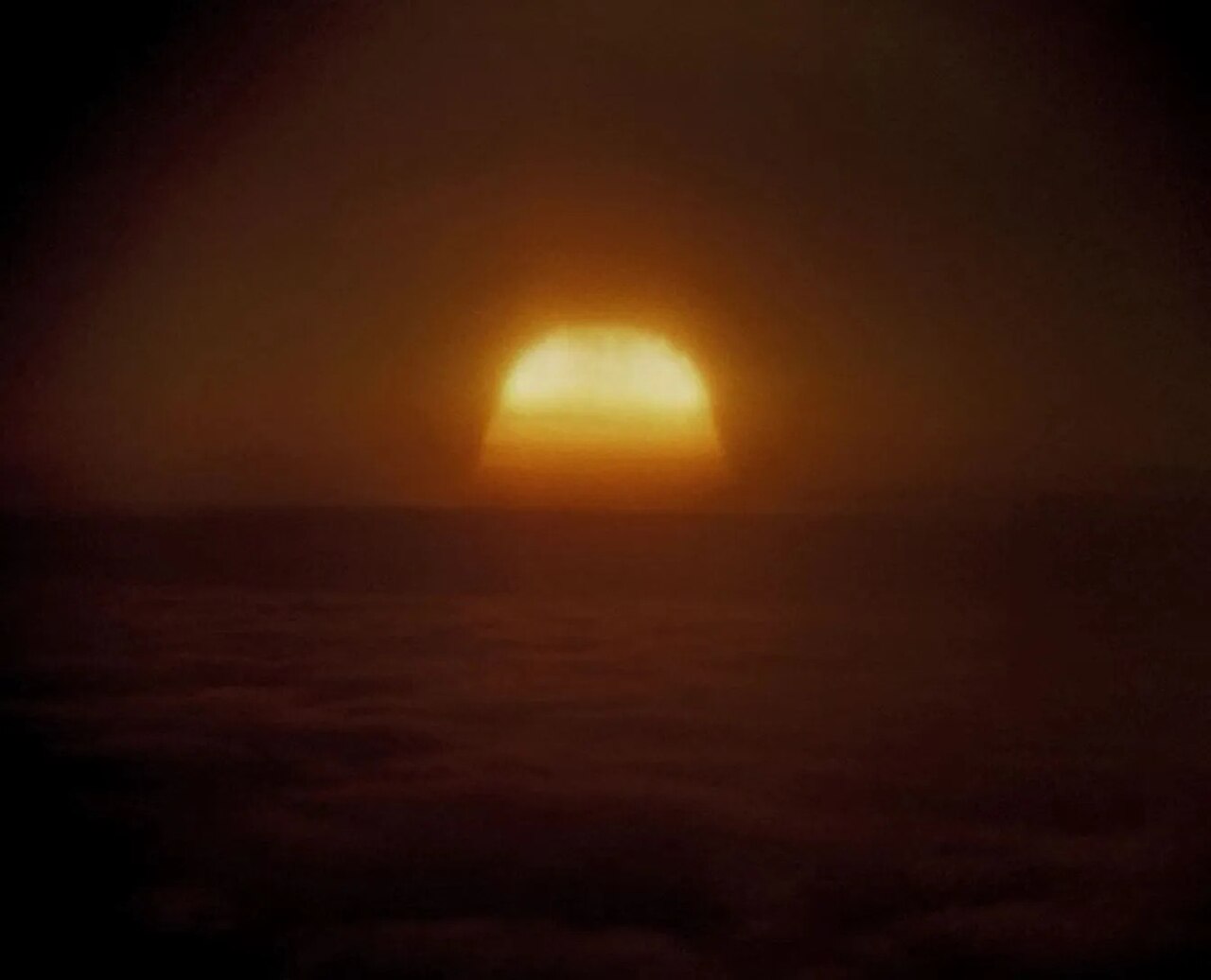
Photo: Soviet test photograph, 1961, public domain, via Wikimedia Commons
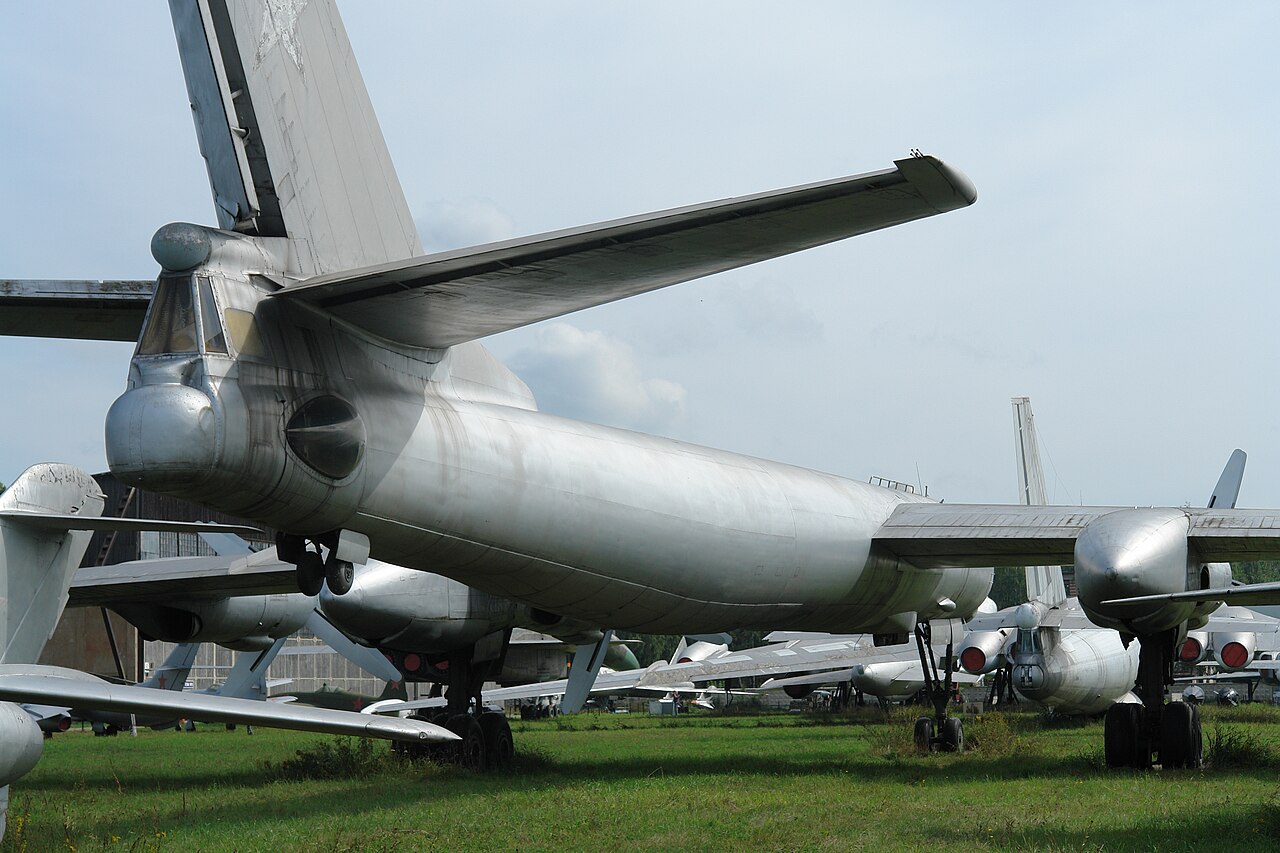
At 11:32 Moscow time on 30 October 1961, a Tu-95 bomber painted white to reflect heat released its load over Sukhoy Nos, a cape on the northern island of Novaya Zemlya, about 4,000 kilometres from Moscow and well inside the Arctic Circle. The bomb was eight metres long, two metres across and weighed 27 tonnes. It was too big for the bomb bay, so the bay doors had been removed and the thing hung half outside the fuselage all the way from the airfield on the Kola Peninsula.
A parachute opened behind it, with a canopy of roughly 1,600 square metres, to slow the fall and give the crew, commanded by Major Andrei Durnovtsev, about three minutes to get away. The bomb went off around 4,000 metres above the ground. The bomber was some 40 kilometres off by then, and the shock wave still caught it and dropped it about a kilometre before the pilot recovered control.
The Soviet figure for the yield was 50 megatons. Some later Western estimates run to 57 or 58. Either way it was the largest explosion human beings had ever produced, and sixty-five years on nothing has come close.
A bomb nobody could deliver
The device was designated RDS-220 and known inside the programme as Ivan, or sometimes by the diminutive Vanya. The name Tsar Bomba came later and from outside, by analogy with the Tsar Cannon and Tsar Bell in the Kremlin, two other enormous Russian objects that were never actually used for anything.
It was designed as a three-stage weapon rated at 100 megatons. The team, which included Andrei Sakharov, built it in a matter of months after Nikita Khrushchev announced the project to the 22nd Party Congress on 17 October 1961 and promised the delegates a 50-megaton test before the month was out. To bring the yield down and cut the fallout, the uranium tamper of the final stage was swapped for lead. That halved the explosion and, as it happened, made the bomb unusually clean for its size: most of the energy came from fusion rather than fission.
Nobody had any realistic plan for using it. No missile could carry it, and the only aircraft that could lift it had to be modified so heavily that it was barely a bomber any more. Durnovtsev was promoted to lieutenant colonel and made a Hero of the Soviet Union after the flight, which tells you something about how the odds of his coming back had been assessed beforehand.
What 50 megatons looked like
Photo: the Tu-95 at the Central Air Force Museum at Monino near Moscow, identified by the museum as the aircraft that dropped the bomb, Bernhard Gröhl, CC BY-SA 3.0, via Wikimedia Commons
The fireball was about eight kilometres across. It never touched the ground, because the shock wave reflecting off the surface pushed it back up, but it reached nearly to the altitude the bomber had dropped from. The mushroom cloud rose to somewhere between 60 and 67 kilometres, seven or eight times the height of Everest, and its cap spread out to about 95 kilometres wide.
The flash was seen 1,000 kilometres away. The pressure wave went round the planet three times, and seismic stations registered the third pass. Window glass was reported broken in Norway and Finland, hundreds of kilometres off. In the abandoned settlement of Severny, about 55 kilometres from ground zero, the wooden houses were flattened and the stone ones lost their roofs.
The Soviet film of the test sat in a classified archive for almost sixty years, until Rosatom put a 40-minute cut of it online in August 2020. It is strangely quiet footage: men in greatcoats, a bomb on a rail trolley, then a horizon that goes white.
Why October 1961
The timing was political. The Berlin Wall had gone up in August. The Soviet Union had ended a three-year informal moratorium on testing on 1 September and run a long series of atmospheric shots through the autumn; the Americans resumed underground tests two weeks later. The 22nd Party Congress, where Khrushchev announced the 50-megaton bomb, was the same congress that voted to remove Stalin's body from the Lenin mausoleum, which was done quietly on the night of 31 October, the day after the test.
Khrushchev liked a big number. He is often quoted as saying the full 100-megaton version would not be fired because it might break the Soviet Union's own windows. I have never found a reliable first-hand source for the line, so treat it as the sort of thing he would have said rather than something we know he said.
The man who built it and regretted it
Sakharov was 40 and already the leading figure in Soviet thermonuclear design. He had argued against the autumn 1961 test series on the grounds that it would wreck the chance of a test ban, and lost; Khrushchev told him, more or less, that scientists made the weapons and politicians decided when to use them.
His own account in his memoirs is that the Novaya Zemlya shot was the point at which he stopped being able to think of himself as a weapons designer and nothing else. He had calculated how many people worldwide would eventually die from the fallout of each megaton tested in the atmosphere and did not like the answer. He pushed for the 1963 treaty that banned tests in the atmosphere, underwater and in space. By 1975 he was a Nobel Peace laureate the Soviet state would not let out of the country.
What is left on Novaya Zemlya
The archipelago is still a military test range. The last Soviet nuclear test anywhere was conducted there on 24 October 1990, and the site has been kept in a state of readiness ever since; Russian officials have said more than once that it could host a test again if the decision were made. The Nenets families who lived on the islands were moved off in the 1950s and never returned.
Thirty years of a treaty that never took effect
Which brings us to why the anniversary is worth more than a paragraph this year. The Comprehensive Nuclear-Test-Ban Treaty opened for signature thirty years ago, in September 1996, and has never entered into force, because a handful of the states it needs, the United States and China among them, have not ratified it. Russia withdrew its own ratification in November 2023, saying it would still observe the moratorium unless Washington tested first. The United States has not fired a nuclear test explosion since September 1992. Just over a year ago President Trump said he wanted American weapons tested on an equal basis with other powers, and his administration spent months explaining what that did and did not mean; on 30 September this year the National Nuclear Security Administration ran a chemical, non-nuclear explosive experiment at the Nevada site, which it said was for detection research. No state has acknowledged a nuclear test explosion since North Korea's in 2017.
So the record set over Sukhoy Nos stands, and the range where it was set has been kept ready for sixty-five years in case somebody wants it again. The buildings at Severny were never rebuilt. The island is mostly ice, wind and a few hundred military personnel.
Enjoyed this story?Get a new one every day on social.