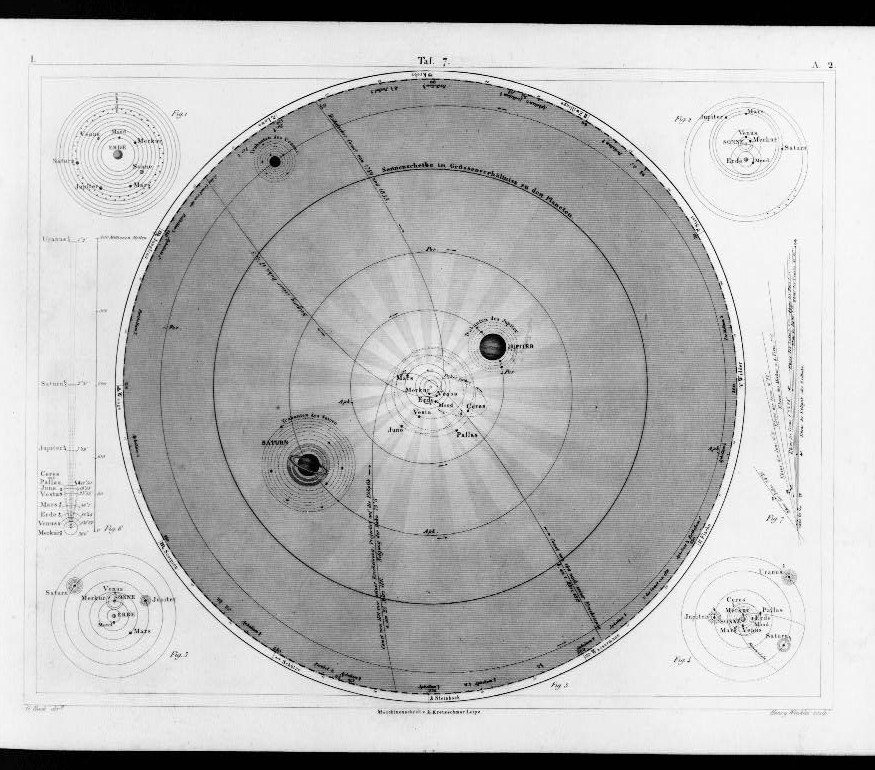
Engraving: Henry Winkles, 1851, Library of Congress Prints and Photographs Division, no known restrictions
On the evening of 13 October 1601, at the Prague palace of Peter Vok of Rožmberk, the most famous astronomer in Europe sat through a long dinner with a full bladder and decided it would be rude to get up. Tycho Brahe was fifty-four, a Danish nobleman in exile, Imperial Mathematician to the Emperor Rudolf II, and a man who had spent his life insisting on precision. By the time the guests rose he could no longer pass water at all. He went home in agony and lasted eleven more days.
He died on 24 October 1601, four hundred and twenty-five years ago today. That much nobody disputes. Almost everything else about his death was argued over for a century, and settling it meant opening his grave twice.
A nose, an elk and an island
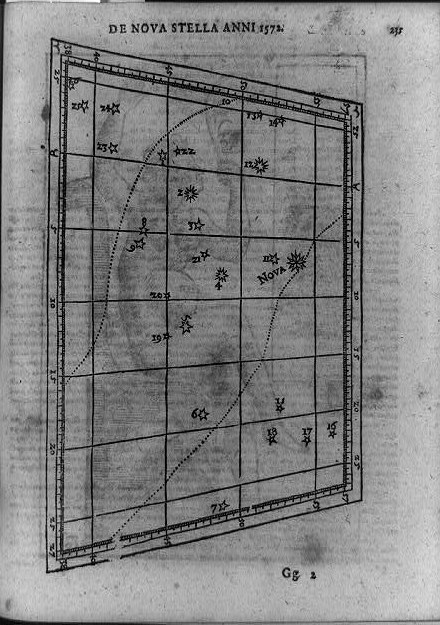
Tycho's own chart of the new star of 1572 in Cassiopeia, from a 1648 edition of his works. Library of Congress Prints and Photographs Division, no known restrictions
Tycho's life reads like something a novelist would be told to tone down. At twenty, as a student in Rostock, he fought a duel in the dark with a fellow Dane over which of them was the better mathematician and lost the bridge of his nose. For the rest of his life he wore a prosthetic held on with paste, which legend upgraded to silver and gold. He kept a tame elk that, by his own account, drank too much beer at a neighbour's castle, fell down the stairs and died.
Beneath the eccentricities was the best observer the world had yet produced. In 1572 he watched a new star blaze in Cassiopeia and showed that it was far beyond the Moon, in the heavens Aristotle had declared unchanging. King Frederick II of Denmark gave him the island of Hven in the sound between Denmark and Sweden, and there Tycho built Uraniborg, a castle that was also an observatory and an alchemical laboratory, with instruments so carefully made that he could fix a star's position to about a minute of arc without a telescope, which had not been invented.
He fell out with the next king, left Denmark in 1597 and ended up in Prague, where in 1600 a young, half-blind, perpetually broke German mathematician named Johannes Kepler came to work for him. They quarrelled constantly. Tycho guarded his decades of observations like a miser; Kepler wanted them more than anything on earth.
Eleven days
What happened after the banquet we know mostly from Kepler, who kept a diary of the illness. Tycho could not urinate, then could only pass a little with terrible pain. He ran a fever and was delirious for stretches, and in lucid moments repeated that he hoped he had not lived in vain. On the last night he was calm. He asked Kepler to finish the great planetary tables they had begun, and (this is the part that matters) to finish them according to Tycho's own model of the universe, in which the planets circled the Sun but the Sun circled a stationary Earth.
Kepler promised. Then Tycho died, and Kepler, who had been the assistant of a man who did not fully trust him, found himself in possession of the finest set of astronomical measurements ever made. He did not keep the promise. He used the data to show that Mars moves in an ellipse, which broke Tycho's model and everyone else's, and went on from there to his three laws of planetary motion. The tables came out in 1627. Without Tycho's numbers Kepler would have had nothing to work with, and he knew it.
Tycho was buried with full ceremony in the Church of Our Lady before Týn, on Prague's Old Town Square, under a slab carved with his likeness in armour. The bladder story went into the biographies and stayed there for three centuries.
The beard hairs
In 1901, for the three-hundredth anniversary of his death, the tomb was opened. The skeleton was examined and a few strands of beard and hair were taken away as relics. They sat in a Prague museum until the 1990s, when Danish researchers tested them and reported mercury, apparently taken in the day or so before he died.
That was all the twentieth century needed. Mercury was the poisoner's metal and Tycho's house had been full of it; he made his own medicines, some of them mercury-based. Had he dosed himself and got it wrong, or had someone else done the dosing? Two American writers argued in a 2004 book that the someone was Kepler, who had the motive (the data), the opportunity (the sickbed) and the temperament (difficult). A second theory had the Danish king, Christian IV, ordering a hit through a cousin of Tycho's, over a rumoured affair with the king's mother. Neither theory had a body.
Opening the grave again
In November 2010 a Danish and Czech team led by the Aarhus archaeologist Jens Vellev lifted the slab in the Týn church again, with the church's permission and a good deal of press interest. They had four days. They took samples of bone, teeth and beard, scanned the skull, and put him back.
The results came in 2012 and were, from a mystery writer's point of view, a let-down. Kaare Lund Rasmussen at the University of Southern Denmark measured the mercury in the hair and bone and found it low, within the range of a healthy person, and if anything falling in the final weeks. He had not been poisoned, by Kepler or anyone else. The team's best reading was the old one: something went catastrophically wrong with his bladder or kidneys, perhaps an infection that followed the night he would not leave the table.
The nose got its answer too. The prosthesis itself was not in the grave, but the bone around the nasal opening was stained green, and the stain was copper and zinc. So it was brass, not silver or gold. A man who could afford a private island wore a brass nose, and I find that oddly reassuring.
What the garden gave up
There was a coda in 2024. Uraniborg was torn down after Tycho's death and its stone carted off, but a dig in the garden on Hven in the late 1980s had turned up shards of glass and a piece of a crucible from the laboratory. Rasmussen, by then a professor emeritus, analysed five of them for the journal Heritage Science. Four carried heavy traces of what you would expect an alchemist's vessels to carry, including gold, mercury, lead and antimony. One carried tungsten, which nobody would isolate or name for another 180 years; the best guess is that Tycho was processing a mineral that happened to contain it, and had no idea. His hair and bones had earlier shown gold, which fits a man who prescribed drinkable gold for the plague and very likely took his own medicine.
Prague still has him. The slab in the Týn church shows a bearded man in armour with his hand on a globe, and the nose, if you look, is intact. Hven, now Swedish and spelled Ven, has a museum on the site of Uraniborg and a reconstruction of the sunken observatory next door. The 2012 report put his death down to a bladder that failed, which is to say that the story told at his funeral in 1601 was the right one all along.
Enjoyed this story?Get a new one every day on social.