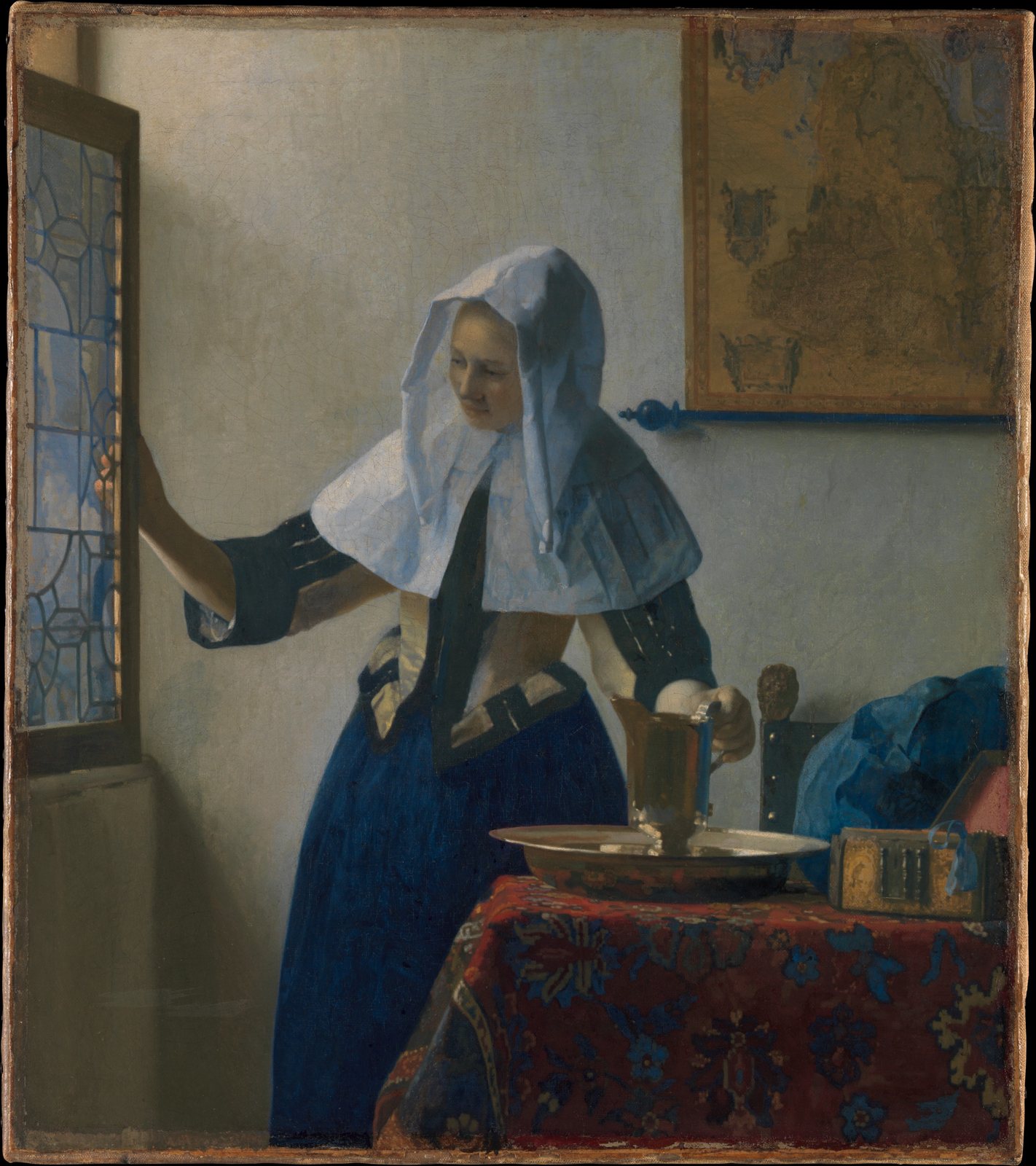
Johannes Vermeer, Young Woman with a Water Pitcher (ca. 1662), The Metropolitan Museum of Art, CC0
Four florins an ounce. On 23 October 1485 the Spedale degli Innocenti, the foundling hospital in Florence, signed a contract with Domenico Ghirlandaio for an altarpiece of the Adoration of the Magi, and the document specified that the blue was to be ultramarine "of the value of about four florins the ounce." Not German blue, which was cheaper azurite, and not any other blue. The lawyers knew the difference, and so did the man paying.
Ultramarine was the one colour in a Renaissance painter's box that could be written into a contract by price, like gold leaf, and it was often the dearer of the two. The reason was geography. Every grain of it had come from one cluster of mines in one valley of what is now northeastern Afghanistan.
One valley, six thousand years
The stone is lapis lazuli, and the mines are at Sar-i Sang in Badakhshan, high in the Hindu Kush. They have been worked for some six thousand years. Lapis from this valley is in the royal graves at Ur, around 2500 BC, and in Tutankhamun's funerary mask a thousand years later.
The earliest surviving use of lapis as a pigment is close to home, in Buddhist wall paintings of the sixth and seventh centuries at Bamiyan, not far from the mines. From there it travelled west through Persia, Byzantium and the ports of the Levant, and by the thirteenth century it was reaching Venice. The Italian name says where it seemed to come from: oltremare, "beyond the sea." Nobody in Florence had the faintest idea where the mines were, only that the stone came on Venetian ships and that the price was what it was.
Why grinding it was not enough
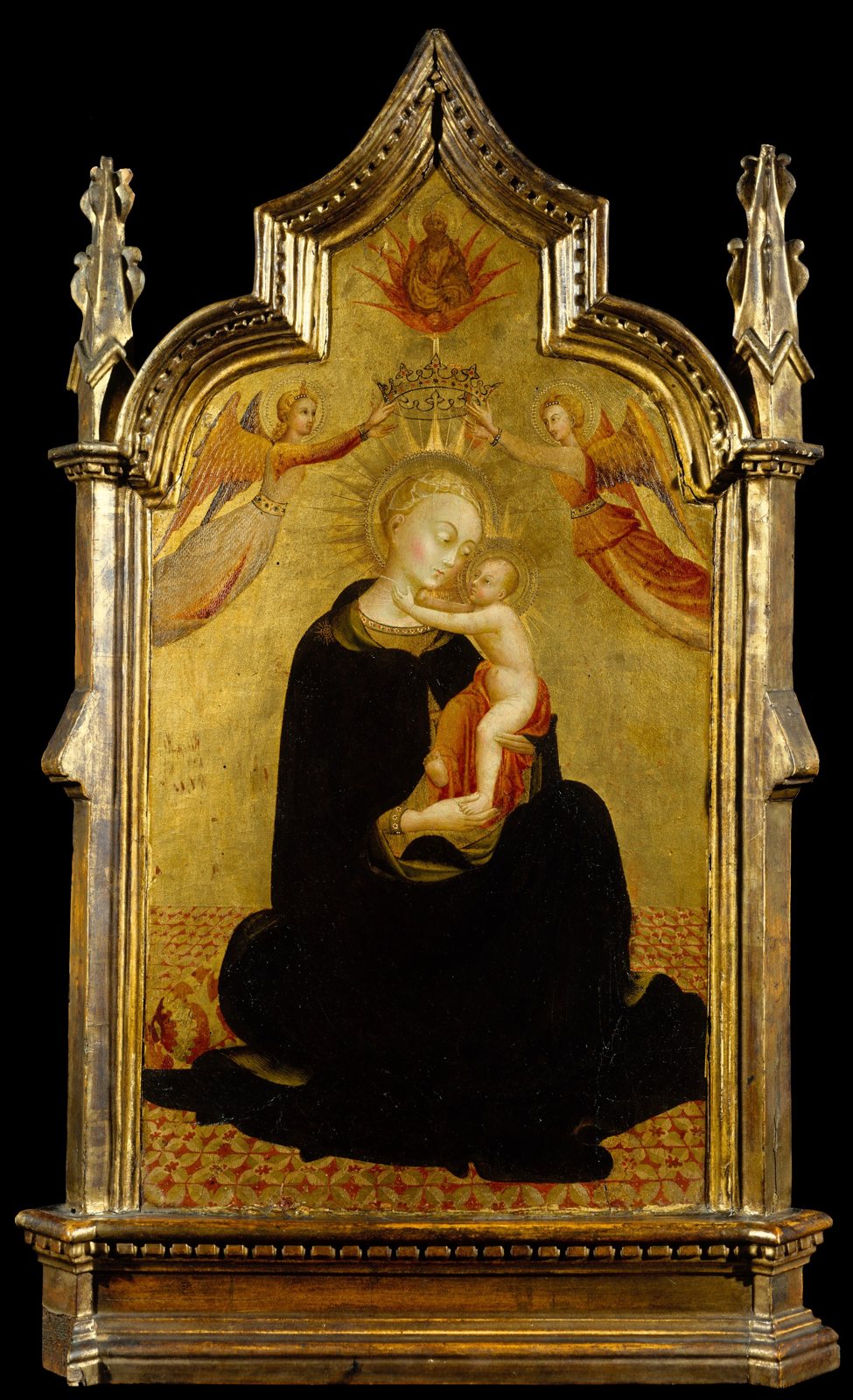
Sassetta, Madonna and Child with Angels (about 1445-50). The Virgin's mantle was painted blue and has darkened over five centuries. The Metropolitan Museum of Art, CC0
The expense was only partly the distance. Grind a piece of lapis and you get a disappointing grey-blue powder, because the stone is mostly calcite and pyrite with the blue mineral, lazurite, scattered through it. The medieval solution was a recipe that Cennino Cennini wrote down around 1400 in his handbook for painters, and it reads like baking. The ground stone is kneaded into a dough with pine resin, gum mastic and wax, left for days, then worked under a weak lye in a bowl. The blue particles release into the liquid and settle; the grey waste stays in the dough. The first extraction gives the deepest blue, each pass after it a paler one, until the last washings produce a weak grey called ultramarine ash, sold cheap and used for skies nobody cared about.
So a small quantity of good stone produced a very small quantity of good pigment, after days of labour. That is what the hospital was paying four florins an ounce for. Cennini, who was fond of the colour, called it "illustrious, beautiful and most perfect, beyond all other colours," which is also roughly what a man says about something he cannot afford.
Reserved for the Virgin, and for people who paid
Because it was the most expensive thing on the palette, ultramarine was spent where it counted, which in a Christian painting meant the robe of the Virgin Mary. Patrons wanted their money seen, and a contract that specified ultramarine for the Virgin's mantle made sure the painter did not quietly substitute azurite, which looks similar when fresh and tends to go green or black with time.
Painters who loved the colour went broke on it. Vermeer used ultramarine with a freedom that still startles conservators, not only in obvious places like the skirt in the painting above but mixed into shadows, into the whites of walls and tablecloths, under the flesh tones. When he died in 1675 he left a widow, eleven children and heavy debts; the war with France had wrecked the Dutch art market, but his habits with lapis cannot have helped. There is a long-standing suggestion that Michelangelo's unfinished Entombment in London has a blank where the Virgin should be because he could not get the blue. I have never seen that proven, and he may simply have stopped.
The chemist who ended it
The end came from France, and from a prize. In 1824 the Société d'Encouragement pour l'Industrie Nationale offered 6,000 francs to anyone who could make artificial ultramarine for under 300 francs a kilo. Jean-Baptiste Guimet, a chemist in Toulouse, got there in 1826; Christian Gmelin in Tübingen published a similar process in 1828, and Guimet took the prize and built a factory. The synthetic is chemically the same mineral, made in a furnace from clay, soda, sulphur and charcoal, at a tiny fraction of the cost. Within a generation "French ultramarine" was in every paint shop.
The valley is still mined. A few colourmen still make genuine ultramarine by something close to Cennini's method and sell it for many times the price of the synthetic to painters and restorers who want the real thing. The hunt for new blues has not stopped: in 2009 Mas Subramanian, a chemist at Oregon State University, heated a mixture of yttrium, indium and manganese oxides for an unrelated experiment and pulled out a brilliant blue nobody had seen before, now sold as YInMn blue and the basis of a Crayola crayon. And in 2016 the sculptor Anish Kapoor acquired exclusive artistic rights to a black coating called Vantablack, which so annoyed the British painter Stuart Semple that he began selling his own pigments to everyone in the world except Kapoor. Kapoor got hold of a jar of Semple's pink anyway and posted a photograph of his middle finger dipped in it, which is roughly where the question of who may own a colour has rested since.
Enjoyed this story?Get a new one every day on social.