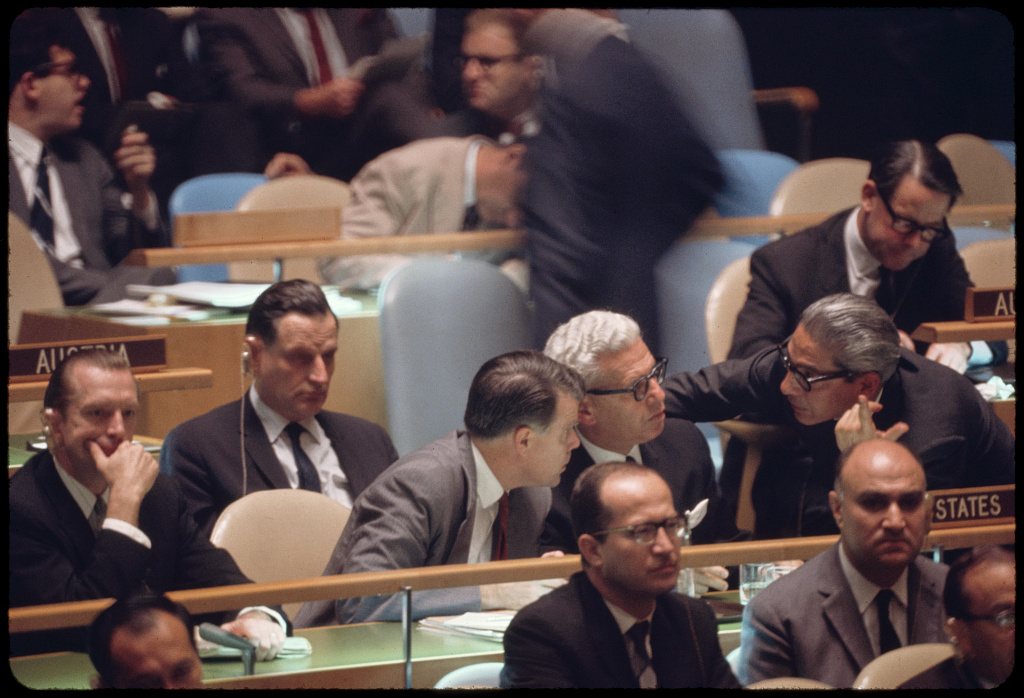
Photo: Bernard Gotfryd, between 1965 and 1968, Library of Congress Prints & Photographs Division, no known restrictions
On the evening of Monday 25 October 1971, the foreign minister of the Republic of China, Chow Shu-kai, asked for the floor of the General Assembly in New York. His government, he said, had decided to take no further part in the proceedings. Then he and his delegation picked up their papers and walked out of a hall their government had sat in since the United Nations was founded.
They left before the vote because they already knew the result. Earlier that evening the Assembly had rejected, 59 to 55, an American motion that would have made expelling them an "important question" requiring a two-thirds majority. Without that shield a simple majority was enough, and everyone could count. Resolution 2758 passed late that night by 76 votes to 35, with 17 abstentions. The delegates from Tanzania danced in the aisle. The United States ambassador, a 47-year-old Texan named George H. W. Bush, sat through it.
Twenty-two years of a seat held by the losing side
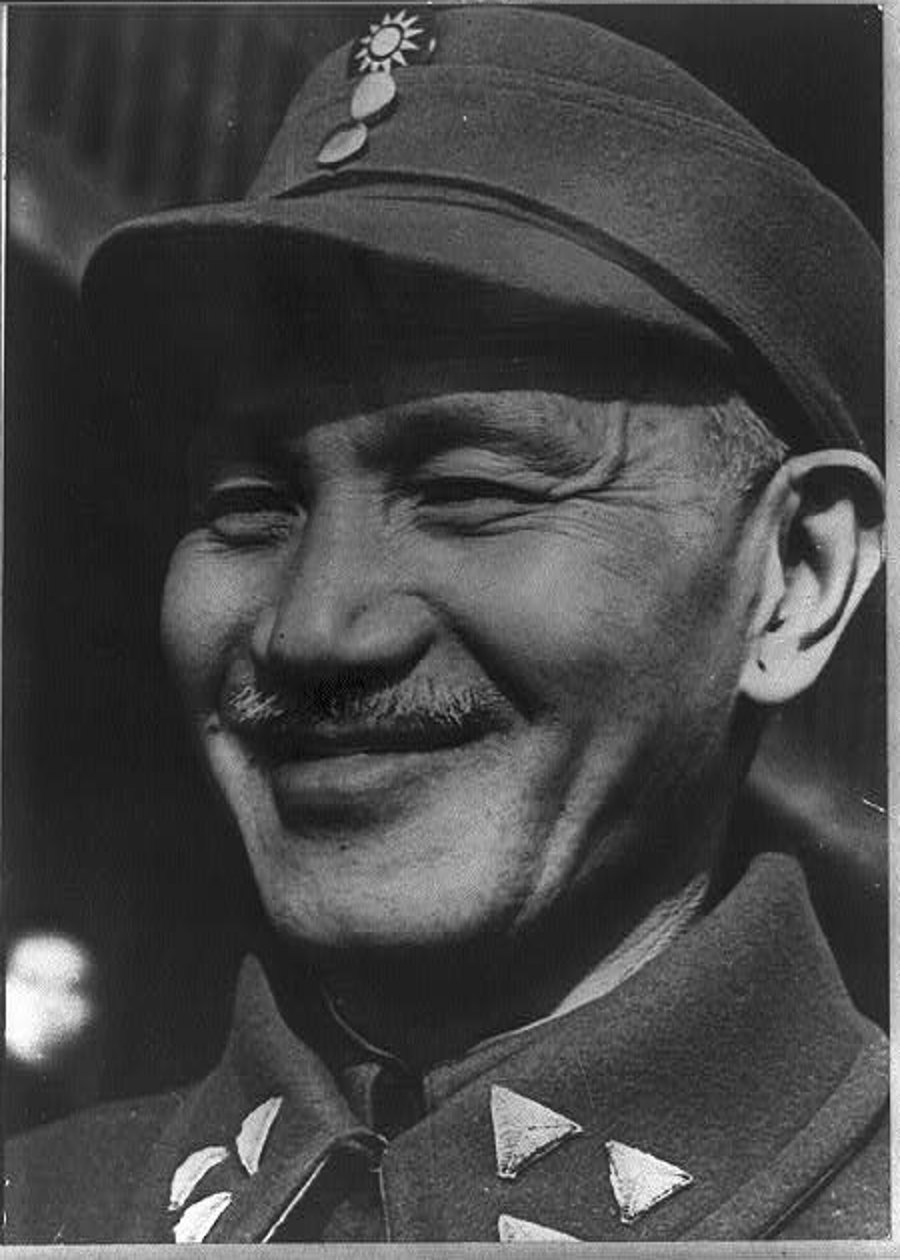
Chiang Kai-shek in March 1945. Photo: Library of Congress Prints & Photographs Division, no known restrictions
China was a founding member of the United Nations and one of the five permanent members of the Security Council. The government that signed the Charter in 1945 was Chiang Kai-shek's Nationalist government. In 1949 it lost the civil war and retreated to Taiwan, and Mao Zedong proclaimed the People's Republic in Beijing on 1 October. From that point there were two governments claiming to be China, each insisting it was the only one, and only one of them had the seat.
For two decades the seat stayed with Taipei, because the United States made sure it did. In the 1950s Washington simply had the Assembly vote each year not to discuss the matter. By 1961 that no longer worked, so the Americans switched to the "important question" device: any change in China's representation would need two-thirds. Year after year a majority of members voted to seat Beijing, and year after year the majority fell short of two-thirds. In 1970 the resolution to admit the People's Republic won 51 to 49, a majority for the first time, and still failed.
The arithmetic was moving for a simple reason. Every year the Assembly had more members, and most of the new ones were newly independent African and Asian states with no interest in pretending that a government on an island of fourteen million people represented a country of eight hundred million.
Kissinger was in Beijing while the vote was taken
What made 1971 different was not the General Assembly but the White House. In July, Henry Kissinger had secretly flown to Beijing, and Richard Nixon had gone on television to announce that he would visit China the following year. American diplomats were still lobbying delegations to protect Taipei's seat. The lobbying was now being done on behalf of a president who was planning to toast Zhou Enlai in the Great Hall of the People.
The American position for 1971 was called "dual representation": seat the People's Republic, give it the Security Council chair, but let the Republic of China keep a seat in the Assembly as well. Beijing had said it would not take the seat on those terms. Taipei had said it would not stay on those terms either. The plan had no customer on either side of the Taiwan Strait, and it never came to a vote, because the Albanian resolution was taken first.
Kissinger, meanwhile, was back in Beijing on his second trip, arranging the details of Nixon's visit. He arrived on 20 October and left on 26 October, the morning after the vote. Several delegations later said that was all they needed to know about how seriously Washington wanted them to vote no. Bush, who had worked hard on the count, later wrote that the timing had hurt. (I have never seen a convincing explanation of why the trip was scheduled for that week, other than that nobody in the White House much minded the outcome.)
What the 150 words actually say
The resolution was sponsored by Albania and 22 other countries, and it is short. It "recognizes that the representatives of the Government of the People's Republic of China are the only legitimate representatives of China to the United Nations" and decides "to expel forthwith the representatives of Chiang Kai-shek from the place which they unlawfully occupy at the United Nations and in all the organizations related to it."
Two things about the wording have mattered ever since. The first is that it talks about representatives, not territory: it settles who speaks for China, not what China includes. The second is that the word Taiwan does not appear. The drafters were not being careful. In 1971 nobody involved, in Beijing, Taipei or Washington, disputed that Taiwan was part of China; the whole argument was about which government ran it. The ambiguity was invisible at the time and has been fought over ever since.
The People's Republic's first delegation, led by Qiao Guanhua, arrived in New York three weeks later and took its seat on 15 November. Taipei never came back.
The island that lost its friends
The practical consequences for Taiwan came fast. Japan recognised Beijing in September 1972. Most of Western Europe followed within a few years. The United States held out until 1 January 1979, when Jimmy Carter switched recognition and the last American embassy on the island closed. By the 1990s Taiwan had become one of the richest places in Asia and a working democracy, and it had fewer than thirty diplomatic partners. From 1993 it applied to rejoin the UN every year, and every year the application went nowhere; it stopped applying in 2008.
Today twelve countries recognise Taipei, most of them small states in the Pacific and Central America. Taiwan has no seat at the UN, no observer status, and no place at the World Health Assembly or the International Civil Aviation Organization, both of which cite Resolution 2758 when they turn it away.
Fifty-five years on, the argument is about those 150 words
Since 2024 a run of parliaments has passed motions saying, in various forms, that Resolution 2758 decided who represents China and said nothing about Taiwan's status or its participation in international bodies. The Australian Senate did it in August 2024, the Dutch and European parliaments the following autumn, then Canada, Britain and the Czech Republic, and Belgium in March 2025. Beijing's position is the opposite: that the resolution settled the matter of Taiwan once and for all, and that any other reading is an attempt to rewrite history.
Beijing has also given the date a second meaning. Last October its legislature created a "Commemoration Day of Taiwan's Restoration," to be marked every 25 October, the anniversary of the day in 1945 when Japanese forces on Taiwan surrendered to Chiang Kai-shek's government. So the same date now carries the day Taiwan was handed to the Republic of China and the day the Republic of China was shown out of the United Nations, and the government in Beijing is, for the moment, the one choosing which of them to celebrate.
Enjoyed this story?Get a new one every day on social.