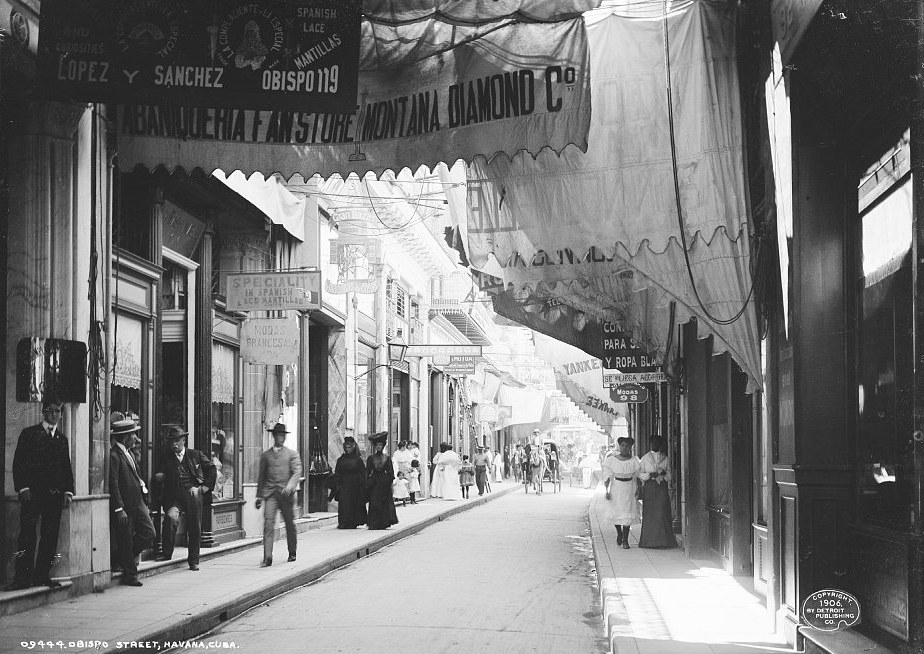
Photo: Detroit Publishing Co., c. 1906, Library of Congress Prints & Photographs Division, no known restrictions
The United States has run Cuba twice. The first time, from 1899 to 1902, came out of a war and everybody knows about it. The second, from September 1906 to January 1909, came out of a resignation and a Secretary of War who had gone to Havana to talk, not to govern.
On 23 October, at a rally in Fort Myers, Florida, President Trump said that warships coming home from the war with Iran would make "a little stopover" off Cuba, that one would halt "about 50 yards off the coast", and that Secretary of State Marco Rubio would then go in to "finish up the deal". Five days later the UN General Assembly voted, for the 34th year in a row, to condemn the American embargo: 130 in favour, 17 against, 25 abstaining, the thinnest majority the resolution has had since the 1990s. The last time an American president was pushed towards Havana against his own judgement, the result was a government nobody had planned.
The clause that made intervention legal
It starts with a piece of paper. When the first occupation ended in 1902, Washington made Cuba's independence conditional on writing the Platt Amendment into its constitution and then into a treaty. Article III gave the United States the right to intervene "for the preservation of Cuban independence" and "the maintenance of a government adequate for the protection of life, property, and individual liberty". Cuban delegates accepted it because the alternative was that the Americans did not leave.
The man who took over as president on 20 May 1902 was Tomás Estrada Palma, a schoolmaster in his late sixties who had spent decades in exile in New York. He ran an honest, frugal government and built up a treasury surplus of something over 13 million dollars. In 1905 he ran for re-election, and his party rigged it so thoroughly that the Liberals withdrew from the vote. In August 1906 they rose instead.
Both sides ask for the Americans
The Liberal revolt of August 1906 (Cubans call it the Little August War) put, by some counts, over 20,000 men under arms against a national army that barely existed, because Estrada Palma had kept it small to save money. Within three weeks he was asking Roosevelt for warships and troops under Article III.
So, and this is the part usually left out, were the rebels. The Liberals wanted the Americans to annul the 1905 election and hold a fair one. Both sides were inviting the same foreign power in, each sure it would rule for them.
Roosevelt did not want to go. He could see what a landing would look like to the rest of Latin America. On 13 September 1906 he wrote to Henry White, his ambassador in Rome, that he was "so angry with that infernal little Cuban republic that I would like to wipe its people off the face of the earth". Instead of troops he sent two negotiators: William Howard Taft, his Secretary of War, and Robert Bacon, the Assistant Secretary of State. They reached Havana on 19 September.
A fortnight of talks and a president who walks out
Taft spent ten days shuttling between the palace and the Liberals and worked out a compromise: Estrada Palma would stay, the 1905 congressional elections would be annulled and run again under American supervision, and the rebels would disband. The Liberals accepted it. Estrada Palma did not. He regarded an annulled election as a judgement on his honour, and he had come to believe that the only cure for Cuban politics was for the Americans to take over for a while.
So on 28 September 1906 he resigned, and his vice-president and cabinet resigned with him. The Cuban Congress, which should have chosen a successor, failed to raise a quorum because his own party's members stayed away. By that evening there was no Cuban government at all. The next day, 29 September, Taft issued a proclamation under the 1903 treaty establishing a provisional government "to be maintained only long enough to restore order and peace", with himself as Provisional Governor. Marines were already ashore protecting American property; the first army units landed on 6 October.
Taft stayed as governor for two weeks and then went home, handing the island to a lawyer from Nebraska.
Mr Magoon's 28 months
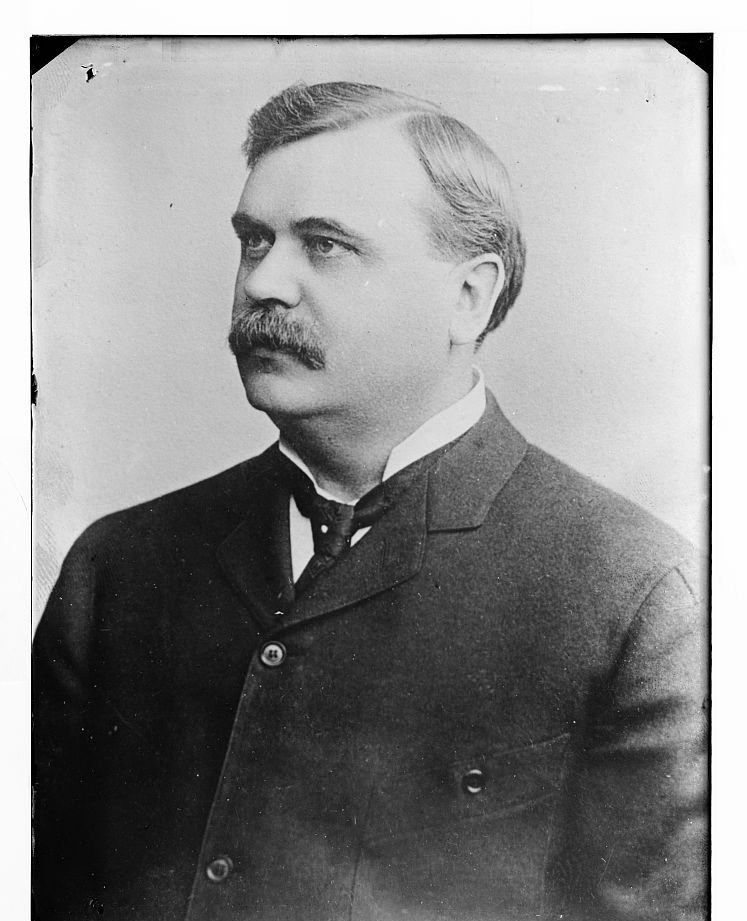
Photo: Charles E. Magoon, Provisional Governor of Cuba 1906 to 1909, Bain News Service, Library of Congress Prints & Photographs Division, no known restrictions
Charles Edward Magoon, who took over on 13 October 1906, had governed the Panama Canal Zone and did not make speeches. He ran Cuba from the palace in Havana until 28 January 1909, with an American force authorised at up to 18,000 men that never exceeded about 6,600, headquartered at Camp Columbia outside the capital. It called itself the Army of Cuban Pacification and did very little pacifying, because the rebels had gone home as soon as the Americans arrived. Soldiers built about 92 kilometres of road instead and mapped the island.
Magoon's government did two things that lasted. It set up an Advisory Law Commission, chaired by the army lawyer Enoch Crowder with Cuban members, which wrote new electoral, municipal, judicial and civil service laws, parts of which stayed in force for decades. And it ran the elections it had promised, provincial and municipal in May 1908 and presidential on 14 November 1908, which the Liberal José Miguel Gómez won cleanly.
What it is remembered for in Cuba is something else. Magoon's name became shorthand for the botella, the no-show government job handed out to buy political quiet, and for spending Estrada Palma's surplus down to nothing. How fair that is, historians still argue; much of the money went on roads and sewers, and Cuban politicians were asking for the jobs. But the reputation set hard. Gómez took office on 28 January 1909, and the last American troops sailed on 6 February.
It kept happening
The second occupation did not end the habit. Marines landed in Oriente province in 1912 during an uprising by the Independent Party of Colour, and came back in 1917 to guard sugar plantations until 1922. Only in 1934, under Franklin Roosevelt's Good Neighbour policy, did Washington give up the Platt Amendment, keeping one piece of it: the lease on the naval station at Guantánamo Bay, which the United States still holds.
What Havana remembers and Washington forgets
For Americans the 1906 intervention is a footnote between the Spanish war and the Panama Canal. For Cubans it is one of the founding grievances: proof that the republic of 1902 was independent only on paper. The government in Havana has cited the whole sequence, 1898, 1906, 1912, 1917, every year it has brought the embargo resolution to the General Assembly.
This spring, after American prosecutors brought criminal charges against Raúl Castro, President Trump told reporters it looked like he would be "the one that does it". In September he said he did not think the military would be needed. Last week he was talking about ships 50 yards off the coast. The American force that governed Cuba from 1906 to 1909 numbered 6,621 men at its peak, 425 officers and 6,196 enlisted, and the man who set it up had gone to Havana to avoid exactly that.
Enjoyed this story?Get a new one every day on social.