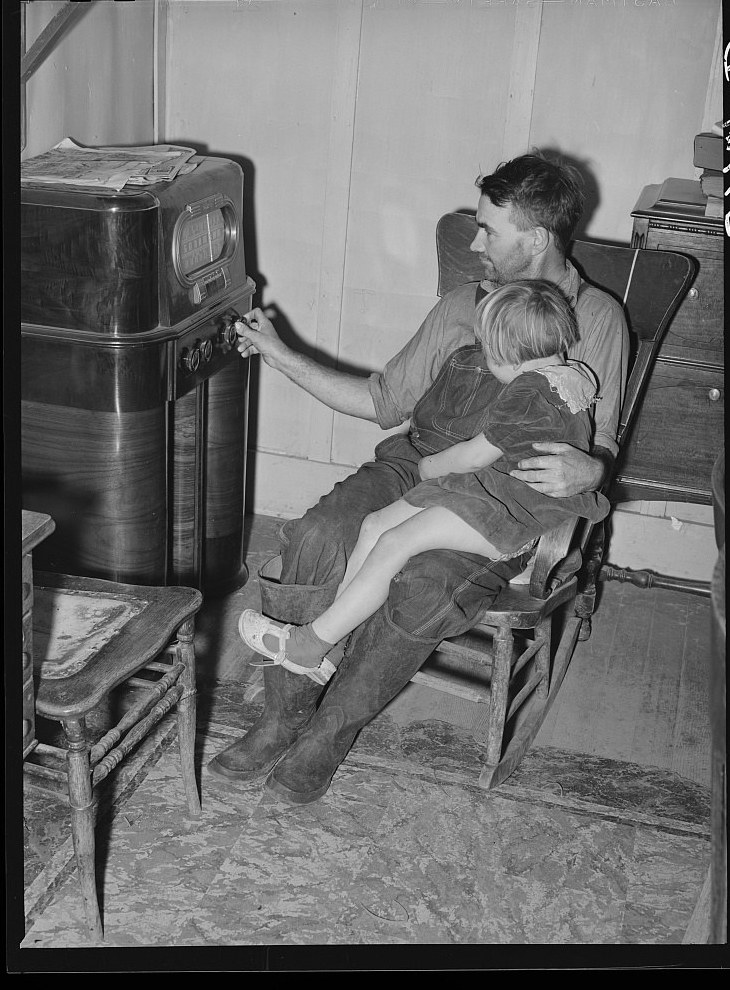
Photo: Russell Lee, a farmer and his daughter at the radio, Tehama County, California, November 1940, Farm Security Administration, Library of Congress, no known restrictions
Two per cent. That was the share of American households tuned to CBS at eight o'clock on the evening of Sunday 30 October 1938, according to the ratings survey that C. E. Hooper's company ran that night by telephoning about 5,000 homes. The rest were mostly listening to Edgar Bergen and his dummy Charlie McCarthy on NBC, or had the radio off. Of the two per cent, not one person told the Hooper callers they thought they were hearing the news.
The next morning the New York Times ran it across the front page: "Radio Listeners in Panic, Taking War Drama as Fact." The Daily News went with "Fake Radio 'War' Stirs Terror Through U.S." Within three weeks American newspapers had printed something like 12,500 articles about the night the country lost its head over Martians. Eighty-eight years later that is still the version most people know. It is not quite false, just a great deal smaller than advertised.
An unsponsored show on a Sunday night
The Mercury Theatre on the Air was a prestige programme with no sponsor and a small audience. Orson Welles, who directed and narrated, was 23. The War of the Worlds was the seventeenth episode, and nobody involved thought much of it. Howard Koch, who had six days to write the script, told the producer John Houseman on day two that he could not make the thing believable. Houseman told him to carry on.
Koch's main idea was to move the invasion from Victorian Surrey to present-day New Jersey and to tell the first two-thirds of it as a music programme interrupted by news bulletins. He said later that he chose the landing site by putting a pencil down on a road map, and that it fell on Grover's Mill, a hamlet in West Windsor Township.
The broadcast was announced as fiction at the start, again at the station break about 40 minutes in, and again at the end. To be fooled you had to miss the opening and then stay with it.
What actually happened that night
Some people were frightened, and that part is real. Police switchboards in New Jersey and New York took calls. In Concrete, Washington, a short circuit at the cement company's substation happened to knock out the town's power and telephones during the broadcast, so listeners could not ring anyone to be told it was a play, and that went out on the wires as proof of nationwide hysteria. There is a well-loved local tale that someone in Grover's Mill shot up a water tower, having taken it for a Martian machine. I have not found a contemporary record of it, and I suspect it grew in the telling.
The study that fixed the panic in the national memory came two years later. Hadley Cantril, a Princeton psychologist, published The Invasion from Mars in 1940 and estimated that six million people had heard the broadcast, that 1.7 million had believed it was news and that 1.2 million had been frightened or disturbed. In 2013 two media historians, Jefferson Pooley and Michael Socolow, went back through Cantril's numbers and found that Cantril's audience figure was more than double any other estimate made at the time, and that his "frightened" category swept up anyone who said they had been excited. Their conclusion was that the panic on the night was "so tiny as to be practically immeasurable".
Why the papers wanted a panic
Newspapers in 1938 had a grievance against radio. It had taken a large share of advertising money during the Depression and was now taking news as well; the Munich crisis a month earlier had been the first big story Americans followed by radio rather than in print. Here was a chance to show that the new medium was irresponsible and its listeners were fools. The Associated Press story most papers ran the next morning made scattered calls to police stations sound like a continental stampede, and the Chicago Tribune's editorial view was that the whole business said something unflattering about the intelligence of the radio audience.
Welles went before the press on 31 October looking shaken and said he had anticipated nothing unusual. Asked whether he should have softened the language he answered, "No, you don't play murder in soft words." A senator from Iowa proposed a bill requiring the Federal Communications Commission to vet every programme before it aired; it was never introduced. The FCC took no action against Welles or CBS. Within weeks the Mercury Theatre had a sponsor, Campbell's Soup, and Welles was the most famous young man in America.
The version that really did cause a riot
If you want a War of the Worlds broadcast that did what the legend says, go to Quito. In February 1949 a radio station there staged its own Spanish-language version, with local place names and no announcement that it was fiction. Crowds who had run into the streets came back when they learned the truth, surrounded the building that housed the station and the newspaper El Comercio, and burned it. Several people were killed. Nobody writes Halloween features about Quito.
Grover's Mill got a bronze monument instead, unveiled in 1988 for the fiftieth anniversary, showing Welles at the microphone and a family gathered round the radio. The family in the sculpture is listening very hard. On the real night, by the best count we have, almost everybody was listening to Charlie McCarthy.
Enjoyed this story?Get a new one every day on social.