Photo: Bain News Service, c. 1910 to 1915, Library of Congress Prints & Photographs Division, no known restrictions
On Sunday, shops will be shut in France, Belgium, Spain, Portugal, Italy, Austria, Poland and the Philippines, and in a good part of Germany, for a feast most of the people enjoying the day off could not explain. In France it means chrysanthemums on graves, in Poland cemeteries lit with candles, in the Philippines families camping overnight at the family tomb. All of this happens on 1 November, and the night before it is the reason we have Halloween at all. (This year, as it happens, the holiday lands on a Sunday, so most of the countries that observe it lose the day off. Belgium and France do not move it. I am told this causes some muttering.)
The odd thing is that none of it began in November, and none of it began as a feast of the dead. The first All Saints was a feast of martyrs, it was held in May, and it was held in a temple built by a Roman emperor for all the gods.
A church that was never a church
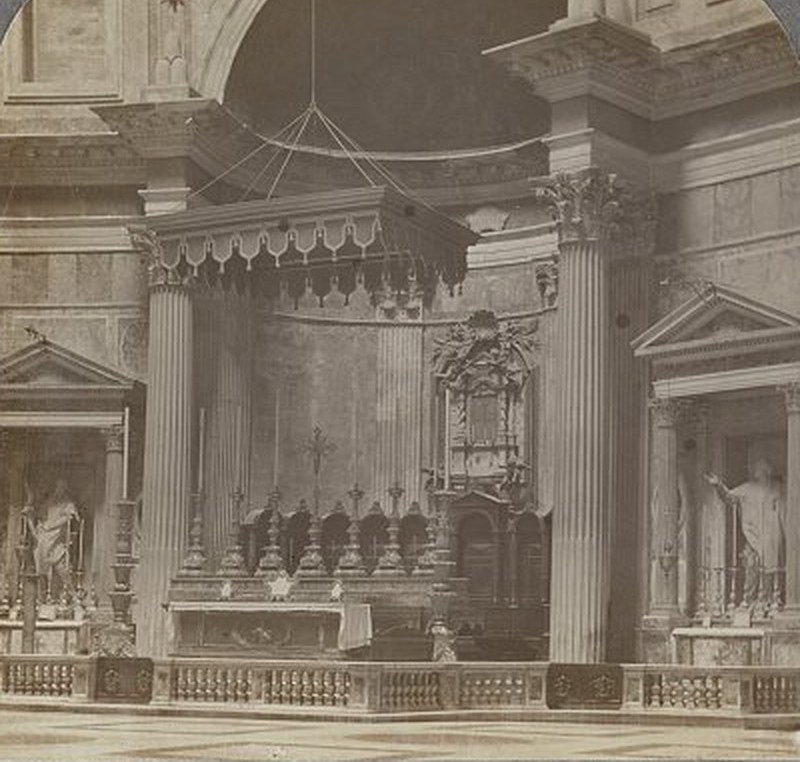
Stereograph of the high altar inside the Pantheon, Rome, 1906, Library of Congress Prints & Photographs Division, no known restrictions
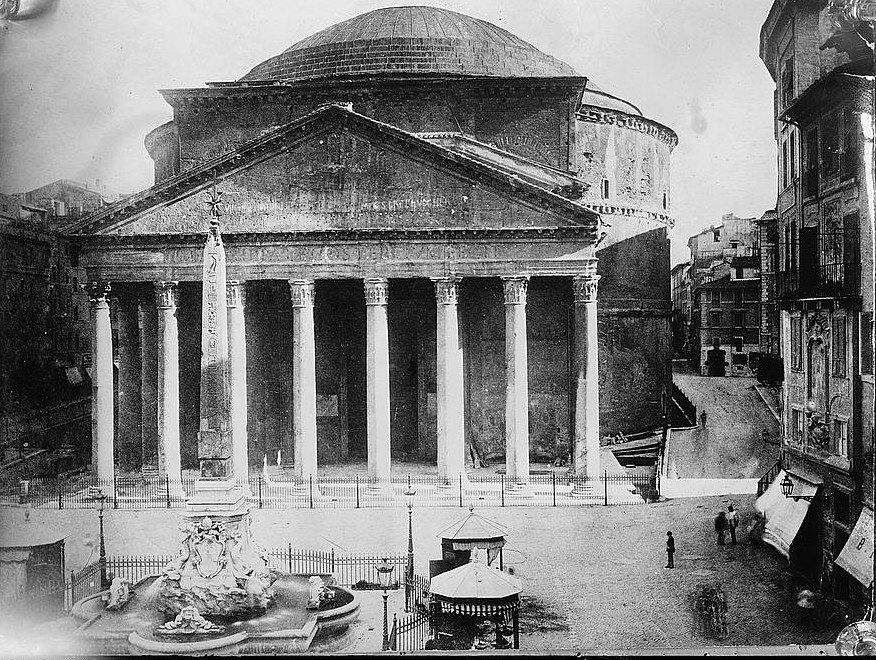
The Pantheon was finished under Hadrian in about AD 125. By the early seventh century it was an empty pagan shell in a city that had shrunk to perhaps a twentieth of its old population. The Byzantine emperor Phocas, who ruled from Constantinople and owned Rome on paper, made a gift of the building to Pope Boniface IV. On 13 May, in 609 or 610 (the sources disagree by a year), Boniface consecrated it as the church of Saint Mary and all the Martyrs, and ordered that the anniversary be kept every year.
A later story says he had twenty-eight cartloads of bones brought up from the catacombs and buried under the floor. I have never seen that traced to anything written within three centuries of the event, so treat it as what the medieval guides told pilgrims. What is well attested is the dedication, and the date.
The date is the interesting part. The Romans had held a festival of the restless dead on 9, 11 and 13 May, the Lemuria, when the head of a household got up at midnight, walked barefoot through the house and threw black beans over his shoulder for the ghosts to take. Some liturgical historians think Boniface chose 13 May on purpose, to put a Christian feast over the old one. Others think it a coincidence; the Eastern church already had a feast of all martyrs on the Sunday after Pentecost, where the Orthodox still keep it. I lean towards coincidence, but I would not bet much on it.
A chapel in St Peter's and a date nobody explains
For a century the Roman feast stayed in May. Then, some time between 731 and 741, Pope Gregory III built an oratory inside the old St Peter's basilica to hold relics of "the holy apostles and all the holy martyrs and confessors, and all the just and perfect who are at rest throughout the world". That dedication is the first time a Roman source puts a feast of all the saints, rather than just the martyrs, near 1 November.
Why that date, nobody in Rome says. The best guess is that Gregory was following a calendar that had already taken hold at the far edge of Christendom.
The Irish and the English got there first
In Ireland and in Northumbria the feast was being kept on 1 November before Rome moved it there. The Félire Óengusso, a verse calendar of saints written in Irish around the year 800, has it on that day. Alcuin of York, who ran Charlemagne's palace school, wrote to his friend Arno, the archbishop of Salzburg, in about 800 urging him to keep "the solemnity of all saints" on 1 November with a three-day fast beforehand, and Arno duly ordered it for his province.
The temptation here is obvious. The Irish year turned at Samhain, the first of November, when the cattle came in and the dead were thought to walk. It is a very neat fit, and for a hundred years popular books have said the church simply baptised the pagan festival. The honest position is that no early source says so, and that the Irish monks who compiled the calendar give no hint of it. The coincidence may be exactly that. I find I believe it a little, and distrust myself for believing it.
An emperor fixes it
Altarpiece: The Trinity Adored by All Saints, Spanish painter, The Metropolitan Museum of Art, CC0
What settled the matter was politics. In 835 the Frankish emperor Louis the Pious, Charlemagne's son, ordered that All Saints be kept on 1 November throughout his empire, which by then ran from the Pyrenees to the Elbe. The chronicler Ado of Vienne says he did it at the request of Pope Gregory IV. A single compulsory date across the whole of western Europe did what no pope could do alone. The May feast lingered in Rome itself until the eleventh century, when Gregory VII struck it from the books, and then it was gone.
The second of November came next. Around 998 Odilo, abbot of Cluny, ordered his monasteries to pray for all the faithful dead on the day after All Saints, and the Cluniac houses carried All Souls across Europe within a century. That is when the feast of the saints in heaven acquired its shadow, the day for everyone else, and it is All Souls, not All Saints, that most of the graveside customs really belong to. In Belgium, France and Poland they have simply migrated a day earlier, because 1 November is the day off and 2 November is not.
Hallowmas, Hallowe'en and a door in Wittenberg
In English the feast was Hallowmas, the mass of the hallows, meaning saints, and the night before was All Hallows' Eve. The Scots shortened it. Robert Burns published a poem called "Halloween" in 1786, and the spelling with the apostrophe hung on for another century before the Americans dropped it.
The eve of All Saints did one other thing to history. In 1517 the elector of Saxony, Frederick the Wise, owned one of the largest relic collections in Europe, more than five thousand pieces, and he put them on show in Wittenberg's Castle Church every 1 November, with indulgences for the pilgrims who came to see them. Martin Luther, a professor at the new university, chose the day before, when the town would be full, to post his ninety-five theses. So Protestants mark 31 October as Reformation Day for the same reason children mark it with sweets: because of what the next day was.
The Pantheon is still a church, Santa Maria ad Martyres, with Mass on Sundays and Raphael buried along one wall. It was free to enter for fourteen centuries. Since July 2023 tourists have paid 5 euros, with the money split 70 to 30 between the Italian culture ministry and the diocese of Rome, and the price went up to 7 euros on 1 July this year. About four and a half million people went through the bronze doors last year, most of them looking up at the hole in the roof rather than down at the floor where the martyrs are supposed to be.
Enjoyed this story?Get a new one every day on social.