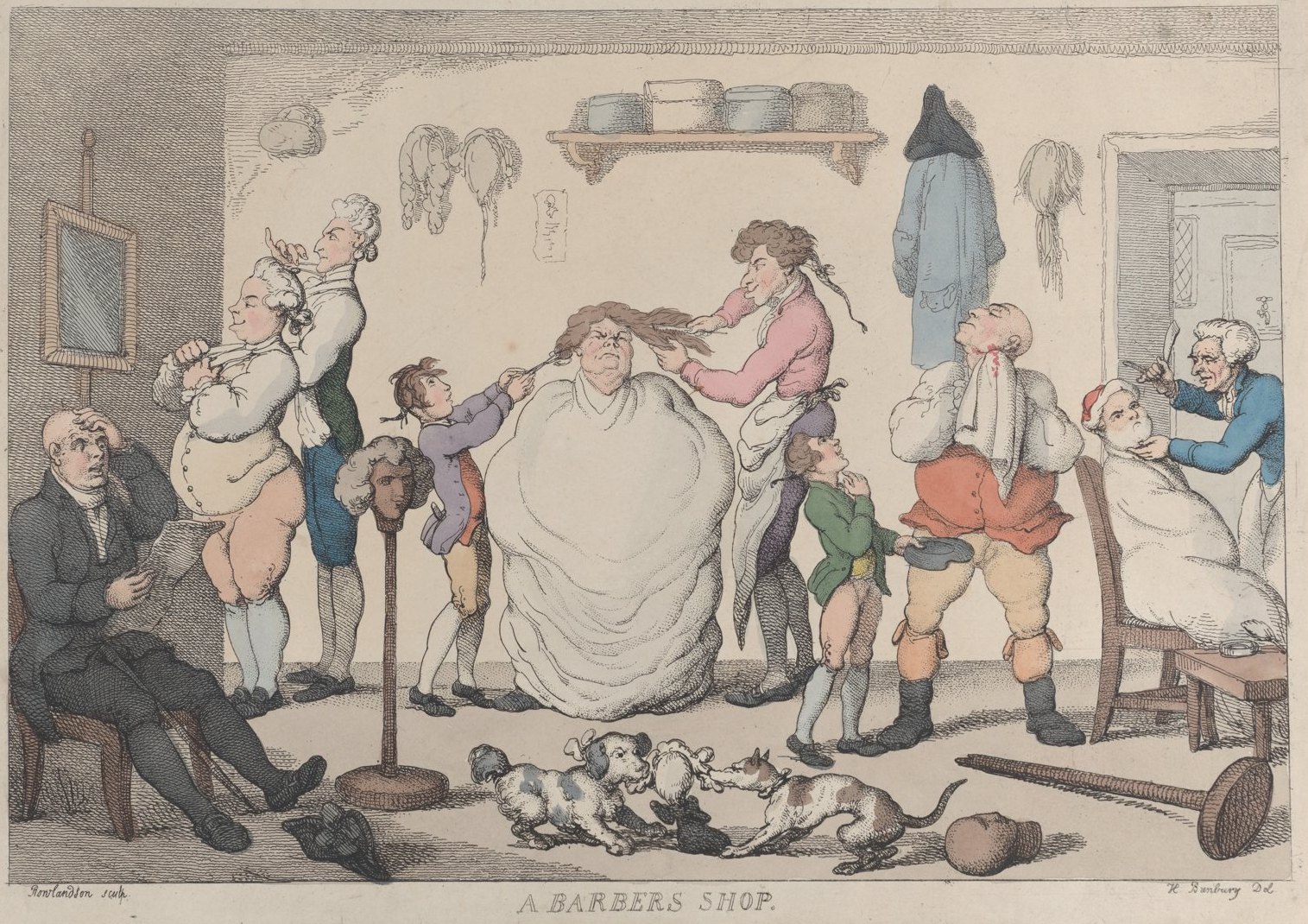
Thomas Rowlandson after Henry Bunbury, A Barbers Shop (1811), The Metropolitan Museum of Art, CC0
"No barbers shall be so bold or so hardy as to put blood in their windows." That is a City of London order from 1307, as it is usually quoted from the city's letter-books, and it tells you most of what you need to know about what a barber did for a living in the fourteenth century. He cut hair, yes. He also bled you, pulled your teeth, lanced your boils, and then put the bowl of blood in the window as advertising, until the aldermen told him to carry it down to the Thames and tip it in quietly.
The red and white pole that still turns outside barbershops is what is left of that trade. I went into this expecting the usual story to fall apart, as it usually does, and for once it holds up.
The stick the patient held
Bloodletting was ordinary medicine for well over a thousand years. The theory, inherited from the Greeks, said that illness came from an imbalance of the body's fluids and that draining some blood put things right. Monks did much of it in the early Middle Ages, until church councils in the twelfth century told clergy to stop cutting people, and the work passed to the men who already owned sharp blades and kept a shop on the high street.
Apart from the blade, the procedure needed a basin to catch the blood (and to hold the leeches, when the barber used them), linen strips to bind the arm afterwards, and a stout stick about the length of a walking cane, which the patient gripped hard so that the veins in the forearm stood out and the barber could find one. When the job was done the barber rinsed the bandages and hung them to dry on the stick outside the door, where the wind twisted them into a loose spiral of stained and clean cloth.
Nobody designed the pole, in other words. When painted wooden poles replaced the stick and bandages, the painters copied what everyone was used to seeing on the doorstep: a white pole with a red stripe winding down it and a brass basin on top. The ball on a modern pole is the basin's descendant.
Henry VIII draws a line
In London the barbers organised early. Edward IV gave them a royal charter in 1462, and by then they had a hall and a monopoly on shaving, bleeding and tooth-drawing inside the city. The surgeons, a much smaller fellowship who thought of themselves as a cut above, were separate and resentful.
In 1540 Parliament put them together in a single Company of Barbers and Surgeons, and Hans Holbein painted Henry VIII handing the charter to the kneeling members; the picture still hangs in Barber-Surgeons' Hall near London Wall. But the act also drew a line down the middle of the new company. In the spelling of the time, anyone "using any shaving or barbery" was not to "occupy any surgery, letting of blood or any other thing belonging to surgery, drawing of teeth only except", and no surgeon was to shave. In practice barbers went on bleeding people for another two centuries, but the law had said that a man who cut your hair should not also cut you.
By one widely repeated account the same tidying reached the pole: barbers were to show blue and white, surgeons red, so a customer could tell at the door which trade he was walking into. I cannot find that rule in the 1540 act and suspect it belongs to a later by-law or to tradition. What is certain is that by the eighteenth century a striped pole outside a shop in England meant barber.
The divorce of 1745
The two trades never got on. In 1745 the surgeons left by act of Parliament to form the Company of Surgeons, which became the Royal College of Surgeons in 1800. The barbers kept the hall, the pole and the name; the Worshipful Company of Barbers is still one of the livery companies of the City of London, seventeenth in order of precedence.
When the trade crossed the Atlantic the Americans added blue, for reasons nobody wrote down. The tidy explanation, red for arterial blood, blue for venous blood, white for the bandage, is a later rationalisation. The likelier one is that a red, white and blue pole on a main street in 1880 was a patriotic object, and that it sold.
The last factory
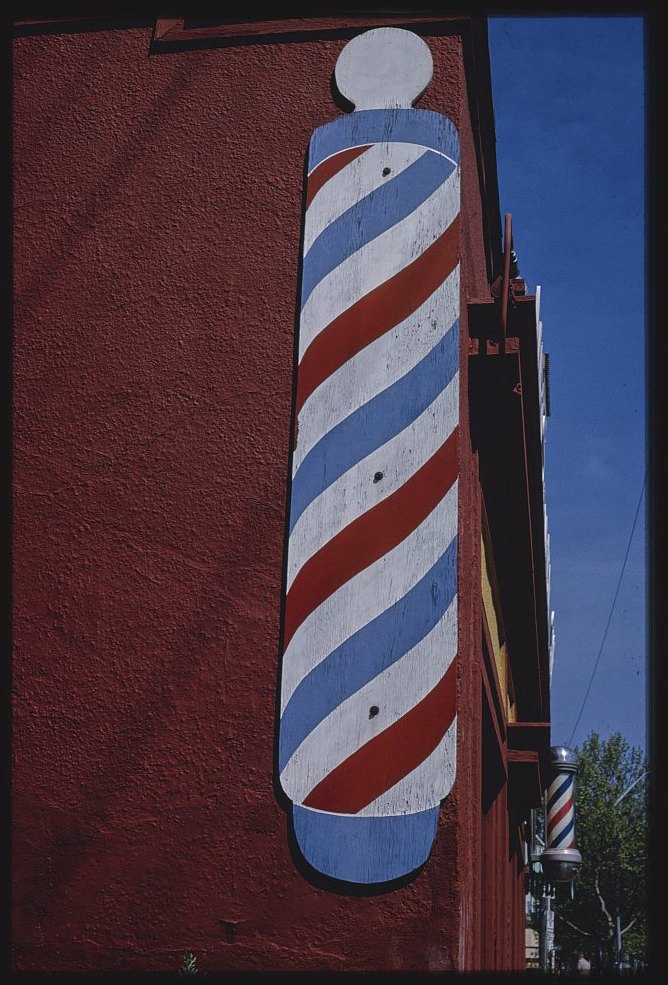
Photo: John Margolies, 1980, Library of Congress Prints & Photographs Division, no known restrictions
The spinning, lit pole most people picture today is an American product of the twentieth century. In 1950 there were four companies in the United States making them. That year a barber-supply salesman in St Paul, Minnesota, named William Marvy decided the existing poles rusted and cracked too easily and started building his own in stainless steel. The other three makers were gone within twenty years.
Several American states still regulate who may hang a pole, and barbers have gone to court against cosmetologists over the right to put one outside a shop that cuts men's hair, arguing that it belongs to their trade by tradition. They are right about the tradition, though the tradition is a stick with blood on it, which is not quite the argument they make.
The William Marvy Company made its 50,000th pole in 1967 and passed 82,000 by 2010. It is still in business on St Clair Avenue in St Paul, run by the family, and by its own account it is the only barber pole manufacturer left in North America. At its peak in the 1960s it shipped more than 5,000 poles a year, and the number has fallen ever since, partly because fewer barbershops open and partly because a good many American cities have banned moving signs. It now sells about 500 a year.
Enjoyed this story?Get a new one every day on social.