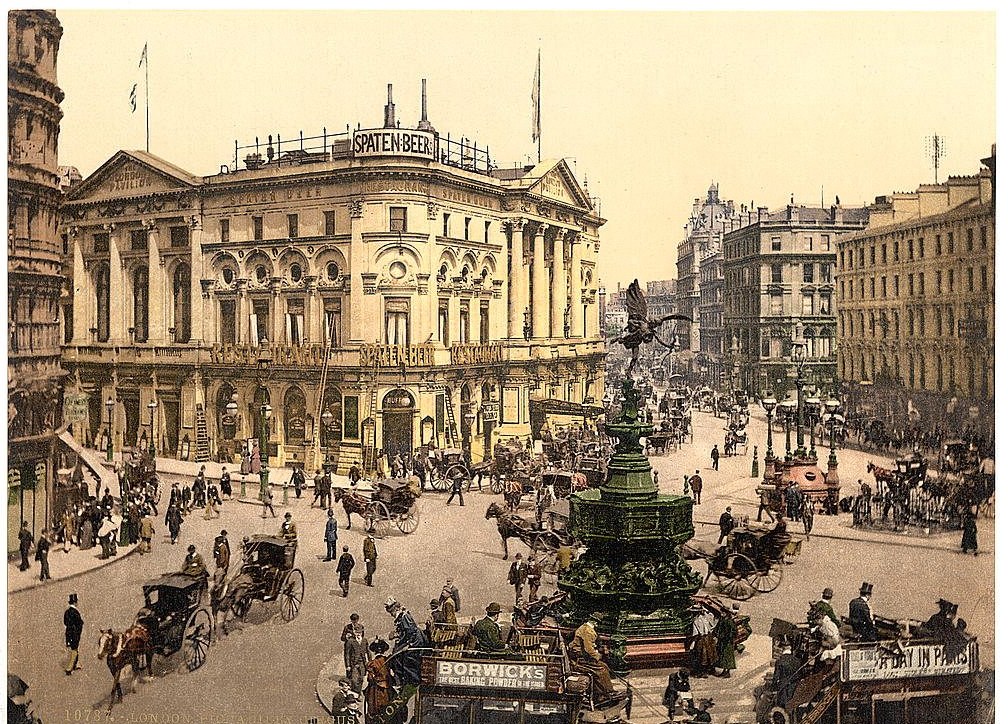
Photochrom print, c. 1890-1900, Library of Congress Prints & Photographs Division, no known restrictions
A reader who had just come back from a holiday in Ireland wrote to ask me, with some feeling, why anyone drives on the left. He had hired a car in Dublin, spent a week flinching at every roundabout, and wanted to know whose idea it was. The honest answer is that nobody decided; the two halves of the world drifted apart over about two centuries, and the moments when a government actually chose a side are rarer, and stranger, than you would think.
About a third of the world's people live in places that drive on the left. The list is long on former British territory, but not only that: Japan, Indonesia and Thailand were never British colonies and keep left anyway, while Canada, Nigeria and Ghana were British and switched. There is a logic to it, but it is the logic of armies, wagons and one Swedish referendum, not of road safety.
Ruts in a Roman quarry
For most of history the question did not come up, because roads were mud and people walked where they liked. The earliest physical evidence anyone has found is a Roman quarry road near Swindon in England, excavated in 1998, where the ruts on one side were worn deeper than on the other. The usual reading is that carts left the quarry loaded and came back empty, and that the deep ruts show the loaded carts keeping left. It is a single site, and I would not hang a theory on it alone, but it is the best we have.
The other early argument is the sword. A right-handed rider keeps to the left so his weapon arm faces whoever is coming the other way, and mounts from the left, so he wants to be at the roadside when he does it. This is plausible and almost impossible to document. The story that Pope Boniface VIII ordered pilgrims to keep left during the jubilee of 1300, to stop them trampling each other in Rome, is repeated in every history of the subject; I have never seen the decree itself quoted, so treat it as tradition rather than fact.
What is certain is that by the eighteenth century, traffic in Britain kept left by custom. A rule for London Bridge in 1756 wrote it down for one crossing, and the Highway Act of 1835 made it the law of the land. Britain then carried the habit, with its gauges and its legal codes, to every colony it ran.
Napoleon takes the right
France went the other way. The story goes that aristocrats' carriages kept left before the Revolution and forced everyone else to the right, so that after 1789 keeping right became a civic virtue; a Paris decree of 1794 made it official. Historians doubt the aristocrat part, but the decree is real enough.
What spread it was Napoleon. His armies marched on the right, his engineers built roads on that assumption, and the rule arrived with the troops in the Netherlands, Belgium, Switzerland, much of Germany, Italy, Spain and Poland. Look at a map of Europe in 1815 and the pattern is almost comically clear: the countries Napoleon conquered drive on the right, and the ones that held him off, Britain, Portugal and the Austrian empire, kept left. Portugal switched in 1928. Austria changed in stages and finished the job only after the German annexation of 1938; Czechoslovakia followed in 1939 and Hungary in 1941, for the same reason.
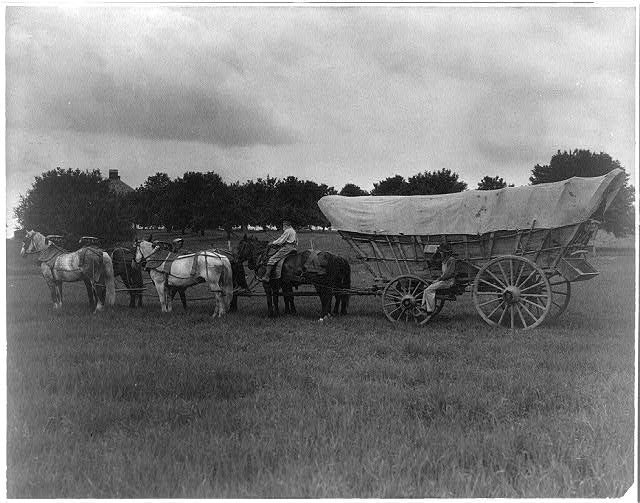
The Pennsylvania wagon
A Conestoga wagon on the National Pike, photographed around 1906, with the teamster riding the left-hand wheel horse. Photo: B. W. Phreanor, Library of Congress, no known restrictions
The United States was never going to follow Britain on this, but the reason is less about independence than about freight. The big Conestoga wagons that hauled goods across Pennsylvania in the 1700s had no driver's seat. The teamster rode the left-hand wheel horse, or sat on a board that pulled out on the left, and from there he could only judge his clearance from an oncoming wagon if both of them kept to the right. In 1792 the law setting up the turnpike from Philadelphia to Lancaster required just that. New York followed in 1804.
The man who made it permanent was Henry Ford. The 1908 Model T put the steering wheel on the left, so that the passenger stepped out onto the kerb instead of into the road, and within a decade almost every American car was built the same way. Canada, which had driven on both sides depending on the province, went right between 1920 and 1924, with Newfoundland holding out until 1947.
The morning Sweden crossed over
Sweden drove on the left while Norway, Denmark and Finland drove on the right, and most Swedish cars had the steering wheel on the left anyway, which put drivers on the wrong side of their own cars. The government held a referendum in 1955. Eighty-three percent voted to keep the left. The Riksdag waited eight years, then in May 1963 ordered the change regardless.
The change had a name, Dagen H, for Högertrafik, right-hand traffic, and a date, Sunday 3 September 1967. Around 350,000 road signs were replaced. More than a thousand new buses with doors on the right were bought and some eight thousand old ones rebuilt. The logo appeared on milk cartons and, by one widely repeated account, on underwear. In the early hours of the Sunday non-essential traffic was banned; at 4:50 a.m. every vehicle still on the road stopped, moved carefully to the other side, and waited; at 5:00 it moved off on the right. That day there were 157 minor accidents, 32 with injuries, none fatal. Accident numbers fell sharply for a few weeks, which is usually put down to everyone driving in terror, and were back to normal within two years. Iceland did the same thing, with less fuss, on 26 May 1968.
The ones that went the other way
Nearly every change in the last century has been from left to right. Myanmar in 1970, Nigeria in 1972 and Ghana in 1974 all followed their neighbours. Okinawa, which the Americans had run on the right since 1945, went back to Japan's left at 6 a.m. on 30 July 1978, in an operation the islanders still call 730.
Samoa is the exception. On 7 September 2009 it switched from right to left, the first country in decades to go that way, so that its people could buy cheap second-hand cars from Japan, Australia and New Zealand instead of expensive ones from America. The government declared a two-day holiday, banned alcohol sales for three days, and cut the speed limit. Bus owners complained that their doors now opened into traffic. It went, by all accounts, rather smoothly.
Where the line runs today
Today roughly 76 countries and territories keep left, and because they include India, Indonesia, Pakistan, Bangladesh, Japan and Britain, that is something over two billion people. The rest of the world keeps right. The border runs through odd places: drive from Hong Kong into mainland China, or across the Mekong from Thailand into Laos, and you change sides at the crossing, on bridges built with a loop to manage it. Nobody is seriously proposing to unify the system; Sweden's switch is usually costed at around 600 million kronor, well over a hundred million dollars at 1967 prices, in a country of eight million people, and the sums for India or Britain do not bear thinking about. My Irish correspondent is back home now, driving on the right, and reports that for the first two days he kept getting into the passenger seat.
Enjoyed this story?Get a new one every day on social.