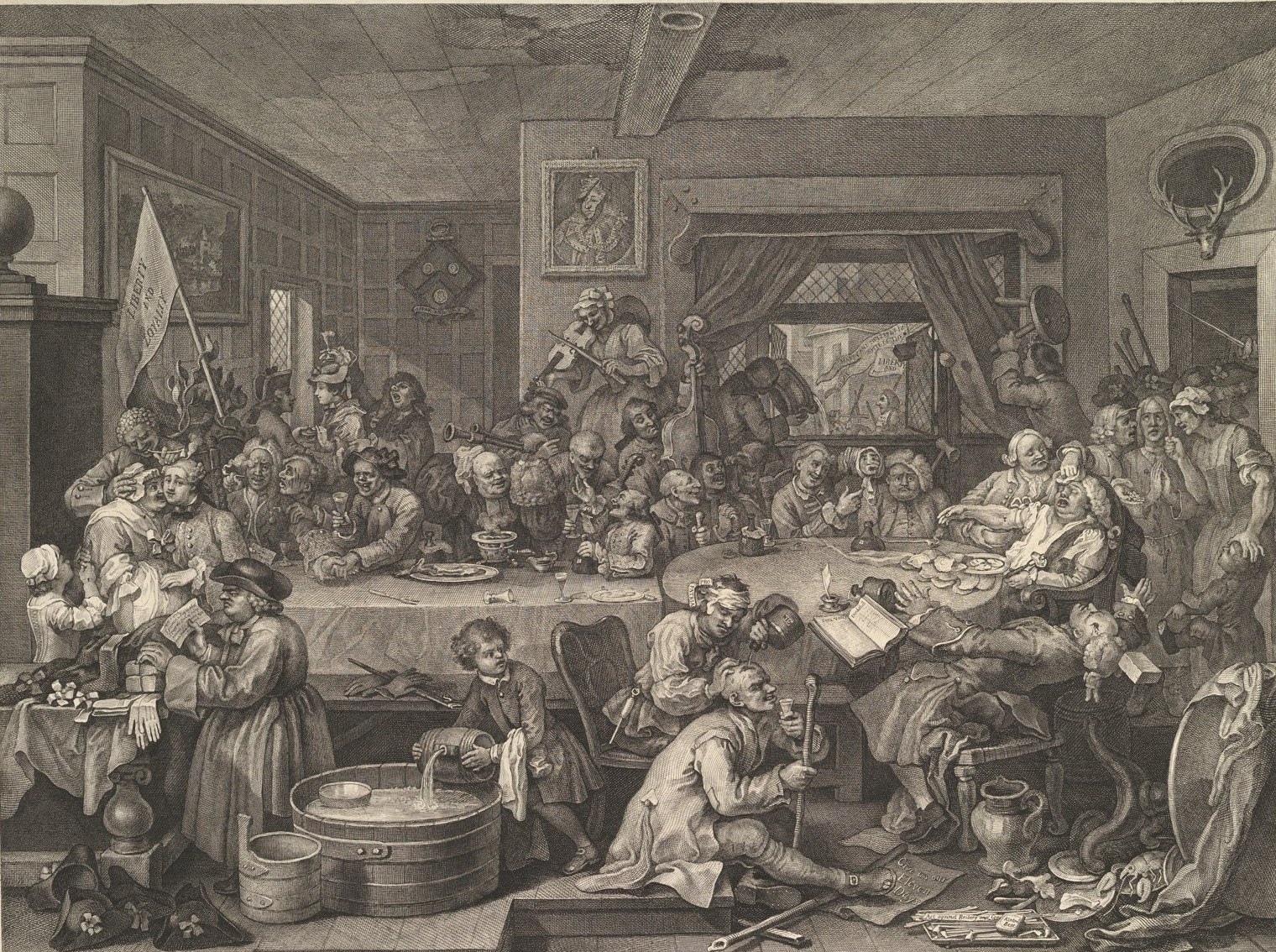
William Hogarth, An Election Entertainment, Plate I: Four Prints of an Election (1755), The Metropolitan Museum of Art, CC0
A reader wrote in last month to ask why the British tax year starts on 6 April, a date that looks as if someone threw a dart at a calendar. I knew the short answer (Parliament deleted eleven days in 1752 and the Treasury refused to lose the revenue), but the longer one begins in Rome, two thousand years earlier, with an army that needed to leave early.
The two questions are the same question. The year starts on 1 January because Roman magistrates once did, and the tax year starts on 6 April because for six hundred years the English year did not start on 1 January at all.
The consuls who could not wait for March
The early Roman year began in March. The names still say so: September, October, November and December are simply the seventh, eighth, ninth and tenth months, which only works if you count from March. January and February were later additions, traditionally credited to King Numa.
The decisive change was administrative. Rome's two consuls took office each year on 15 March, and in 153 BC the start of their term was moved to 1 January. The usual explanation is a war in Spain: a consul was needed in Hispania well before the campaigning season and could not wait until March to take up his command. When Julius Caesar reformed the calendar a century later, inserting 90 extra days into 46 BC to drag the seasons back into line, his new calendar began on 1 January 45 BC, and the Roman world kept it there.
January belonged to Janus, the two-faced god of doors and beginnings. Romans exchanged gifts of honey, figs and small coins, and it is this festival, rather than the astronomy, that gave the medieval Church a problem.
Six hundred years of starting the year in March
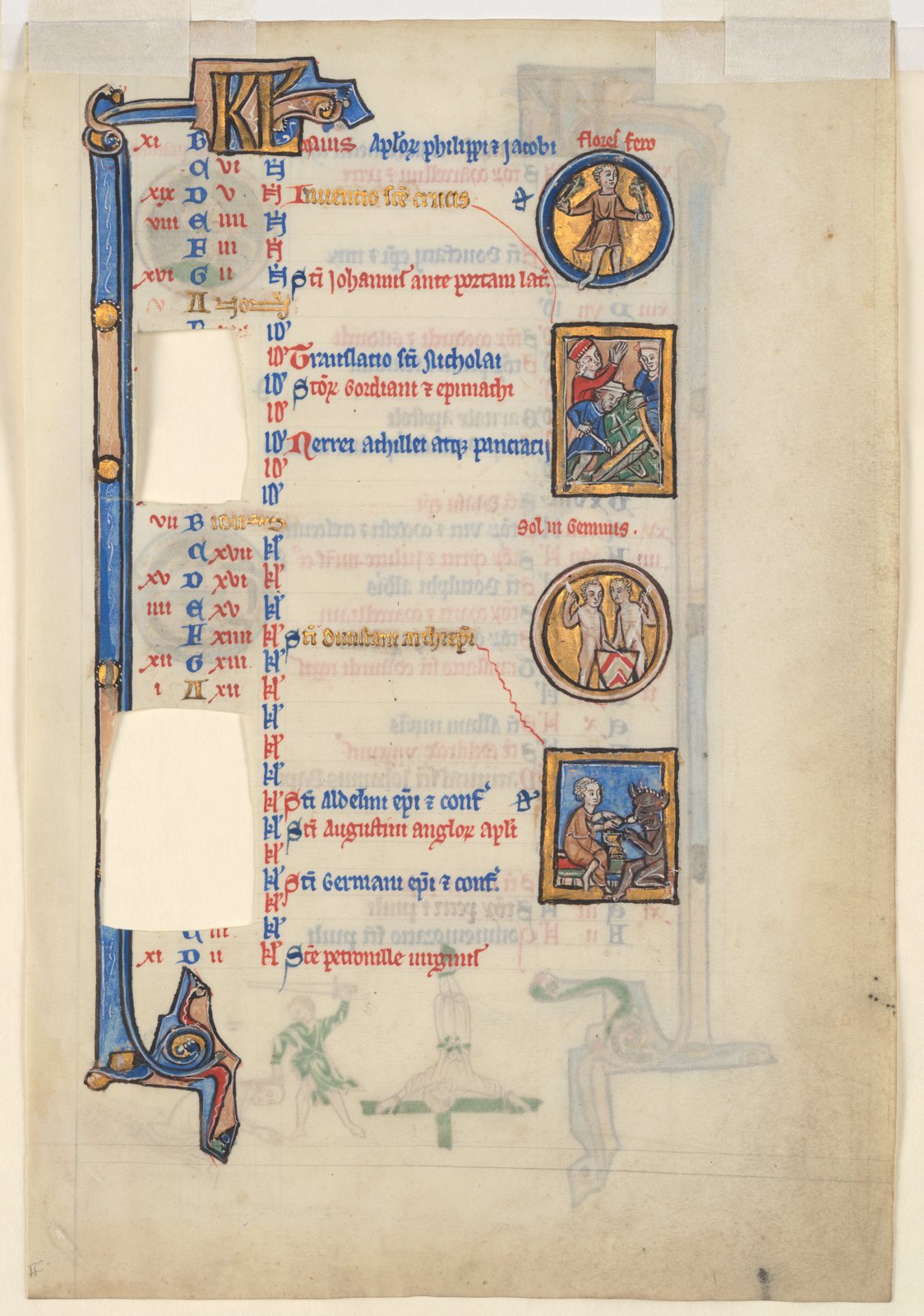
Manuscript Leaf with June Calendar, from a Royal Psalter (13th century), The Metropolitan Museum of Art, CC0
Christian writers disliked the New Year's revels as a pagan hangover, and across medieval Europe the start of the year drifted away from 1 January to dates with religious meaning. Some places began on 25 December, the Byzantines on 1 September. Much of France for a time began the year at Easter, which moves, so that a French year could be anything from eleven to thirteen months long and the occasional date fell twice in one year.
England settled, from about the middle of the twelfth century, on 25 March: the Feast of the Annunciation, or Lady Day, nine months before Christmas, which the medieval mind took to be the true beginning of the Christian era. It was also one of the four quarter days on which rents fell due, servants were hired and accounts were closed. So the English year began on Lady Day, and the English financial year began with it. Calendars still ran January to December on the page, but the year number did not tick over until 25 March. Scotland gave this up in 1600; England carried on for another century and a half.
(This, plus the eleven days below, is why George Washington's birthday appears as 11 February 1731 in the records of his own time and as 22 February 1732 everywhere else.)
Pope Gregory fixes the calendar, and Britain refuses to notice
The deeper problem was Caesar's. The Julian year was about eleven minutes too long, and by the sixteenth century the spring equinox, which fixes the date of Easter, had slipped ten days from where it had been at the Council of Nicaea. In 1582 Pope Gregory XIII struck ten days out of October (Thursday 4 October was followed by Friday 15 October) and tightened the leap-year rule. Catholic Europe went along. Protestant Europe, Britain included, would not take its dates from Rome, and for 170 years a traveller crossing from Dover to Calais lost ten, and later eleven, days on the boat.
By the 1740s this had become absurd for merchants and diplomats alike, and the Earl of Chesterfield, advised by the astronomers James Bradley and the Earl of Macclesfield, carried a bill through Parliament in 1750. It did two things at once: it made 1 January the first day of the year, so that 1751 ran only from 25 March to 31 December, and it deleted eleven days: in Britain and its colonies, Wednesday 2 September 1752 was followed by Thursday 14 September.
The story that mobs rioted in the streets chanting "Give us our eleven days!" is, as far as I can tell, a story. The best-known evidence for it is the placard under a drunk's foot in Hogarth's print at the top of this page, An Election Entertainment, painted in 1754 and engraved the next year, which satirises a bitter Oxfordshire election in which the Tories used the calendar reform as a stick to beat the Whigs with. There is plenty of grumbling in the record about wages and saints' days. Historians who have gone looking for an actual riot, notably Robert Poole, have not found one.
The Treasury keeps its eleven days
The tax year is the Treasury's doing. The financial year had always begun on 25 March, with the quarter day. If the Exchequer had simply let the new calendar run, the 1752 tax year would have been eleven days short, and so would the revenue. The Treasury was not having that. It ruled that the year's taxes would run a full 365 days from the old 25 March, which in the new calendar meant ending on 4 April and beginning the next year on 5 April 1753.
The year 1800 would have been a leap year under the Julian rules but not under the Gregorian ones, so the two calendars drifted another day apart, and the Treasury once more declined to give up a day of revenue. The tax year moved to 6 April, where it has sat ever since. In 1900, the next such year, the Treasury finally left it alone.
What it looks like today
Almost every country now begins its civil year on 1 January, though the latecomers were late indeed: Russia switched to the Gregorian calendar in 1918, which is why the October Revolution was always commemorated in November, and Greece held out until 1923. Several Orthodox churches still keep their feasts by the old reckoning, which is why Christmas falls on 7 January in Moscow and why Russians have an "Old New Year" on 14 January.
And in Britain the tax year still begins on 6 April. The 2026 tax year opened on 6 April 2026, as it has every year since 1800. A government review a few years ago looked seriously at moving the date to 31 March or 31 December and concluded the disruption was not worth it. So a quirk that began with a consul hurrying to Spain in 153 BC, and passed through a medieval feast of the Virgin and a Hanoverian accountant's refusal to lose eleven days, is now coded into every payroll system in the country.
Enjoyed this story?Get a new one every day on social.