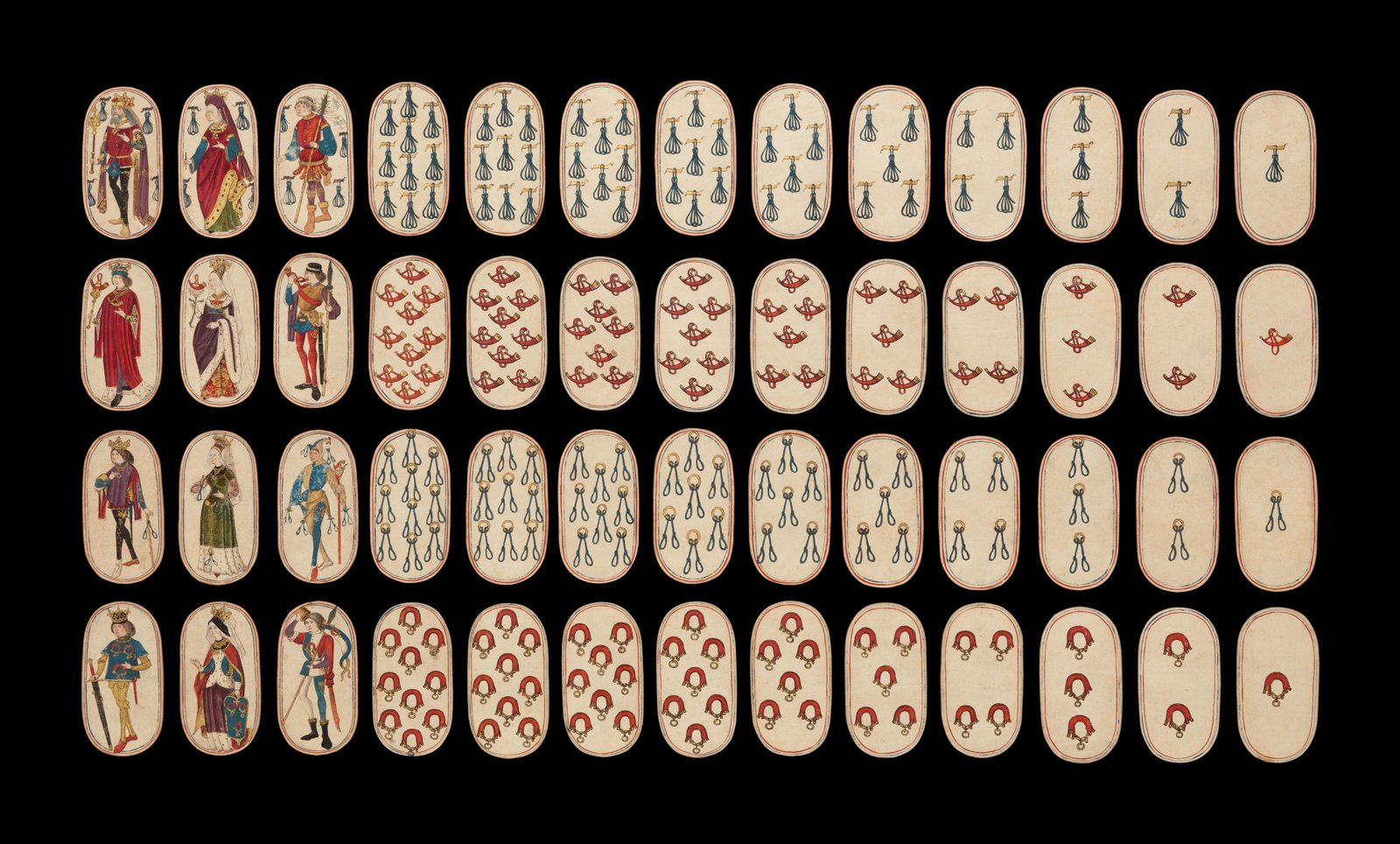
The Cloisters Playing Cards (ca. 1475–80), The Metropolitan Museum of Art, CC0
Take the pack of cards out of the kitchen drawer and look at it as an object. Fifty-two cards, four suits in two colours, three court figures in each suit, an ace fancier than the others, and two jokers nobody asked for. Almost every one of those decisions was made somewhere specific, by someone with a reason, and most of them were made in France in the decades either side of 1480. The game itself is older, and it did not start in Europe at all.
A deck in a palace in Istanbul
The oldest nearly complete pack of cards we have sits in the Topkapı Palace Museum in Istanbul. It was made in Mamluk Egypt, probably in the fifteenth century, and nobody recognised it for what it was until the archaeologist Leo Aryeh Mayer went through the museum's holdings in 1939. It has four suits: cups, coins, swords and polo sticks. Each suit runs from one to ten and then has three court cards, a king (malik), a deputy (nā'ib) and a second deputy. There are no faces on them; the rank is written out in elegant script at the top of each card instead.
That structure, four suits of thirteen, is the modern deck already. The Spanish still call cards naipes and the Italians once called them naibi, and the usual explanation is that both words come from that Mamluk deputy, the nā'ib. Cards crossed into southern Europe through trade in the 1370s and spread fast enough to alarm the authorities. Florence restricted the game in 1377. The same year a Dominican friar in Freiburg, Johannes of Rheinfelden, wrote a Latin treatise describing a deck of 52 cards with four suits, each with a king and two marshals, which he had examined closely for a man who disapproved of gambling.
The polo sticks did not survive the crossing. Europeans had never seen polo, so the Italians turned the sticks into batons, or clubs, and that is what the Spanish and Italian packs still show today, along with cups, coins and swords. Germans, by about 1450, had swapped the whole set for acorns, leaves, hearts and bells. One of the oddest surviving experiments is in New York: the Cloisters Playing Cards, made in the Burgundian Netherlands around 1475 to 1480, are a full deck of 52 with suits of hunting horns, dog collars, hound tethers and game nooses, barely worn and possibly never played with.
The shortcut that made French cards cheap
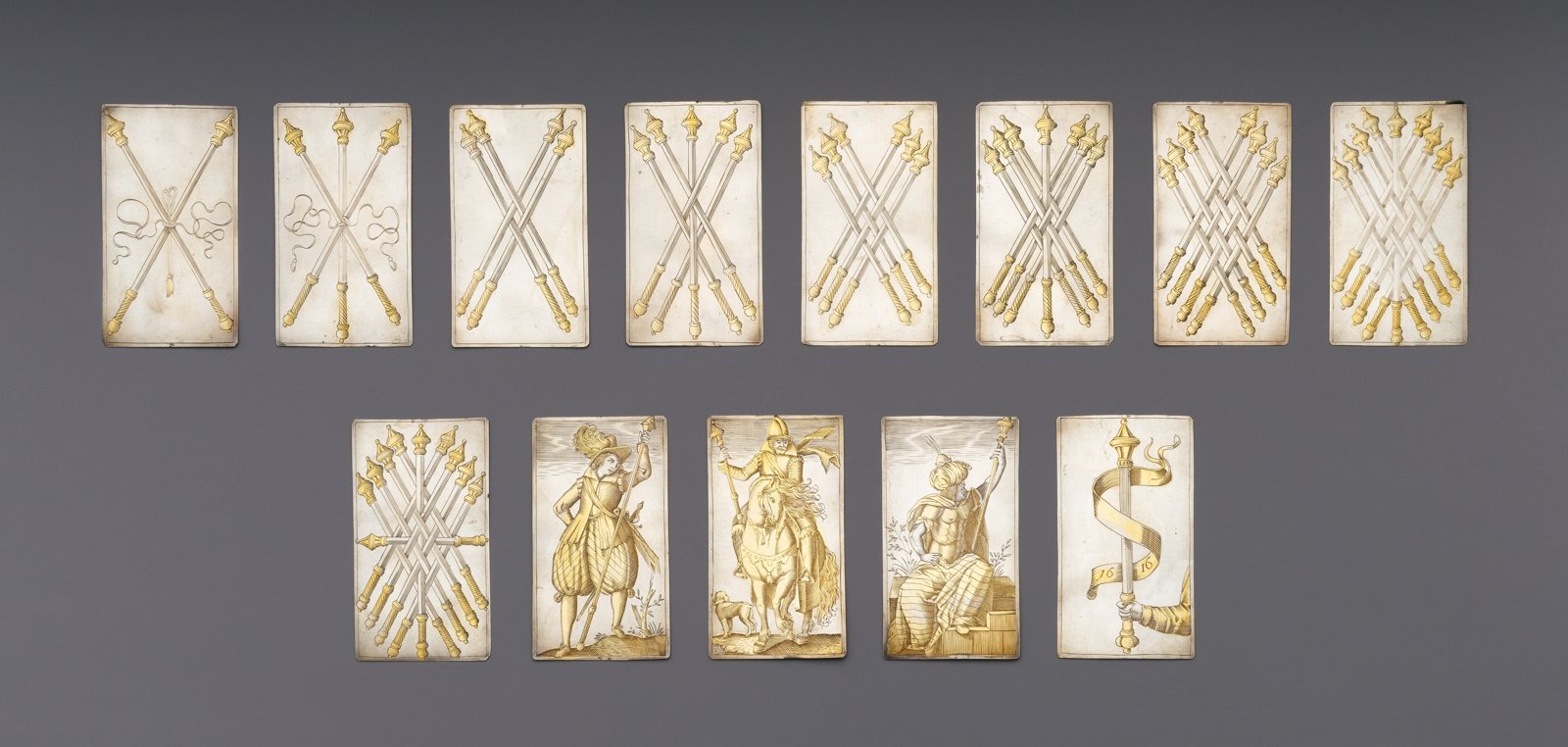
A suit of batons from a set of engraved silver playing cards made by Michael Frömmer in 1616. The Metropolitan Museum of Art, CC0
The French contribution, somewhere around 1480, was not a prettier card. It was a cheaper one. Printers in Lyon and Rouen reduced the suit signs to four flat shapes in two colours: coeurs, carreaux, trèfles and piques, hearts, tiles, clovers and pikes. English speakers kept the hearts, called the tiles diamonds, and for the other two kept the old Spanish and Italian names, clubs and spades, which is why a spade looks nothing like a spade and a club looks nothing like a club. The names are from one tradition and the pictures from another.
The point of the flat shapes was manufacturing. A German acorn or an Italian sword needs a woodblock. A red heart can be stencilled, quickly, by someone with no particular skill, and only the twelve court cards still need a proper block. That cut the cost of a French deck well below everyone else's, and cheap cards travelled: into the Low Countries, into England, and eventually, by ship, everywhere. Germany, Spain, Italy and Switzerland kept their own suits for local games, and still do, but when someone in Lagos or Seoul sits down to play poker, the cards on the table are a French design.
The French also made a decision about the court that the Spanish and Italians never accepted. They dropped the mounted knight and put in a queen, so that the three figures became king, queen and valet. Parisian makers went further and gave the figures names, still printed on French decks today: the king of spades is David, the king of hearts Charles (Charlemagne, by most accounts), the king of diamonds Caesar and the king of clubs Alexander. The queens are Pallas, Judith, Rachel and Argine, the last simply an anagram of regina, and the valets include Lancelot, Hector and La Hire, a captain who fought beside Joan of Arc.
How the knave became Jack
In English the valet was a knave, which in the fifteenth century just meant a boy or a servant. It stayed a knave in polite usage for four hundred years. The word Jack came up from below. In the old English game All Fours, the knave of trumps was called the jack and scored a point on its own, and players who learned their cards in taverns carried the word over to the rest of the deck.
Dickens knew exactly what class of person said it. In Great Expectations, published in 1861, young Pip sits down to play Beggar My Neighbour with Estella, and she turns to Miss Havisham in contempt: "He calls the knaves, Jacks, this boy!"
The argument was settled in the print shop. In the 1860s and 1870s makers in America and Britain began putting small indices in the corners of cards so that players could hold a fanned hand and read it at a glance. K for king and Kn for knave were too easy to confuse in a corner the size of a fingernail. J was clear, and by the 1880s the knave was Jack on the card itself.
The ace that could get you hanged
The ace of spades is ornate for a reason that has nothing to do with games. From 1711 the English government taxed packs of cards, and from 1765 the Stamp Office printed the ace of spades itself, with an elaborate design that was hard to copy, and sold it to the card makers; a pack without an official ace was an untaxed pack. Forging it was a felony, and in 1805 a London card maker called Richard Harding was hanged for it. The duty survived, in reduced form, until 1960, which is why British aces still carry a flourish and a maker's name now that nobody is collecting anything.
The jokers are the newest thing in the box and the only American contribution. They appear in the 1860s as an extra trump for euchre, where the top card was called the best bower and the joker was made to outrank it. Most of the world's games ignore them, and most people use them to replace the four of clubs after the dog has eaten it.
What is left of all this today
The Mamluk deck is still in Topkapı. The Cloisters cards are on view at the Met Cloisters in upper Manhattan, in Gallery 13, where you can decide for yourself whether the nooses and dog collars were a joke about Burgundian court fashion, as the museum suspects. The English pattern, with its double-headed courts and its Jack, descends directly from the cards Rouen was shipping across the Channel in the sixteenth century, and a Rouen printer would recognise your deck at once, apart from the corner indices, the jokers, and the plastic coating that lets you shuffle it ten thousand times without the hearts rubbing off.
Enjoyed this story?Get a new one every day on social.