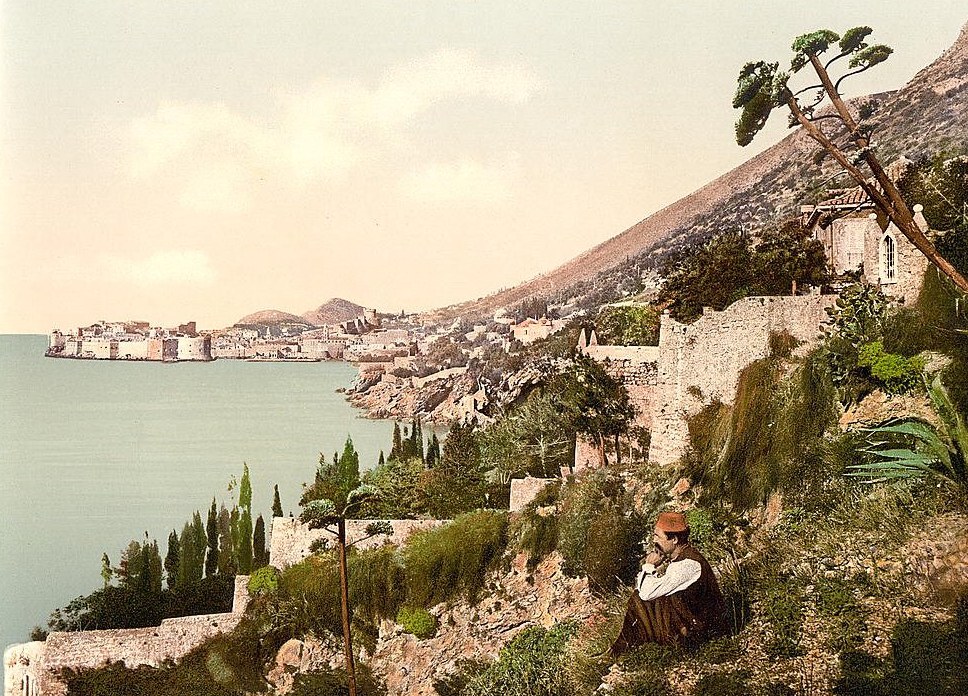
Photochrom: Detroit Publishing Co., c. 1890 to 1900, Library of Congress Prints & Photographs Division, no known restrictions
A reader wrote to me during the pandemic with a question I could not answer at the time: if quarantine means forty days, and nobody has been shut in for forty days since roughly the age of sail, why do we still use the word? I have since done the reading. The short version is that the number was chosen by a committee in the Adriatic in the fourteenth century, lengthened by another committee a few decades later, and has never had much to do with how long any disease actually takes to show itself.
A council meeting in Ragusa, July 1377
The Black Death reached Europe in October 1347 on Genoese ships putting in at Messina, and within four years it had killed something between a third and a half of the continent. The cities that lived by the sea learned faster than the rest, because they could watch the disease arrive. By the 1370s the plague was coming back in waves, and the small republic of Ragusa (the city is Dubrovnik now, in Croatia) decided to do something about the ships.
On 27 July 1377 the Major Council of Ragusa passed a rule that survives in the city archive. Anyone arriving from a plague-infected place, by land or by sea, was not to enter the city until they had spent a month on the islet of Mrkan or in the small town of Cavtat down the coast. Ragusans who went to visit them were to stay a month too. Anyone bringing food to the isolated was to have the council's permission. The period was thirty days, and the Ragusans called it a trentina, which is simply the Italian for a thirty.
This is generally counted as the first quarantine law anywhere, and what strikes me about it is how calm it is. It does not say what plague is or how it moves, and it does not blame Jews, foreigners or the stars, which most writing about the plague in that century did. It simply assumes that people and goods from a sick place can be dangerous for a while, and that the way to deal with that is a fixed waiting period on a rock in the bay, enforced by fines. Six and a half centuries on, that is still more or less the whole of the idea.
Venice adds ten days and an island
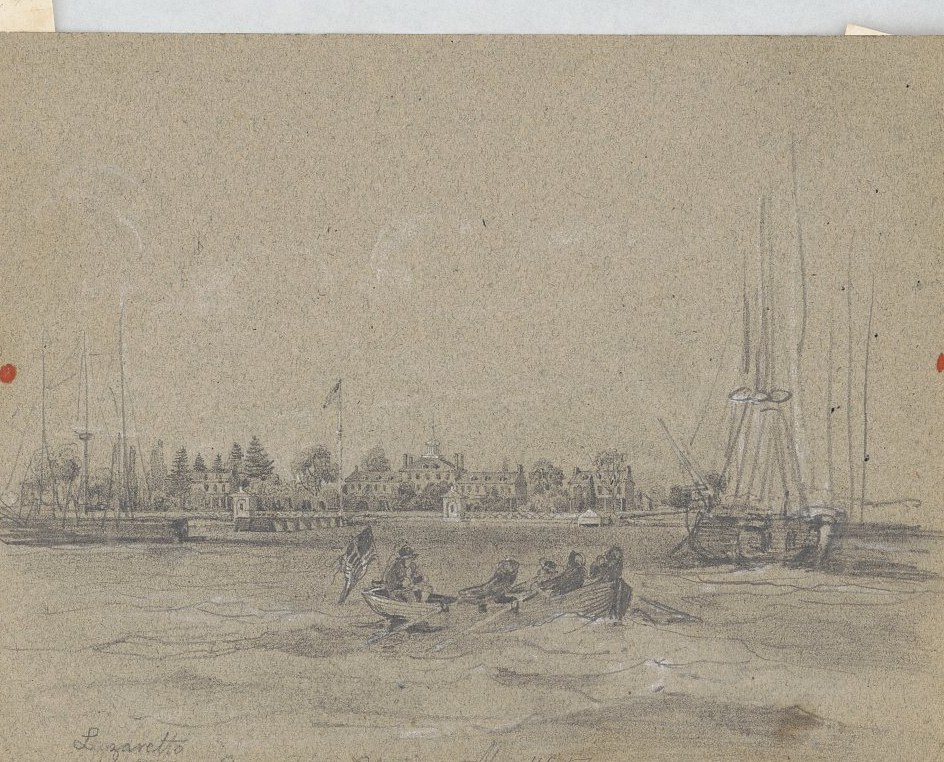
Venice took the Ragusan idea and did what Venice did with most things, which was to build it in stone. In 1423 the Senate ordered a permanent isolation hospital on a lagoon island called Santa Maria di Nazareth, a short row from the Lido. Infected people, suspect people and suspect cargo were taken there and kept until the city was satisfied. The island's name wore down in Venetian mouths from Nazaretum to lazaretto, probably helped along by Lazarus, the patron of lepers, and lazzaretto became the word for a plague hospital across Europe. In 1468 a second island, the Lazzaretto Nuovo, was set aside for people who had merely been exposed, so the sick and the possibly sick were no longer locked up together.
Somewhere in this period the thirty days became forty. The Venetian documents talk of quaranta giorni, and the practice spread with the word: quarantena in Italian, quarantaine in French, and from there into English. Marseille claimed a forty-day rule for its harbour as early as 1383, and by the sixteenth century most Mediterranean ports with any ambition had a lazzaretto and a forty-day book.
Why forty, exactly
Nobody wrote down the reason, which has not stopped people guessing for five centuries. The number sat in the Christian mind already: forty days of rain in Genesis, forty years in the wilderness, forty days of Christ in the desert, forty days of Lent. There was also an old medical idea, which goes back to the Hippocratic writings, that the fortieth day of an illness is the line between an acute disease and a chronic one, so a person who had not fallen ill after forty days could be presumed safe. Some historians think the Venetians just wanted a margin over Ragusa's thirty. I lean towards the last explanation, with the religious number making it feel right, but I have never seen a source that settles it.
What is clear is that forty was far longer than the disease needed. Bubonic plague shows itself in two to six days, and the pneumonic form faster than that. The ports were overcounting by a factor of about ten, which was wasteful for merchants and probably the reason the system worked at all. A ship held for forty days was a ship whose rats had mostly died or left.
The word had an earlier life
The Lazaretto quarantine station on the Delaware below Philadelphia, pencil drawing by James Fuller Queen, 11 May 1856. Library of Congress, no known restrictions
English took quarantine from Italian in the seventeenth century, but the word was already in the language with a different meaning. The 1215 Magna Carta allows a widow to remain in her late husband's house for forty days while her dower is sorted out, and English lawyers called that period her quarentine. So for a few hundred years the word meant the one stretch of forty days that was a protection rather than a confinement. (The legal sense survived in textbooks into the nineteenth century, long after everyone else had forgotten it.)
By the eighteenth century the maritime meaning had won. Britain passed a Quarantine Act in 1721, in a panic over plague at Marseille the year before, and ships waiting to be cleared flew a plain yellow flag so that boats would keep away. The yellow flag is still in the international signal code as the letter Q, though its meaning has flipped: a ship flying it today is declaring that it is healthy and asking for permission to enter port.
What the islands look like now
The Lazzaretto Nuovo in the Venetian lagoon can be visited at weekends in the warmer months, and the long brick warehouse where the suspect cargo was aired is still standing. The Lazzaretto Vecchio, the original 1423 island, is a different case. Excavations there between 2004 and 2007 turned up the remains of more than 1,500 plague victims in mass graves, and the island has been promised a lagoon museum for years; at the time of writing I could not find a firm opening date. Dubrovnik's own Lazareti, a row of stone halls built outside the Ploče gate in the seventeenth century, long after the 1377 rule, now holds galleries and a club, which I think the Major Council would have found hard to picture.
The forty days themselves went long ago. By the nineteenth century ports were holding ships for a week or two, and the modern rules, written into the World Health Organization's International Health Regulations, set the period by the disease rather than by scripture. In January 2020 the city of Wuhan was sealed for seventy-six days, and over the two years that followed most countries set some fixed period of their own, usually ten or fourteen days, which they then shortened as they learned more. So my answer to the reader is that we kept the Venetian word because every language in Europe had already borrowed it by the time anyone thought to count the days, and nobody has since come up with a better one.
Enjoyed this story?Get a new one every day on social.