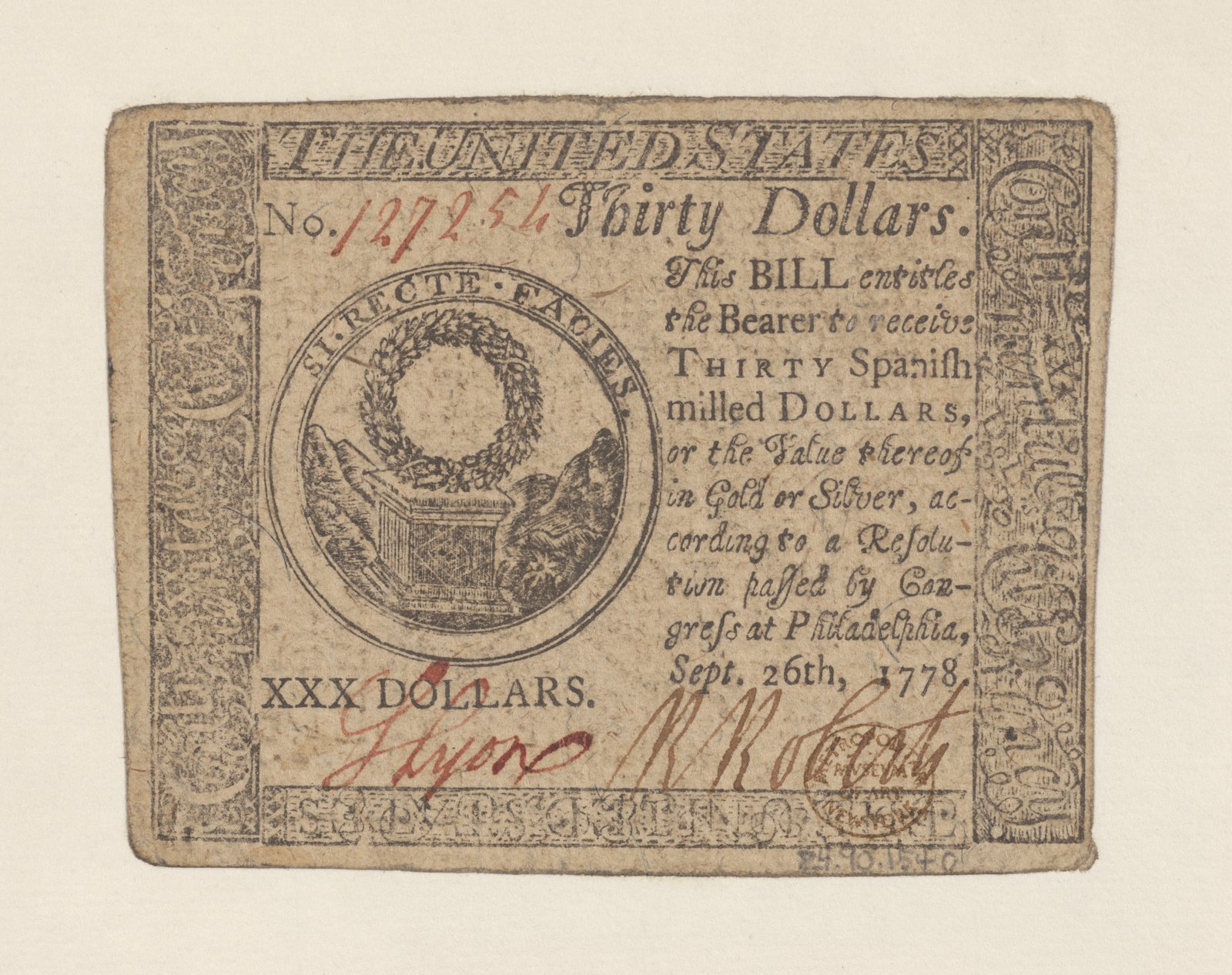
Banknote: Hall and Sellers, Philadelphia, United States Continental Currency, Thirty Dollars, 26 September 1778, The Metropolitan Museum of Art, CC0
A reader wrote in last month with a question I thought I could answer in two lines: why does the dollar sign look like an S when the word starts with a D? Two lines turned into a week of reading, because the honest answer is that the symbol is older than the dollar, was invented for a different currency by people who were not American, and nobody wrote down the moment it happened.
What follows is the best version of the story that the documents support, with the parts historians still argue about marked as such.
The coin came first, and it was Spanish
For the first two centuries of English settlement in North America there was almost no English money in circulation. London did not ship silver coin to the colonies, and the colonies were forbidden to mint much of their own. What people actually used, from Boston to Savannah, was the Spanish silver dollar: the piece of eight, the eight-real coin struck in Mexico City, Lima and above all Potosí, in what is now Bolivia, from silver dug out of a mountain by forced labor.
The coin arrived through trade with the Spanish Caribbean and it was good silver, roughly an ounce of it, reliably assayed. Colonists cut it into eight wedges for small change, which is why Americans still say "two bits" for a quarter. By the time of the Revolution it was simply the money people thought in. When the Continental Congress borrowed, it borrowed in Spanish dollars. When Alexander Hamilton designed a currency for the new republic, the Coinage Act of 1792 defined the United States dollar by weighing a sample of Spanish milled dollars and copying the silver content.
The word "dollar" itself is a borrowing too. It comes from the thaler, short for Joachimsthaler, a large silver coin first struck in 1519 at Joachimsthal in Bohemia. The Dutch made it the daalder, the English made it the dollar, and English speakers applied it to any big silver coin of about that weight, which in the Americas meant the Spanish one.
Pesos, abbreviated by tired clerks
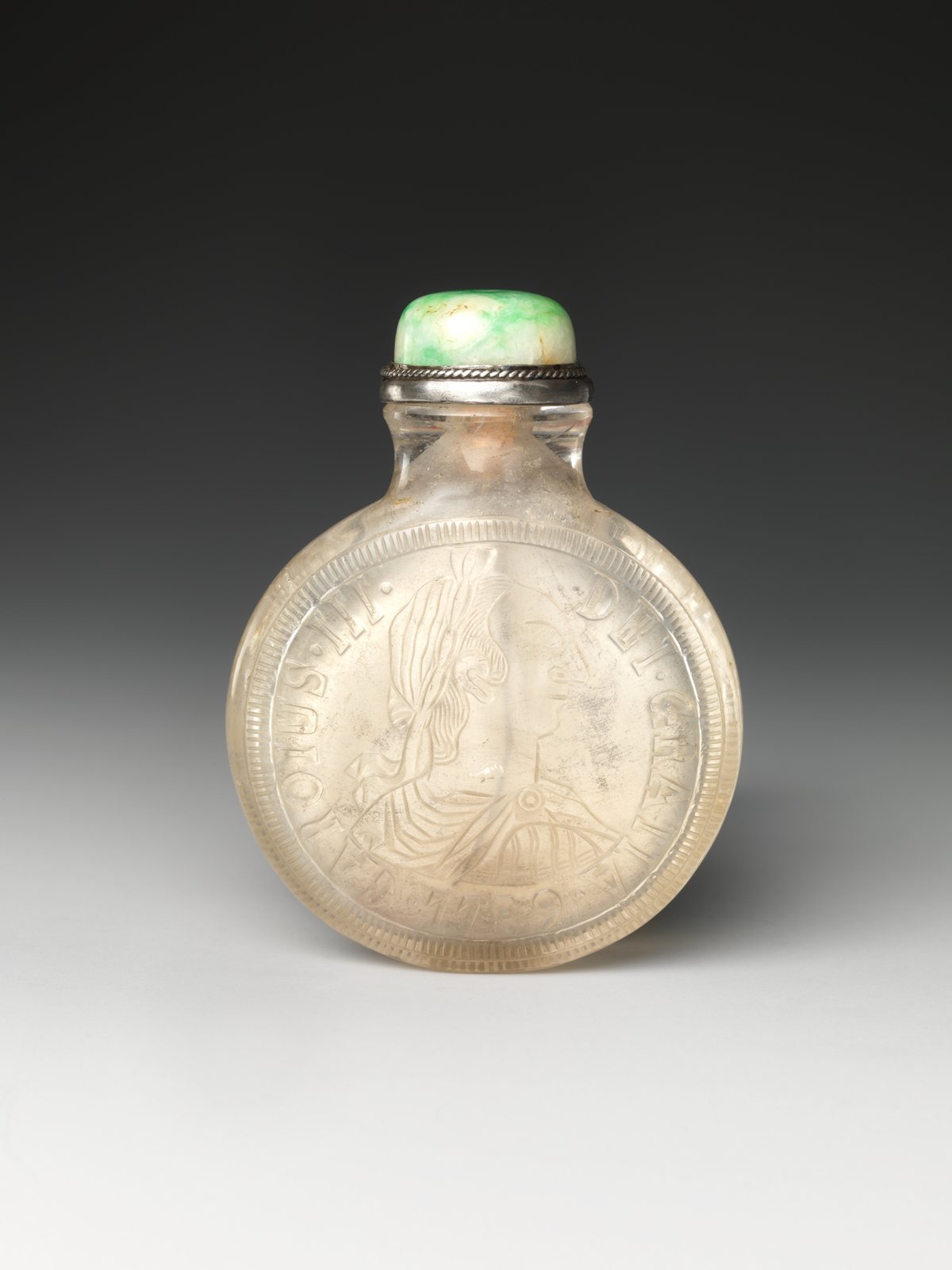
Snuff bottle set with a Mexican eight reales coin, late 18th to early 19th century, The Metropolitan Museum of Art, CC0
In Spanish the coin was a peso, and in the ledgers and letters of the Spanish Atlantic it was written as an abbreviation: a p with a small s above or after it, the way we might write "lbs" or "No." Merchants in New Orleans, Havana and Philadelphia who traded in both languages wrote the same abbreviation thousands of times.
Here is the part that is well documented. Manuscripts from the late eighteenth century show that abbreviation collapsing. The s drifts down onto the p, the loop of the p shrinks to a stroke, and what is left is an S with one or two vertical lines through it. The earliest American example that scholars usually point to is in the business correspondence of Oliver Pollock, an Irish-born merchant in New Orleans who was buying supplies for the Continental Army on credit. In a letter from 1778 his "ps" already looks like a dollar sign. The sign was not his invention (similar marks have been found in Portuguese and Spanish documents from the mid-1770s, including a receipt written in Coimbra in March 1775), but his letters are the clearest early case on this side of the Atlantic.
So the symbol was born as shorthand for pesos, and the United States took it over for the same reason it took over the coin: there was nothing else to hand. By the 1790s it was being set in type in Philadelphia, and by the early nineteenth century it was the standard way to write a sum of American money.
The rival theories, and why I do not buy them
Because nobody signed the dollar sign, other explanations have been circulating since at least the 1870s, and some of them are more fun than the truth.
The most popular says the sign is the Pillars of Hercules. The Spanish coat of arms shows two columns wrapped with an S-shaped ribbon, and that design was stamped on the back of the pillar dollars struck at Potosí and Mexico City. Squint at a worn coin and you can see a dollar sign in it. The trouble is that nobody in the eighteenth century seems to have said so, and the manuscript trail of the p and s is continuous. It is possible that the pillars made the new mark feel familiar; it is unlikely that they produced it.
The second theory says the sign is a U written over an S, for United States, with the bottom of the U worn away. This one appears in letters to a British magazine in 1876 and in an American engineer's essay in 1886, and it got its biggest audience in 1957 when Ayn Rand built a whole speech around it in Atlas Shrugged. It is tidy, patriotic and wrong: the symbol was in use before anyone wrote "US" as a monogram, and the two-stroke form shows up in Portugal, which had no interest in the United States.
A third version credits Robert Morris, the financier of the Revolution, with designing the sign in 1778. A biographer of Oliver Pollock put that about in the 1930s, and it has been contradicted by the documents since. A fourth points to the mint mark of Potosí, a monogram of the letters P, T, S and I stacked on top of one another. That mark does contain something like a dollar sign, which is a nice coincidence and perhaps nothing more.
I have never seen a convincing case for anything except the pesos abbreviation, and I notice that the people who have spent their careers on the question (the historian of mathematical notation Florian Cajori went through hundreds of manuscripts for his 1929 study) all land in the same place.
One line or two
If you learned to write the dollar sign with two vertical strokes, you are not wrong, just old-fashioned. Both forms were in use from the start, because the stroke was originally the stem of a p and clerks drew it however their hand fell. The two-stroke form was common in nineteenth-century print, and it survives in a few typefaces, such as Baskerville. The one-stroke form won because it is quicker to write and, later, because typewriters and computer keyboards only ever had room for one version.
Spanish dollars themselves kept circulating alongside American coins for a surprisingly long time. Congress made Spanish and Mexican silver legal tender in 1793, and it was only the Coinage Act of 1857 that finally took the foreign coins out of the system, by which time the symbol that had come in with them had long since stopped meaning pesos to anyone.
What the sign does today
Today the character is Unicode U+0024, one code point that covers both the one-stroke and two-stroke drawings, and the standard American keyboard puts it above the number 4. It is the symbol for the dollars of the United States, Canada, Australia, New Zealand, Singapore, Hong Kong and a dozen smaller economies, and for most of the Latin American currencies still called pesos, where it is, in a sense, back home. (The Philippines, whose peso came out of the same Spanish system, uses a P with two bars instead.) Banks and traders mostly avoid it, since "$" alone does not tell you whose dollar, and write USD, CAD or MXN.
Programmers use it for variables and regular expressions, which has nothing to do with money and everything to do with it being on the keyboard. And in Spanish-speaking Latin America, when a shopkeeper in Mexico City chalks "$20" on a crate of oranges, she is using the sign for exactly what it was invented for 250 years ago. It is the Americans who are borrowing it.
Enjoyed this story?Get a new one every day on social.