Painting: Raphael, The Marriage of the Virgin, 1504, Pinacoteca di Brera, Milan. Photo: Francesco Bini, CC BY-SA 4.0, via Wikimedia Commons
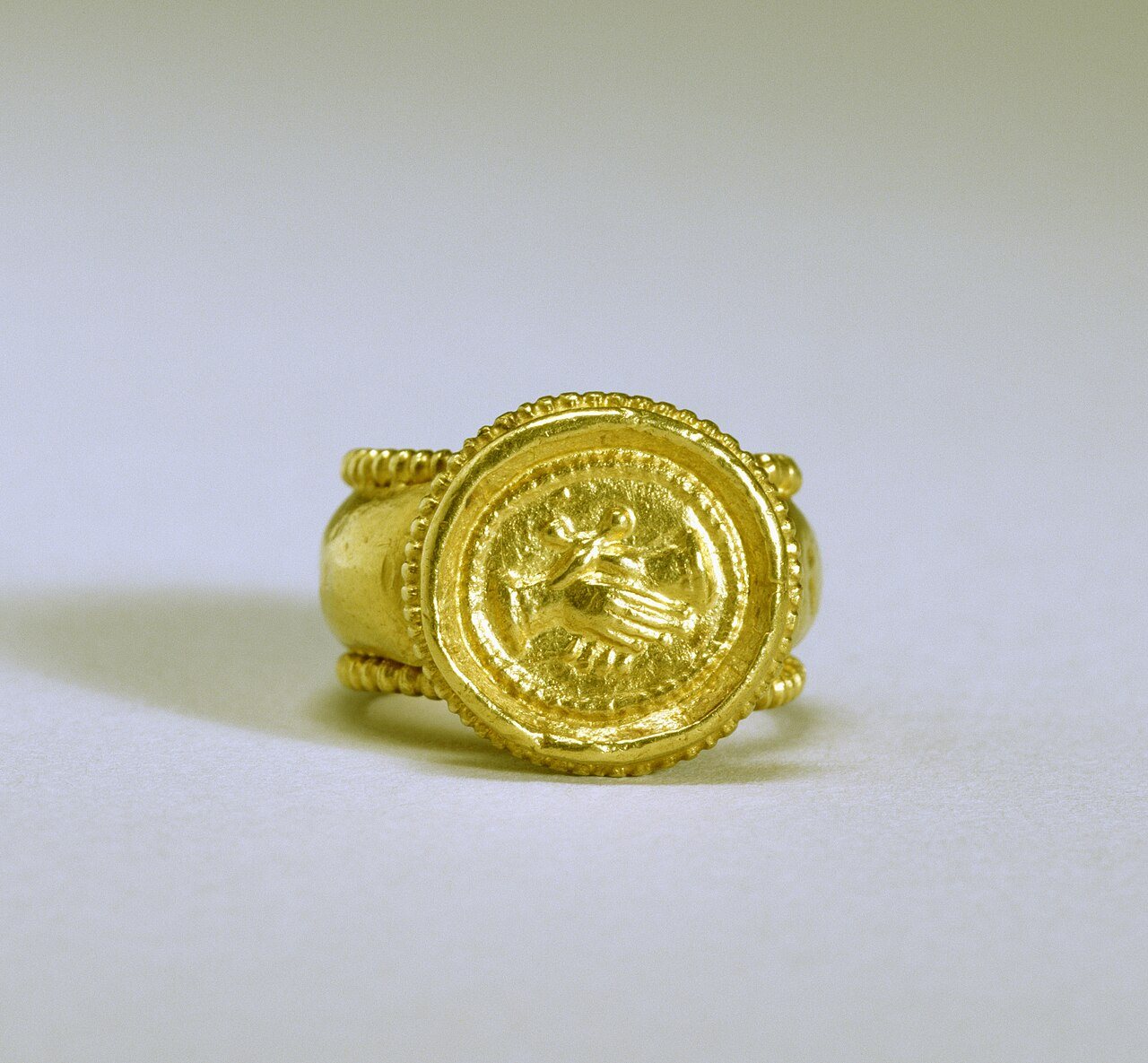
There is a gold ring in the British Museum, Roman, from somewhere around the third century, and its bezel is a pair of tiny right hands clasped together. Jewellers call the type a fede ring, hands in faith, and they were still being made in the sixteenth century. Nobody can prove this particular one was given at a betrothal. But the Romans did give rings at betrothal, they did put them on the fourth finger of the left hand, and they had a reason for choosing that finger which was wrong in every particular and which people are still repeating at weddings today.
The vein that runs to the heart
Aulus Gellius, a Roman writer of the second century AD with a magpie's taste in facts, set down in his Attic Nights why the ring went where it did. He was quoting Apion, a scholar from Alexandria, who said that the Egyptians had found, when cutting up bodies, a very fine nerve running from the fourth finger of the left hand straight to the heart. It had therefore seemed right to honour that finger with a ring. Macrobius, two centuries later, repeated it and added that the Egyptians were embalmers, and so would know.
There is no such nerve, and no such vein. The fingers are all supplied in much the same way, and nothing in the hand goes anywhere near the heart without travelling up the arm like everything else. The Egyptians left no record of the idea; it looks like a Greek or Roman notion dressed in Egyptian clothes, a common way of making a claim sound old and wise. By the Middle Ages the nerve had become a vein, the vena amoris, the vein of love, and in that form it has outlived the Roman Empire by about fifteen hundred years.
Iron first, then gold
Byzantine gold marriage ring with two clasped hands on the bezel. Walters Art Museum, public domain, via Wikimedia Commons
Pliny the Elder, who disapproved of most luxuries, says the Roman bride was sent an iron ring with no stone, and that in his own day (he died in 79 AD) gold was creeping in. The ring was a token of an agreement between families, not a religious object; the wedding itself was a contract, a procession and a dinner. Surviving Roman rings show clasped hands, a couple facing each other in profile, or a key, which is often said to stand for the keys of the house handed to the new wife. I have never seen a source that proves that reading and I half suspect a Victorian made it up.
Gellius and Macrobius both say the fourth finger of the left hand. But Romans wore rings on other fingers too, seal rings especially, and the left hand was simply the one that did less work, so a ring there took less punishment. I suspect the practical reason came first and the story about the vein was attached later, the way these things usually go.
Three fingers in the name of the Trinity
The Church took over the ring slowly; there is none in the earliest Christian marriage services, and when one appears in the West, around the ninth century, it is blessed and given rather than exchanged. The medieval English rite, the one used at Salisbury and known as Sarum, has a lovely bit of stage business. The groom holds the ring over the bride's thumb and says "In the name of the Father," then over the index finger, "and of the Son," then over the middle finger, "and of the Holy Ghost," and then slides it on to the fourth finger with "Amen." The ring ended up where the Romans had put it, but now the Trinity had chosen the finger.
The vein came back in through the lawyers. Henry Swinburne, a church lawyer at York who died in 1624, wrote a treatise on betrothal in which he explained that the ring belonged on the fourth finger of the left hand because a vein ran from there to the heart. He was paraphrasing a Roman who was paraphrasing an Alexandrian who was describing Egyptians who had never said it. (Swinburne did add, to his credit, that others thought the finger was chosen because it was the least used.)
Right hand, left hand
In 1549 the first English Book of Common Prayer put the ring, in print, on the fourth finger of the woman's left hand, and the English-speaking world has kept it there since. Much of the rest of Europe did not follow. In Germany, Austria, Poland, Norway, Russia and Greece the wedding ring goes on the right hand, which has as good a claim: the right hand is the one that swears oaths and signs documents. None of this is law anywhere; it is habit, which is true of nearly everything in this story.
The engagement ring as a separate object with a stone is much more recent than people assume. The diamond ring Archduke Maximilian of Austria gave Mary of Burgundy in 1477 is the first well-documented one, and for four centuries afterwards a diamond on the finger meant you were very rich indeed. The expectation that an engagement ring must have a diamond dates to an advertising campaign. De Beers hired the N. W. Ayer agency in 1938, and in 1947 a copywriter named Frances Gerety came up with "A Diamond Is Forever." Within a generation the diamond had gone from a rarity to a convention.
When men started wearing them
The ring was a woman's badge for most of its history; a married Roman man wore nothing to show it, nor did a medieval one, nor a Victorian. American jewellers pushed double-ring ceremonies through the 1920s without much success. The Second World War changed that: men going overseas wanted something of the marriage on them, and the historian Vicki Howard has estimated that by the late 1940s something like four out of five American weddings used two rings, up from perhaps one in six before the war.
So the ring at a wedding today is a Roman iron token turned to gold, worn on a hand fixed by a Tudor prayer book, with a stone made compulsory by a 1947 advertisement, and explained to the couple by a vein that was invented in Alexandria and has never been found. My own view is that the explanation does not matter in the least. It is a good finger for a ring, because it does less work than the others and is protected on both sides, so the thing stays on.
Enjoyed this story?Get a new one every day on social.