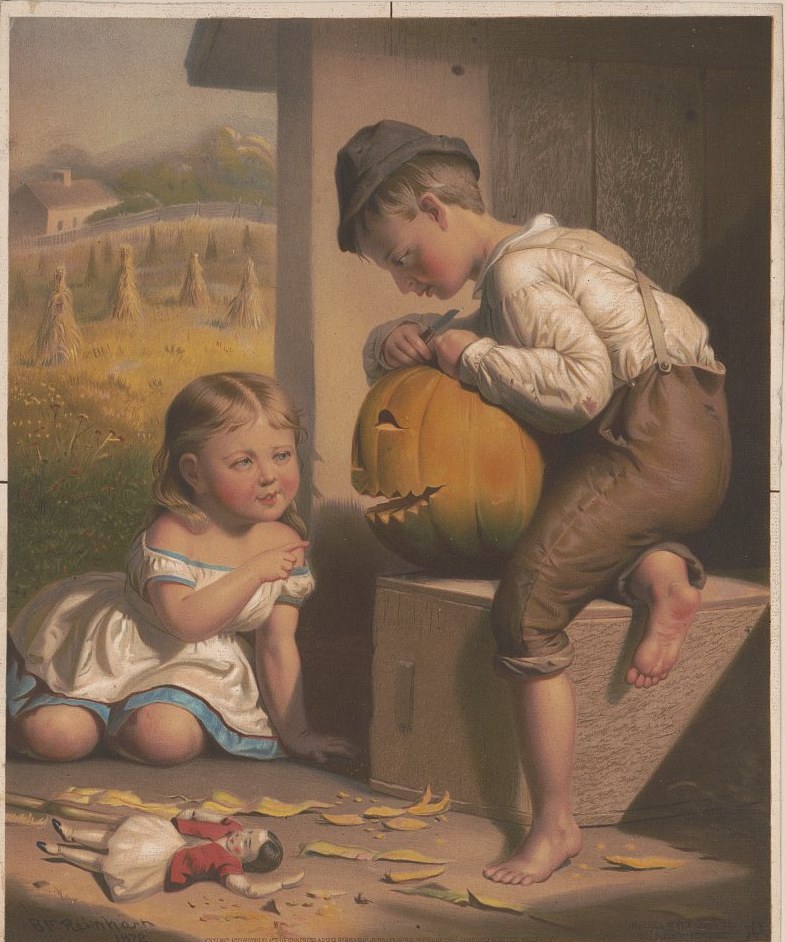
Chromolithograph, c. 1872, Library of Congress Prints & Photographs Division, no known restrictions
A reader wrote in last week to ask a fair question: if the jack-o'-lantern is Irish, as everyone keeps saying, why have none of her Irish relatives ever carved a pumpkin? The short answer is that her relatives are right and the internet is half right. The lantern is Irish, and Scottish, and probably older than either name. The pumpkin is American. The two met in the nineteenth century, and the pumpkin won because it is enormous and soft.
Jack was a watchman before he was a sinner
The phrase "jack-o'-lantern" turns up in England in the seventeenth century, and it did not mean a vegetable. It meant a man. "Jack of the lantern" was a night watchman, in the same way that "Jack" stood in for any working man (jack-tar, steeplejack). From the watchman it slid over to the light itself, and then to a light with nobody carrying it: the pale flame that drifts over bogs at night, which country people also called will-o'-the-wisp, and which scientists put down to marsh gas, though I have never seen two of them agree on how it ignites.
That is the sense Nathaniel Hawthorne is using in the 1830s when a character warns that a glowing jewel hidden under a cloak would make its owner "look like a jack-o'-lantern".
Stingy Jack and the turnip
In Ireland the marsh light had its own story, and this is the one that stuck. A blacksmith called Jack, mean and fond of drink, tricks the Devil (up an apple tree, or into a coin in his pocket next to a cross, depending who is telling it) and makes him promise never to take his soul. When Jack dies, heaven will not have him and hell cannot. The Devil tosses him a burning coal. Jack puts it in a hollowed turnip to light his way and has been walking ever since.
I should say that nobody has traced the printed version of this tale back before the nineteenth century, and I doubt a medieval one exists. The custom it explains is older than the explanation. In Ireland and the Scottish Highlands people hollowed turnips, swedes and mangelwurzels at Samhain, the end-of-harvest festival the church had overlaid with All Hallows' Eve, cut faces in them and set a candle inside. Some were carried by children going door to door; some were set in windows to keep away whatever the night held. A turnip is small and dense and you cannot carve much, so what comes out is a shrunken, grimacing head, and the candlelight through the thin flesh looks like skin.
The National Museum of Ireland holds the best-known survivor, and it is not even a turnip. It is a plaster cast, painted by the museum artist Eileen Barnes, of a lantern of the type made around 1900 near Fintown in County Donegal. A schoolteacher working in the area, Rois Ní Braonáin, gave the museum an original in 1943, and a real turnip does not keep. The cast is on display at the museum's Country Life branch in Turlough Park, County Mayo, and it is horrible. Even in the museum's own photograph it looks like something found in a bog rather than made in a kitchen.
The vegetable changes in America
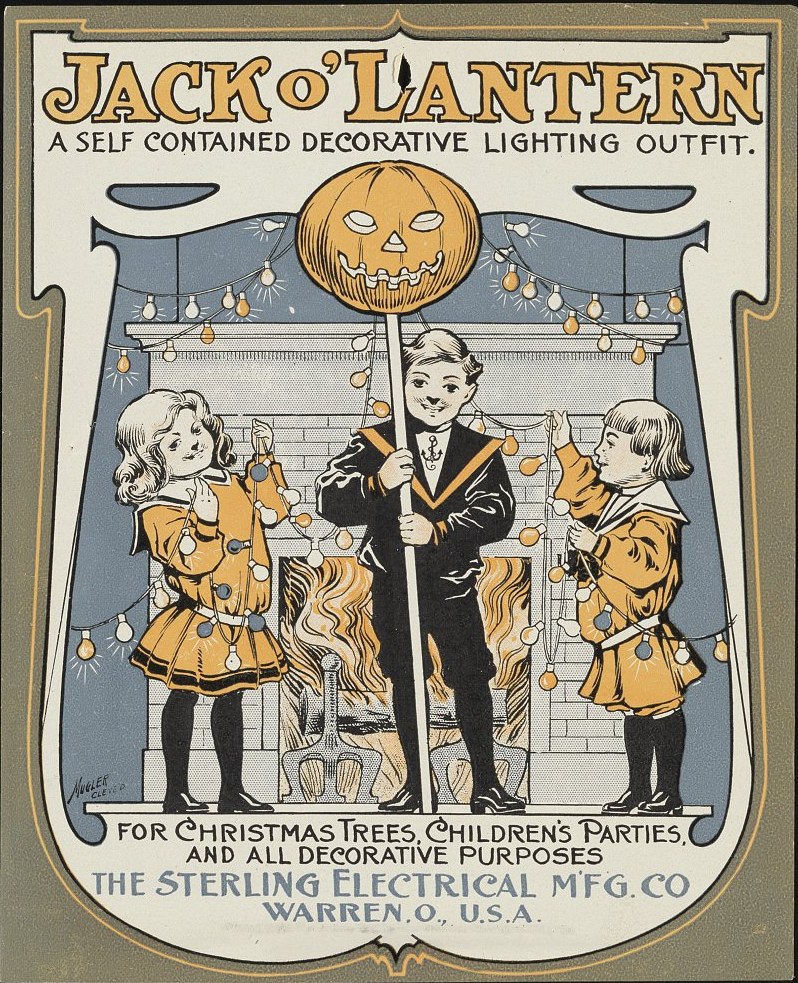
Poster, 1906, for the Sterling Electrical Manufacturing Company's "Jack o' Lantern" lighting outfit, Library of Congress Prints & Photographs Division, no known restrictions
What moved the lantern across the Atlantic was people. Roughly two million left Ireland between 1845 and 1855, most of them for North America, and they brought Halloween with them, lanterns and mischief included.
America had no turnip lanterns, but it had a vegetable native to the continent, grown everywhere in the north-east, ripe in late October, and so much larger and softer than a turnip that a child could hollow one with a spoon. American writers were already using hollowed pumpkins as grotesque heads by the 1850s, and by the 1860s newspapers on both sides of the Canadian border were describing pumpkins carved with faces and lit with candles as part of the night. Our cover image is a chromolithograph of about 1872: a boy with a knife, a pumpkin on his knee, a small sister watching. By then the thing was ordinary enough to be sentimental about.
By 1906 an Ohio firm, the Sterling Electrical Manufacturing Company of Warren, was selling a string of electric lights called the "Jack o' Lantern", a "self-contained decorative lighting outfit" for Christmas trees and children's parties, with a grinning pumpkin on the poster. The watchman's lamp had become a wall socket.
Where the pumpkins come from now
The crop that feeds all this is a real one, and the United States Department of Agriculture counts it. American farmers harvested about 1.47 billion pounds of pumpkins from roughly 68,100 acres in 2025, worth about 259 million dollars at the farm gate. Illinois grew about 533 million pounds of that, more than a third of the total, on 14,800 acres. But most of the Illinois crop never meets a knife: about 70 per cent of its acreage goes to processing plants, for the tinned pie filling we have written about before. Across the rest of the country roughly 85 per cent of the acreage is for the fresh and ornamental trade, which is a government way of saying porch decorations.
So the jack-o'-lantern on the step tomorrow night is an Irish idea, an English name and an American vegetable. The turnip version has been coming back in Ireland and Scotland among people who want the old thing rather than the orange one. Having stared at the Mayo cast for longer than I meant to, I understand the appeal, and I also understand why their grandparents were pleased to switch.
Enjoyed this story?Get a new one every day on social.