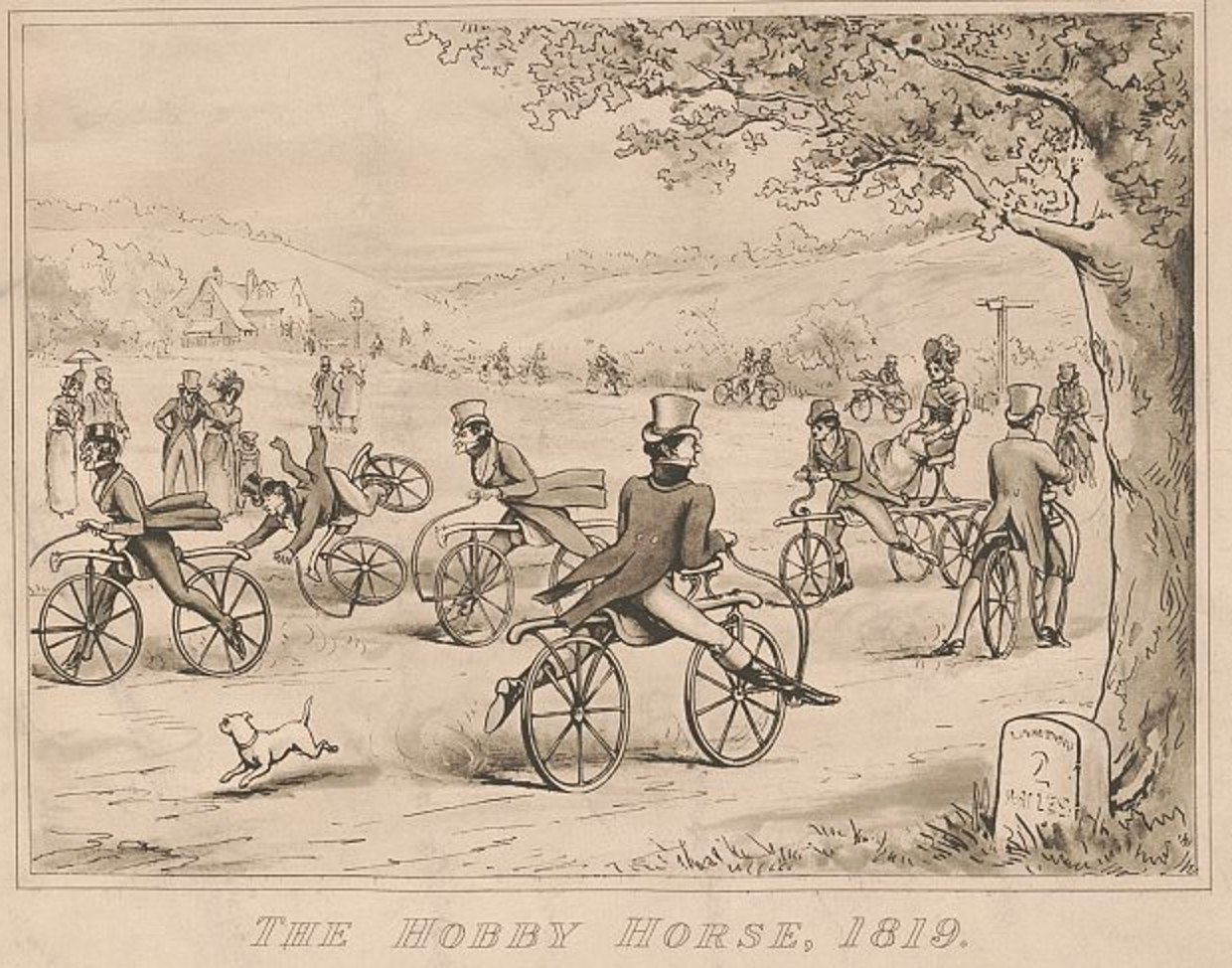
Print: The Hobby Horse, 1819, reissued by the Leadenhall Press, 1894. Library of Congress Prints and Photographs Division, no known restrictions
Everyone who writes about 1816 calls it the year without a summer, and that is not quite right. There was a summer; it just kept being interrupted. Snow fell across New England on 6 June and killed the young corn. In Europe it rained, week after week, through June and July and August; the harvest rotted in the fields from Ireland to Switzerland and the price of bread doubled. Nobody alive had any idea why, and the people who thought they did blamed sunspots, lightning rods, or God.
Snow in June, frost in August
The New England farmers' diaries are the best record of it. On 7 and 8 June men worked their fields in overcoats and mittens, and sheep that had just been shorn froze. A warm spell brought the corn back, and then the frosts of 9 July and 21 August took most of what was left. The price of oats, by one figure that every account repeats and which I have never been able to trace to a source, went from twelve cents a bushel to ninety-two. People called it "eighteen hundred and froze to death," and thousands of them gave up on Vermont the next spring and went west to Ohio.
In Europe it was worse, because Europe had just finished twenty years of war and had no reserves. Switzerland had an outright famine, and Ireland's failed potato harvest brought a typhus epidemic that ran for three years.
A party in a wet villa
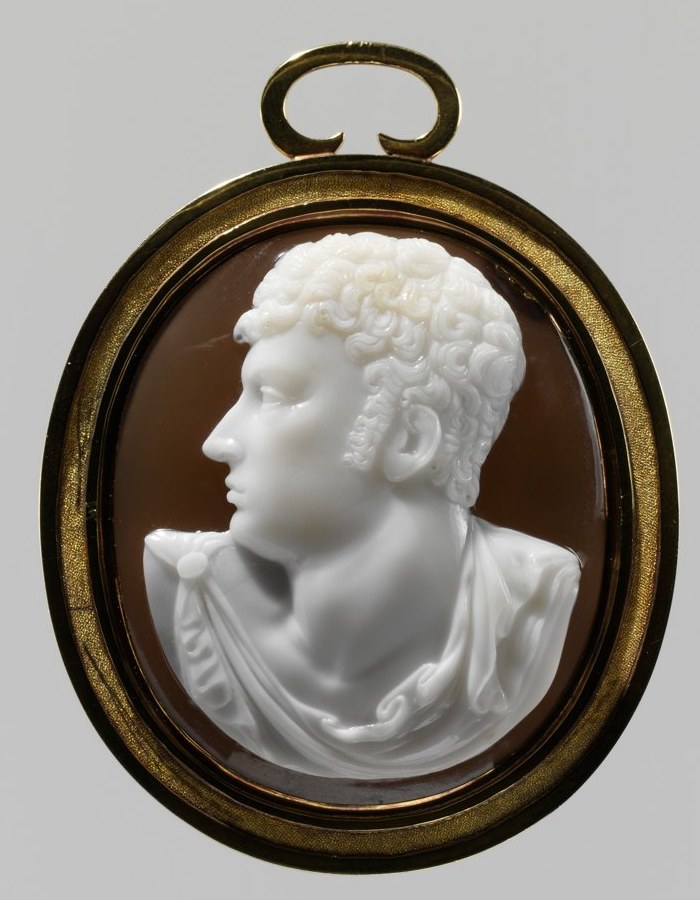
Shell cameo portrait of Lord Byron in profile, made around 1820. The Metropolitan Museum of Art, CC0
In the middle of this, in June 1816, Lord Byron rented a house called the Villa Diodati above Lake Geneva, having left England in a hurry over his marriage. Down the hill were Percy Shelley, the eighteen-year-old Mary Godwin, who had run off with him two years earlier and was not yet his wife, and Mary's stepsister Claire Clairmont, who was pregnant by Byron and was the reason they were all there. Byron had brought his doctor, John Polidori, aged twenty.
It rained so much that they could not go out on the lake, so they sat by the fire reading German ghost stories in French translation, and one evening, usually dated to 16 June, Byron said they should each write one. Byron produced a fragment and gave up. Polidori wrote the first vampire story in English, The Vampyre, published three years later under Byron's name by mistake. Mary, who said later that she lay awake for nights unable to think of anything, eventually had a waking dream of a pale student kneeling beside the thing he had put together. She wrote it as a short story, Percy told her to make it longer, and Frankenstein came out anonymously in London on 1 January 1818, in an edition of 500 copies. She was twenty.
The horses starved, so a baron built a machine
Karl Drais was a forester and inventor in Mannheim, in Baden, with a baron's title and no money. On 12 June 1817 he climbed on to a wooden frame with two wheels in line, a padded seat and a steering bar, pushed off with his feet, and ran it the seven kilometres or so to the relay house on the Schwetzingen road and back in about an hour. He called it a Laufmaschine, a running machine; the English called it a hobby-horse, and within two years young men were falling off them in London and Paris.
Why he built it is the contested part. The bicycle historian Hans-Erhard Lessing has argued that Drais was answering the crisis of 1816 and 1817, when oats were so dear that horses were being slaughtered across Baden and anybody who needed to get somewhere faster than walking needed a horse that did not eat. Drais never said so in as many words, and other historians think he was simply an inventor with a lot of ideas. I find the oat argument persuasive without being able to prove it. Either way, every bicycle since has had two wheels in line because of the thing he rode that morning.
Finding the volcano
What had actually happened was on the other side of the world. On 5 April 1815 Mount Tambora, on the island of Sumbawa in what is now Indonesia, began to erupt, and on the evening of 10 April it blew most of its upper third into the sky. The mountain lost something like 1,400 metres of height. Perhaps 10,000 people died in the eruption itself and tens of thousands more on Sumbawa and the neighbouring islands in the famine that followed, the deadliest eruption in recorded history. The sulphur it threw into the stratosphere spread around the planet over the following year and took the world's average temperature down by something like half a degree. Half a degree sounds like nothing, and it was enough.
Nobody connected the two for a century. The American meteorologist William Humphreys made the link in the 1920s, and it was not laid out properly until the oceanographer Henry Stommel and his wife Elizabeth published Volcano Weather in 1983. Mary Shelley died in 1851 without knowing why it had rained.
Her monster is doing fine. Guillermo del Toro's Frankenstein, with Oscar Isaac as Victor and Jacob Elordi as the creature, came out last autumn and in March took three Academy Awards, for production design, costume design and make-up. In her introduction to the 1831 edition, Shelley looked back at the wet summer, the ghost stories and the dream, and sent the book out again with a line that has done the job for nearly two centuries: "I bid my hideous progeny go forth and prosper."
Enjoyed this story?Get a new one every day on social.