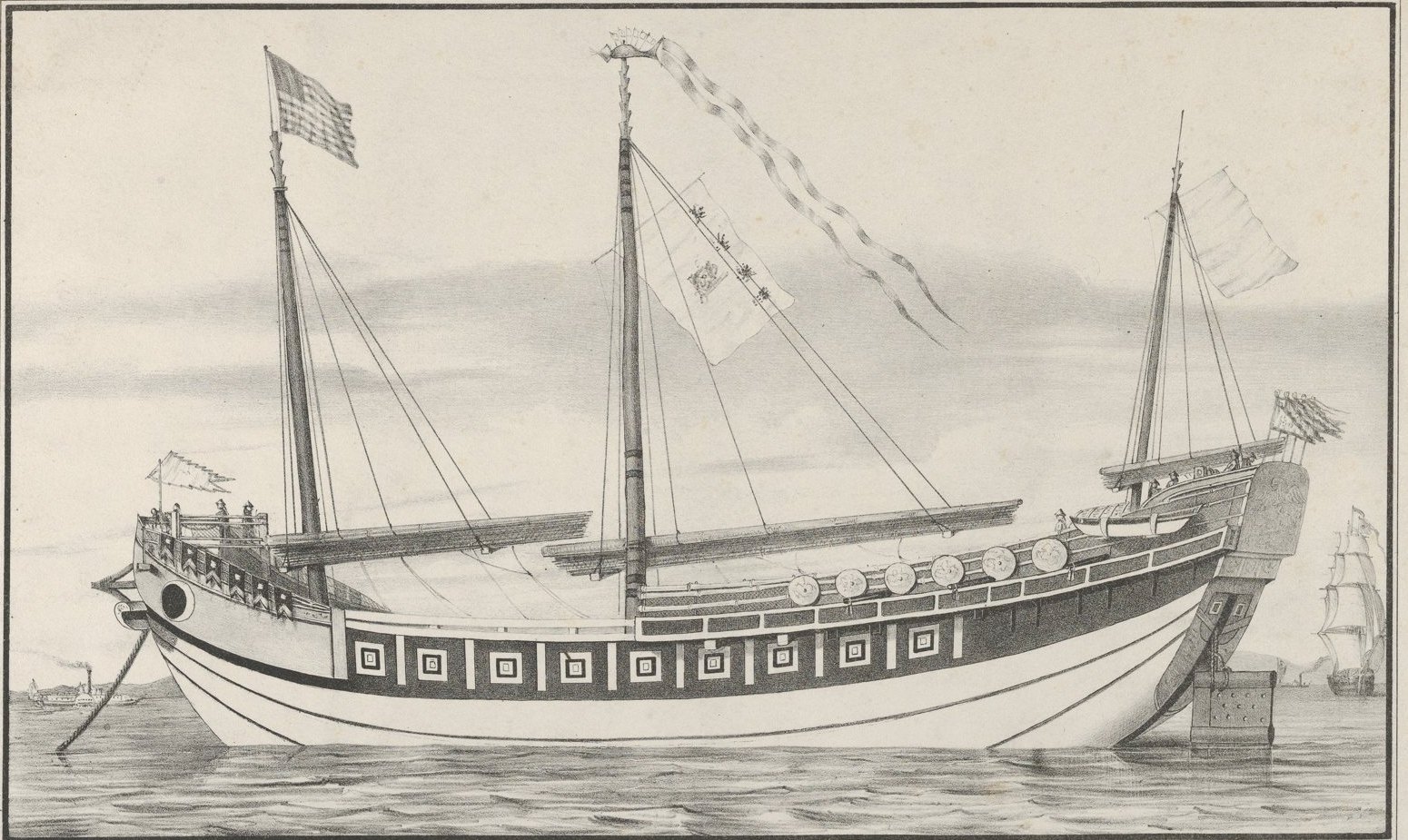
Lithograph: Nathaniel Currier, The Chinese Junk Keying, 1847, The Metropolitan Museum of Art, CC0
Seventeen thousand three hundred and eighteen pirates, 226 ships, 1,315 cannon and 2,798 assorted swords and muskets. That is the inventory the governor-general of Guangdong recorded in April 1810 when the largest pirate organisation the world has ever seen gave itself up, and the person who handed it over was a woman of about 35 who had started out, by the usual accounts, on a floating brothel in the Pearl River delta.
She is known in the West as Ching Shih, which is not a name at all. In Cantonese it means roughly "Zheng's widow." Chinese sources call her Zheng Yi Sao, wife of Zheng Yi, and her own name was probably Shi Yang. Almost nothing about her early life is certain, and I would treat the brothel story with some caution, since I have never seen a contemporary source that actually says it. What is well documented is what she did between 1807 and 1810, because the Qing navy, the Portuguese at Macau and the East India Company all kept records of losing to her.
A business arrangement in 1801
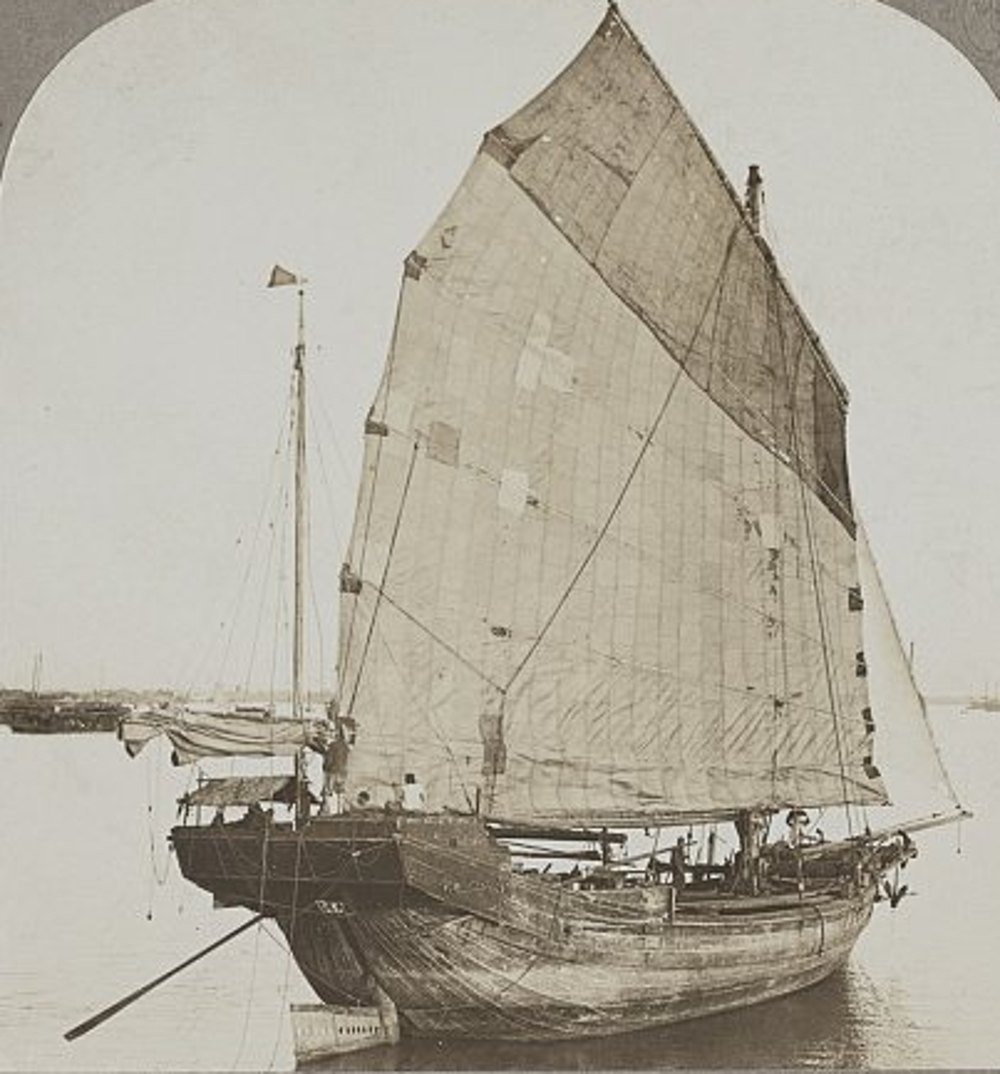
A Chinese junk under sail on the Canton River, photographed in 1902, from a stereograph. Library of Congress Prints & Photographs Division, no known restrictions
Zheng Yi was a pirate captain from a family of pirates who had spent the 1790s fighting as a mercenary in the Vietnamese civil wars. When that work dried up he brought his ships back to the Guangdong coast, and in 1801 he married Shi Yang. In 1805 he did something unusual for a pirate: he got the rival gangs along the coast to sign a written agreement. Six fleets, each flying a different colour, agreed to divide the sea lanes, share intelligence and stop raiding each other. Zheng Yi's Red Flag Fleet was the largest. Contemporary estimates of the whole confederation run from 400 to more than a thousand junks and from 40,000 to 70,000 men, and the plain answer is that nobody counted; even the low figures make it bigger than any pirate force in the Caribbean by a wide margin.
The confederation ran what amounted to a protection business. Salt junks, fishing boats and coastal villages paid an annual fee for a certificate of safe passage. Those that did not pay were burned.
The gale of November 1807
On 16 November 1807 Zheng Yi went overboard in a storm off the Vietnamese coast and drowned. He was 42. Pirate fleets in this situation generally broke up into their component gangs, and most people expected that to happen.
Instead his widow took the leadership, with the support of her husband's nephew and of a young man named Zhang Bao, whom Zheng Yi had kidnapped from a fishing boat at fifteen, adopted and raised as his heir. Zhang Bao commanded the Red Flag Fleet at sea; Zheng Yi Sao ran the confederation. Within a year or so the two were also lovers, which the Qing officials who wrote about them found more scandalous than the piracy.
The fleet had a written code. Anyone who went ashore without permission had his ears cut off and was paraded around the fleet; a second offence meant death. All plunder was registered with a purser, with the crew keeping two parts in ten and the rest going to a common fund. Captured women were registered too, and a pirate who raped one was executed. The code is usually credited to her. The Chinese chronicler who wrote it down, Yuan Yonglun, credits it to Zhang Bao, and the attribution to the widow seems to have come from a careless English translation in the 1830s and a popular history of 1932, which is also where Jorge Luis Borges found it. Whoever wrote it, it was enforced, and it is part of why the fleet held together.
Two admirals, one year
In September 1808 Zhang Bao ambushed the Qing provincial fleet under Admiral Lin Guoliang near Mazhou Island and destroyed it; Lin was killed. The following March, off Dawanshan, Zheng Yi Sao herself took command of the Red and White Flag fleets and routed the new provincial commander, Sun Quanmou. In the late summer of 1809 the pirates sailed up the Pearl River and raided the rich districts of Dongguan, Shunde and Xinhui more or less at will, which is the point at which the government in Canton stopped pretending it could handle them alone.
It asked the Portuguese at Macau for help, and in November 1809 signed an agreement under which Portugal supplied six warships. The Portuguese, who had their own grievances (the pirates had taken a brig belonging to the governor of Timor), blockaded the Red Flag Fleet in a shallow bay near Macau in January 1810. Zhang Bao wrote to them offering two provinces of China in exchange for four ships. They declined. On 29 January the pirates broke out anyway.
Seventeen women and children walk into the yamen
The confederation was still winning at sea. What finished it was politics. In January 1810 Guo Podai, leader of the Black Flag Fleet and an old rival of Zhang Bao, accepted a pardon from the governor-general, Bai Ling, and took his ships over to the government side. The Red Flag Fleet now had the Qing, the Portuguese and a former colleague against it, and Zheng Yi Sao seems to have concluded that the business had peaked.
Her first attempt to negotiate, on Zhang Bao's flagship on 21 February with a Portuguese magistrate from Macau mediating, broke down because Bai Ling would not let the pirates keep 80 ships and 5,000 men as a private navy. So on 17 April she went to Canton herself, unarmed, with a delegation of seventeen women and children, and walked into the governor-general's yamen to talk directly. Three days later the surrender was signed at Furongsha.
The terms were generous to her side. Zhang Bao was made a lieutenant in the Qing navy and allowed to keep twenty or thirty ships. The crews were pardoned, with the exception of 126 men who were executed and some 200 who were banished. Zheng Yi Sao was given permission to marry Zhang Bao officially, which she did, and she got land in Canton. She had surrendered 24 ships and 1,433 men personally and kept whatever she had made from the rest.
The gambling house
Zhang Bao rose to colonel, was posted to Fujian, and died at sea near Penghu in 1822 at the age of 39. His widow, now widowed twice, went back to Guangdong with their son and opened a gambling house. In 1840 she sued a government official for 28,000 taels of silver she said he had embezzled from her late husband; the case went all the way to Lin Zexu, the viceroy who was busy that year starting the Opium War, and he had it thrown out. She died in 1844, aged 68 or 69, still running the gambling house.
Enjoyed this story?Get a new one every day on social.