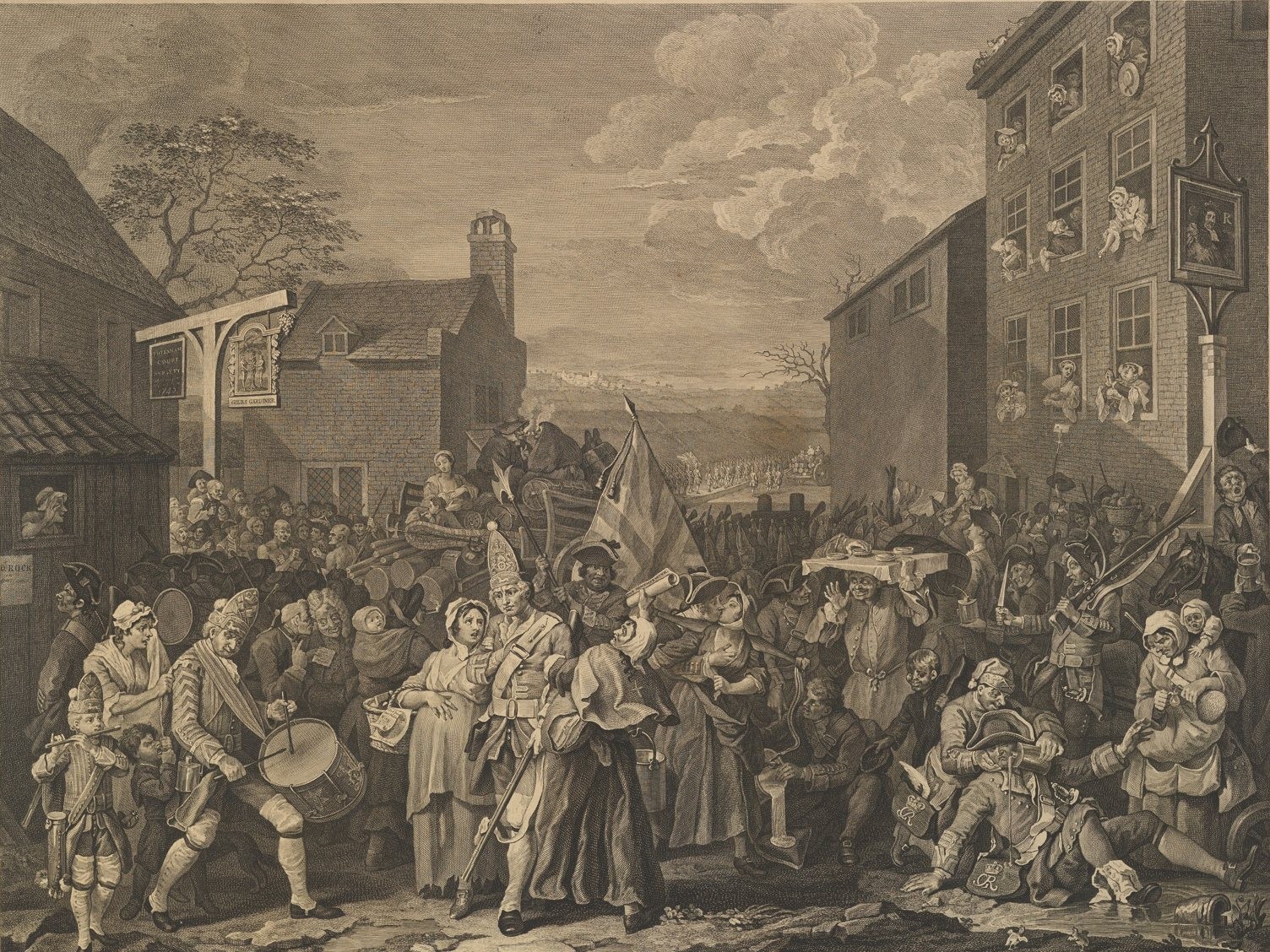
Luke Sullivan after William Hogarth, The March to Finchley (1750), The Metropolitan Museum of Art, CC0
The English sixpence of 1746 is a small silver coin with a word under the king's neck that seems to have no business there. The word is LIMA. The Mint put it on coins struck from late 1745 out of treasure taken at sea from Spain and France, some of it by George Anson and some by a pair of British privateers, and the idea was that everybody who handled the money should know about the victory. Coin specialists now think the name was probably a mistake and that plenty of the silver came from Potosí, which is the sort of detail that gets lost when a coin is doing propaganda.
I keep one eye on the sixpence this week because of what it was doing in London at that same moment, which was defending the Bank of England against its own customers.
The reason it comes to mind is Binance. Thieves took $6.3 billion from the exchange at the end of October, the largest crypto theft on record. The FBI blames the North Korean group it calls TraderTraitor, and Kim Yo Jong has called that "a trite provocation." When transactions resumed on Sunday, customers took out $7.4 billion and put back $2.7 billion. Anyone who has read about a bank run will recognise the queue. In 1745 the bank could still do something about how fast it moved.
Paper money and a rebel prince
Most Londoners in 1745 had probably never held a banknote. The lowest the Bank issued was £20, a serious sum, so the people with notes in their pockets were merchants and the comfortably off. A note was a promise to hand over coin on demand at the counter in Threadneedle Street, where the Bank had moved in 1734, and that promise worked as long as nobody tested it all at once.
Charles Edward Stuart landed in the Hebrides in July. By mid-September his army was close to Edinburgh, and the Scottish banks did the sensible thing: they carried their gold, silver and papers up to the castle and stopped paying. He entered the city on the 17th, and four days later he destroyed a government army at Prestonpans. London began to look at its notes.
Eleven hundred signatures by four o'clock
The first help came from the customers. Merchants met at Garraway's coffee-house in Exchange Alley that September (B. B. Turner's 1897 chronicle of the Bank gives the 20th, and I would not swear to it) and agreed a declaration that they "will not refuse to receive bank-notes in payment of any sum of money to be paid to us," and would make their own payments in notes as well. Turner says more than eleven hundred traders and fund-holders had signed by four that afternoon. John Noorthouck's history of London, published in 1773, adds that the merchants also resolved to raise two regiments at their own expense, which is a good deal more than most depositors offer.
That held through the autumn. Then the Jacobites came south, and on 4 December they reached Derby, about 120 miles from the City.
Black Friday and the slow cashiers
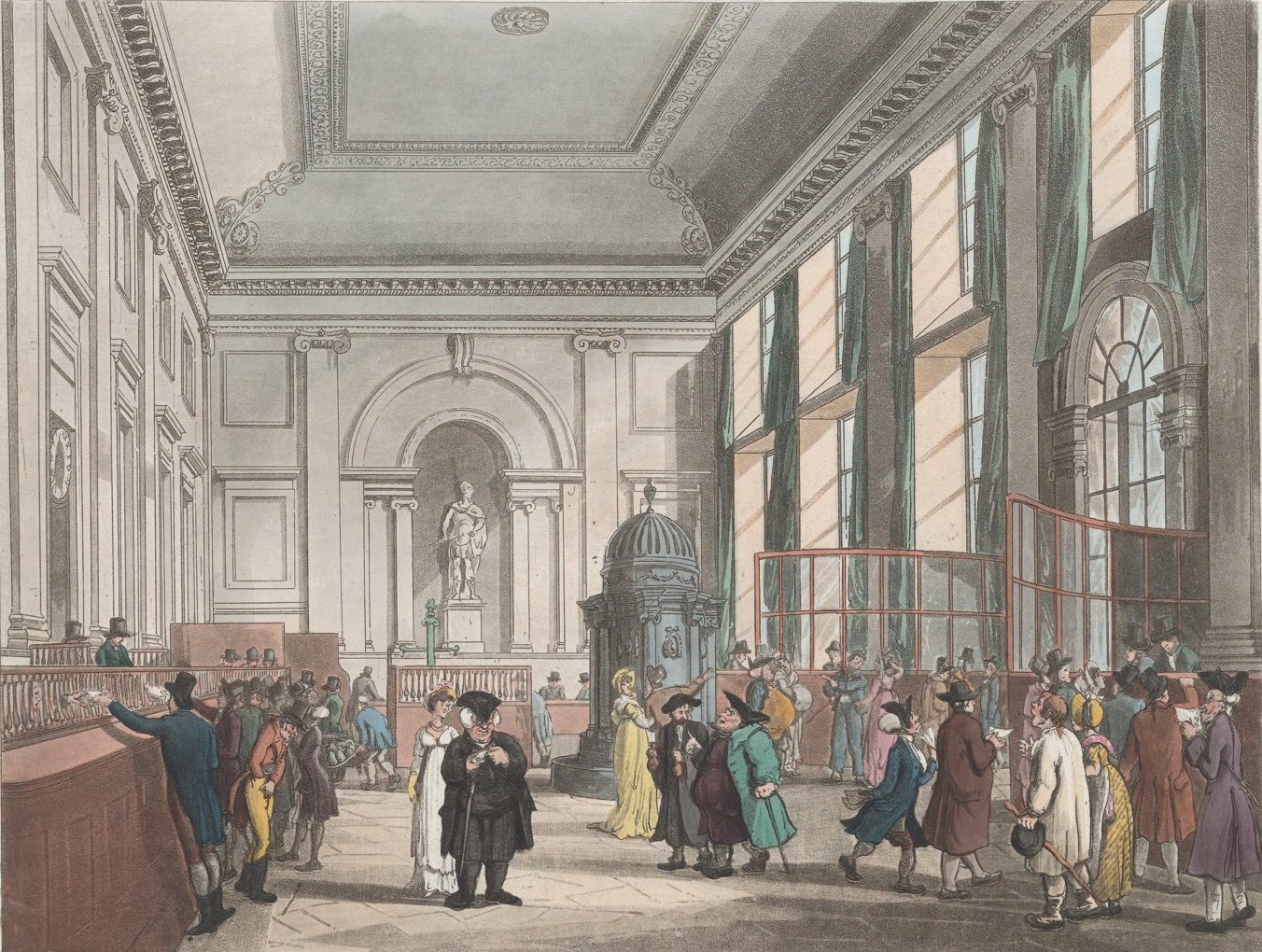
The Great Hall of the Bank of England as Rowlandson and Pugin drew it in 1808. Thomas Rowlandson, The Great Hall, Bank of England (1808), The Metropolitan Museum of Art, CC0
The news reached London on Friday 6 December, remembered afterwards as Black Friday. Shops shut and some people left town. George II, according to the story that went round, had his valuables put aboard a yacht at the Tower. People holding notes made for Threadneedle Street to turn them into coin while they still could.
The Bank paid them, as it was bound to, but it paid in sixpences (one Victorian account says shillings and sixpences). A £20 note is 800 sixpences, and a clerk in no hurry has to count every one across the counter. Economic historians accept this much. Hugh Rockoff, citing the standard histories by Andréadès and Clapham, says plainly that the Bank "paid in six pences to slow withdrawals."
The Victorians added a flourish. Thornbury's Old and New London and Turner both say that the front of the queue was the Bank's own people, who presented notes, carried their sixpences out of one door and came round by another to pay them straight back in, so that real customers never reached the counter. I would love this to be true. I have not seen it traced to a document from 1745, though, so I file it with the stories the Bank's admirers enjoyed telling.
One modern economist lists 1745 among the Bank's suspensions of payment, while Turner says it avoided one by "artifice." Both seem fair to me, since a bank paying out in sixpences has more or less stopped without having to say so.
The retreat London did not know about
The danger had in fact already passed. On 5 December, the day before the panic, Charles's commanders met at Exeter House in Derby and voted to go home. By 20 December the army was back across the border. The Guards who had been sent to Finchley to defend the capital never had to fight there, and Hogarth later painted their march as a drunken shambles. The broker Sampson Gideon, who spent the crisis buying government stock while everyone else was selling, is said to have roughly doubled his fortune.
The same queue with no counter
Binance has no cashiers. It did stop transactions for a time, the nearest thing it had to a sack of sixpences, but once it reopened the money moved at the speed of the network and nobody had to walk through a door. Its defence was arithmetic: a promise to cover losses from company funds, about $3 billion of the stolen assets frozen, and a net outflow it put at around 3 percent of $157 billion in assets. Its spokesperson said withdrawal levels were "stabilizing to what we would consider normal and expected on-chain activity."
I have read that sentence several times now. The men at Garraway's, who stood to lose rather more if they were wrong, did it in nineteen words: "we will not refuse to receive bank-notes in payment of any sum of money to be paid to us."
Enjoyed this story?Get a new one every day on social.