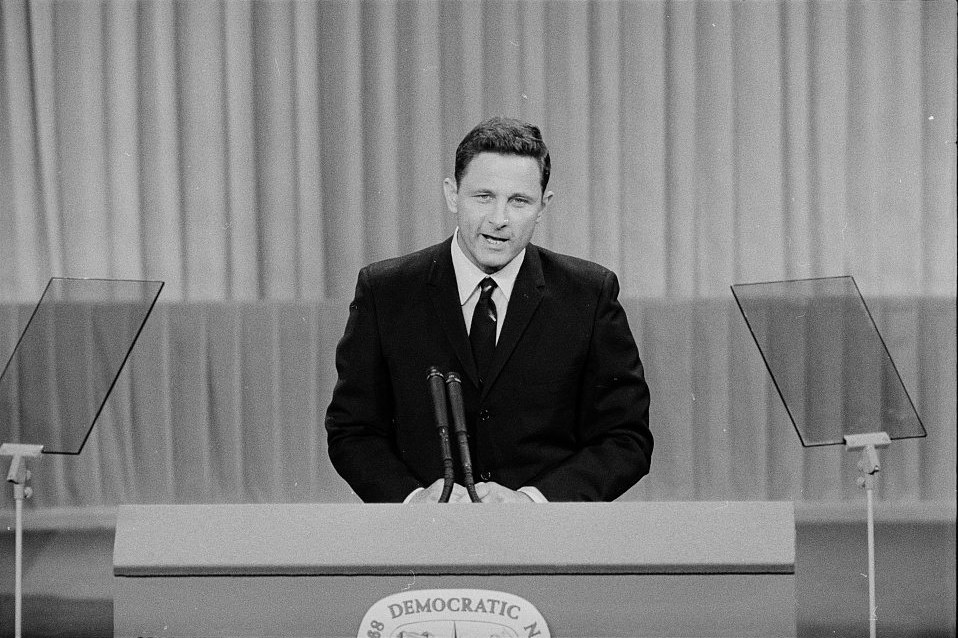
Senator Birch Bayh at the Democratic National Convention, Chicago, 26 August 1968, Warren K. Leffler, Library of Congress Prints & Photographs Division, no known restrictions
The vote was 338 to 70. On 18 September 1969 the House of Representatives passed a constitutional amendment that would have abolished the Electoral College and elected the president by direct national vote. Richard Nixon urged the Senate to follow. Gallup had found about 80 percent of Americans in favor. It never became law.
The idea is back this week by another road. Democrats won full control of state government in Michigan, Nevada, Pennsylvania and Wisconsin on Tuesday, and all four are prospects for the National Popular Vote Interstate Compact, which already has 18 states and Washington, D.C., worth 222 electoral votes. It switches on at 270. Those four states carry 50 between them.
The election that scared everybody
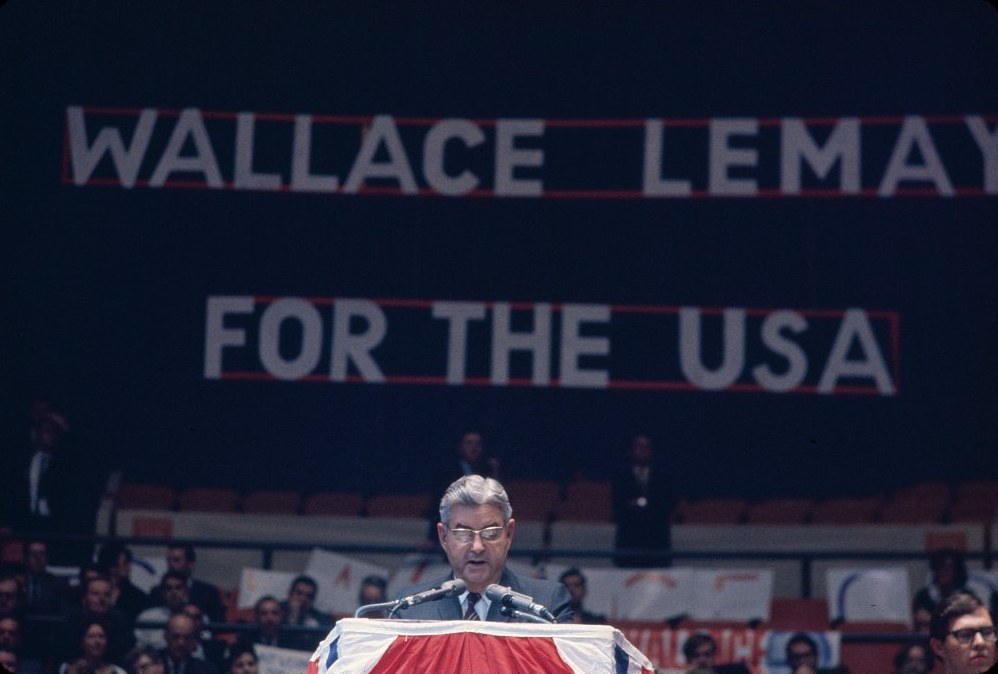
Colour photograph of a speaker at a lectern draped in red, white and blue at a 1968 rally in Madison Square Garden, beneath a large banner reading Wallace LeMay for the USA
The push in 1969 came out of the year before. In 1968 George Wallace ran as a third-party segregationist and carried five Southern states. His strategy, which he did not hide, was to win enough electoral votes to deny Nixon and Hubert Humphrey a majority. Then either the electors would have to bargain with him, or the election would go to the House, where each state delegation casts a single vote.
It did not come to that. Nixon won 301 electoral votes. But the popular margin between him and Humphrey was well under one percentage point, and a modest shift in a couple of states would have left nobody with a majority. Members of both parties spent the winter thinking about how close that had been.
A Wallace and LeMay campaign rally at Madison Square Garden, New York, 1968, Bernard Gotfryd, Library of Congress Prints & Photographs Division, no known restrictions
Bayh and Celler
The amendment had two sponsors. Emanuel Celler of Brooklyn, who chaired the House Judiciary Committee, had been in Congress since 1923 and was not easily impressed by anything. Birch Bayh, a young Democratic senator from Indiana, chaired the Senate subcommittee on constitutional amendments and had already steered one amendment, the 25th, on presidential succession, all the way to ratification.
Their plan was simple to describe. Every vote for president would count the same, wherever it was cast. A candidate who won at least 40 percent of the national vote would win outright. If nobody did, the top two would meet in a runoff. The American Bar Association backed it, and so did the Chamber of Commerce and the AFL-CIO, which may be the only thing those three organizations agreed on that year.
The House passed it with large majorities from both parties. Nixon, who had earlier leaned towards a different reform, came round and asked the Senate to act, warning that otherwise the chance would be lost.
Strom Thurmond's filibuster
The Senate was another place. A constitutional amendment needs two-thirds of both houses, and in 1970 ending a filibuster also needed two-thirds of the senators voting. Southern senators, led by Strom Thurmond of South Carolina, had no intention of letting the amendment reach a final vote, and senators from some small states were glad to let them talk.
The opponents' arguments were not all about the South. Some warned that a national vote would encourage splinter parties and endless recounts. Thurmond also went looking for allies among Black and Jewish leaders in the big cities, telling them that the Electoral College gave their voters extra weight in swing states. Some of them agreed.
On 17 September 1970 the Senate voted 54 to 36 to end debate, a clear majority and well short of two-thirds. On 29 September a second attempt failed 53 to 34. In October the leadership set the amendment aside. Bayh brought it back in 1979, and this time it got a simple up-or-down vote: 51 to 48 in favor, nowhere near two-thirds. He blamed lobbying by the National Urban League and the American Jewish Congress, groups he said "mistakenly believe they have an advantage under the Electoral College."
The workaround
The compact now being discussed is a way around the problem Bayh could not solve. It needs no amendment. Each member state agrees to give its electoral votes to whoever wins the national popular vote, but only once states holding a majority of the Electoral College have signed up. If Michigan, Nevada, Pennsylvania and Wisconsin all joined, the compact would clear 270.
That is a big if. Nevada's governor vetoed a bill to join in 2019, arguing it would reduce the influence of small states. Lawyers have argued for years over whether the compact needs the consent of Congress, and a court fight is widely expected. And a Wisconsin legislator interviewed this week said, fairly, that it was not what he had heard about on the doors.
I think the 1970 votes are worth remembering for one reason: the last time Americans tried to change how they pick a president, a clear majority of the Senate wanted it, and that was not enough.
Enjoyed this story?Get a new one every day on social.