The usual history of the preemptive pardon starts with Gerald Ford forgiving Richard Nixon in 1974 and jumps to Joe Biden signing them for Anthony Fauci, Mark Milley and the January 6 committee on his last day in office. That history is about a century short. The ground under all of those pardons was laid in January 1867, by a Supreme Court that split 5 to 4 over an Arkansas lawyer who wanted his old job back.
His name was Augustus Hill Garland, and he is worth knowing about this week. In an interview published on Monday on Miranda Devine's Pod Force One podcast, Donald Trump was asked what he would do if Democrats went after Elon Musk and his aides. "I would if I needed to, sure," he said of pardoning them, and he added: "That's what Biden did. He gave everybody a pardon." On Tuesday the Democrats won the House and the Senate. Musk has not been charged with anything and no pardon process has been announced, but there is little legal doubt that a president could do it, and the reason is Garland.
The lawyer in the wrong Congress
Garland was 28 when he was admitted to the bar of the Supreme Court in the December term of 1860. He was not a natural rebel. He backed John Bell, the compromise candidate, that autumn, and he went to Arkansas's secession convention opposed to leaving. Lincoln's call for troops changed his mind, reluctantly by his biographers' account, and from May 1861 he sat in the Confederate Congress, first in the lower house and at the very end in the Senate, filling the seat of a member who had died.
He never carried a rifle, which would turn out not to matter. On 24 January 1865 Congress in Washington passed a law barring anyone from practising in the federal courts unless he first swore the oath of 1862, the one Northerners called ironclad. The swearer had to state that he had never voluntarily borne arms against the United States, and also that he had not sought or accepted "any office whatever" under a hostile authority. A man who had spent four years in the Confederate legislature could not say those words truthfully.
The queue at the White House
Then Lincoln was shot, and Andrew Johnson inherited the question of what to do with the South. His proclamation of 29 May 1865 offered amnesty to most former rebels but carved out fourteen classes of people, among them Confederate officials and anyone with taxable property worth more than $20,000. Those people had to apply to the president individually. They did, in very large numbers. By 5 June 1866 Johnson had issued 12,652 pardons.
Garland's came in July 1865: a "full pardon and amnesty for all offences by him committed, arising from participation, direct or implied, in the said Rebellion." The odd part is what was missing. I have found no record that any court had ever indicted him, so as far as I can tell he was being forgiven for something nobody had formally accused him of. He took the paper to the Supreme Court and asked to be let back in without swearing the oath.
Five to four
The answer came on 14 January 1867. Justice Stephen Field, a Lincoln appointee, wrote for the majority, and he did not write narrowly. The pardon power, he said, "is unlimited, with the exception stated," the exception being impeachment. Then came the sentence everybody has relied on since: "It extends to every offence known to the law, and may be exercised at any time after its commission, either before legal proceedings are taken, or during their pendency, or after conviction and judgment."
Congress could not touch this, Field added: "This power of the President is not subject to legislative control." And a full pardon "blots out of existence the guilt, so that in the eye of the law the offender is as innocent as if he had never committed the offence."
Justice Samuel Miller dissented for himself, Chief Justice Salmon Chase and Justices Swayne and Davis. He was willing to concede that a pardon lifted punishment, "but it relieves him from nothing more." An oath for lawyers, he argued, was a qualification for a job, and no president could waive that. It was a good argument and it lost by one vote.
What later presidents took from it
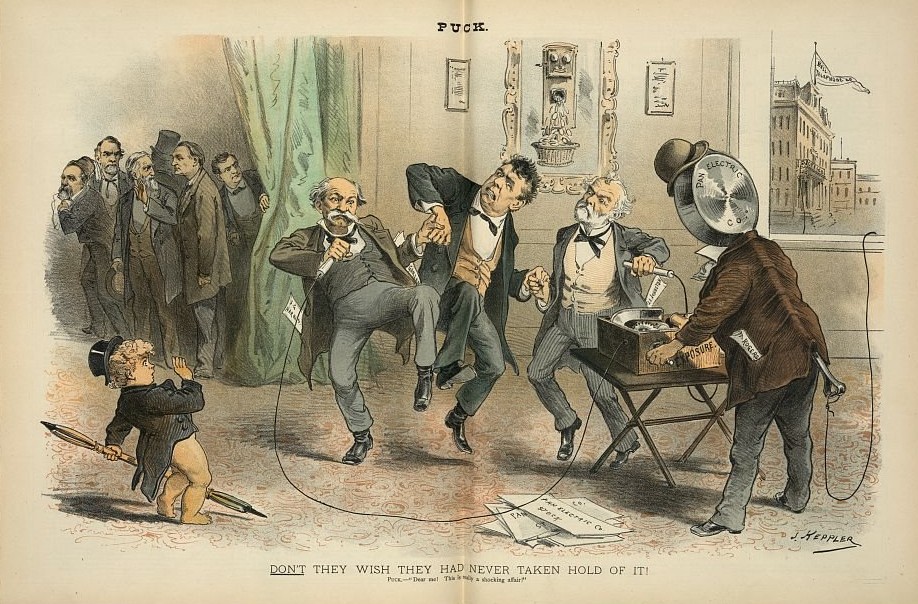
Joseph Keppler's Puck cartoon of February 1886, with politicians jolted by a telephone, ran during the row over telephone stock that dogged Garland's time as attorney general. Joseph Keppler, Library of Congress, no known restrictions
Parts of Field's language have not survived. The Constitution Annotated now treats "blots out of existence the guilt" as too broad, after later decisions, and in Burdick v. United States in 1915 the Court said a pardon carries an imputation of guilt and accepting it a confession of it. That is why Biden's January 2025 statement went out of its way to say acceptance should not "be misconstrued as an admission of guilt for any offense."
The timing sentence has held. When Ford pardoned Nixon on 8 September 1974, covering everything Nixon "has committed or may have committed" in office, no charge had been filed. Biden's pardons rested on the same footing, and so would any for Musk.
Garland himself did well out of forgiveness. Arkansas sent him to the US Senate in 1867, and he was refused the seat, but he was governor by 1874, a senator in earnest from 1877, and Grover Cleveland's attorney general from 1885. A man once barred from the federal courts ended up running the government's side of them. (His time in the job was soured by a scandal over telephone stock, which is another story.)
He went back to private practice in Washington, and on 26 January 1899 he was on his feet before the Supreme Court, arguing a case, when he had a stroke. A clerk's note in pencil records it: "Mr. Garland fell while making this argument, and died in the clerk's office."
What a pardon would and would not reach
The new Congress sits in January, and a Trump pardon, if it comes, will have limits Garland's case left in place. The clause covers only "offences against the United States," so state prosecutors would be untouched. Field's words "after its commission" mean nothing can be forgiven in advance of being done. And nothing in the case stops a committee from sending a subpoena to a man who has been pardoned.
Most of what people will argue about in Washington this winter was argued in 1867, on behalf of a former Confederate. If you want the sentence for yourself, it is in volume 71 of the United States Reports, at page 380.
Enjoyed this story?Get a new one every day on social.