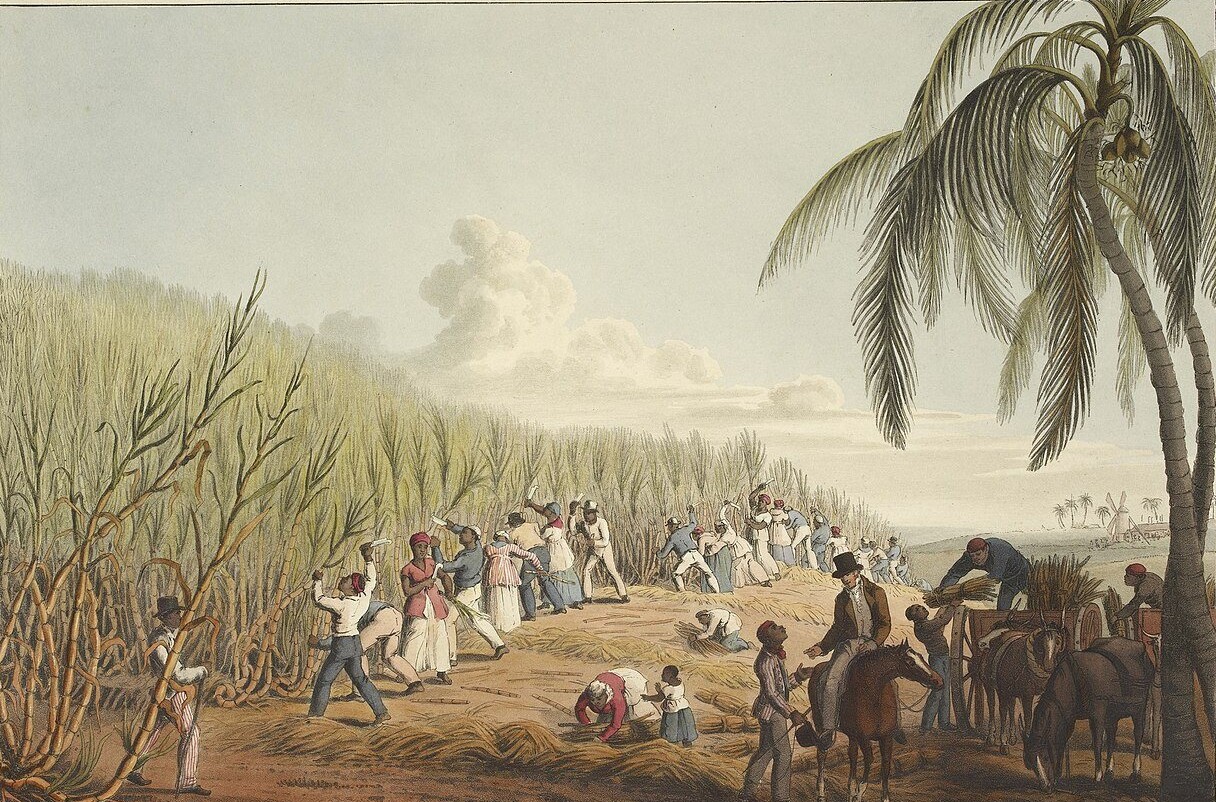
William Clark, Ten Views in the Island of Antigua (1823), CC0, via Wikimedia Commons
In the first days of October 1736, in a pasture outside St John's, Antigua, a man of about 42 was made a king. His owner called him Court. The people around him seem to have known him by other names, Tackey or Kwaku among them, and a colonial report later recorded that he was "Crowned and Honoured as KING" at a feast. White onlookers appear to have taken the whole thing for entertainment. Within a month he had been broken on a wheel, in public, on ground that is now a cricket field.
A British monarch stood up in the same town on Tuesday. Opening the Commonwealth summit at the National Performing Arts Centre, Charles III said the slave trade filled him with "horror" and "the most profound personal sorrow." He did not apologise, and the Palace had said beforehand that he would not. Andy Burnham, the prime minister, is reported to be open to a formal apology and is ruling out reparations.
The coverage I have read does not mention that Antigua once had another king, and I think he belongs in the conversation.
A boy from the Gold Coast
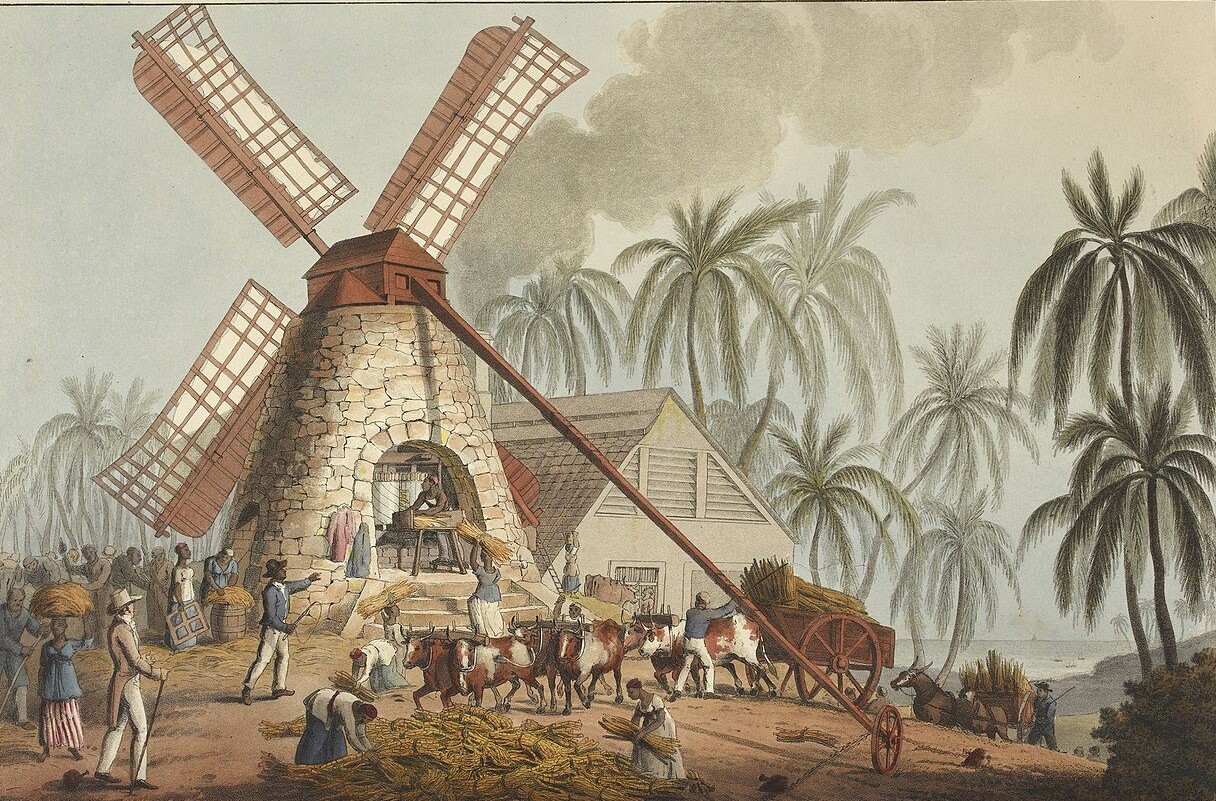
The mill yard on an Antigua estate, plate from William Clark's Ten Views in the Island of Antigua, 1823. CC0, via Wikimedia Commons
Court was taken from West Africa in 1704, aged about ten. His Wikipedia entry places his capture in a civil war at Eguafo, on what is now the coast of Ghana. David Barry Gaspar, the historian who has spent longest with the Antiguan records, considered him Ashanti. By the 1730s he belonged to Thomas Kerby, a judge and speaker of the island's assembly, and he had risen as far as the system let him. He was Kerby's head slave and lived in town.
The island around him was a sugar machine. Colonial records put the population at "at least 24,000 negroes" and "not above 3000 whites," and that ratio was on everyone's mind, whatever they said in public.
Ten gallons of gunpowder
The plan, as the planters' court later reconstructed it, was simple and ambitious. Every year St John's held a great ball for the anniversary of George II's coronation, and in 1736 it was set for 11 October, with the governor and the leading planters expected to attend. A ten-gallon barrel of powder would be placed under the building. Tomboy, an island-born man and Court's chief lieutenant, was to plant it. The explosion would be the signal for people on the estates to rise, and columns would march on the town from four directions. Court would then rule.
The ball was postponed to 30 October. That delay is what undid it, according to the usual account: nineteen extra days are a long time to keep a secret among thousands of people. Whites started to notice loud talk, conch shells blown at night and gatherings at odd hours. On 19 October a committee under the magistrate Robert Arbuthnot began its inquiry.
The wheel, the gibbet and the stake
They killed Court the next day. Tomboy followed on 21 October and a man called Hercules on the 22nd. The authorities had expected those deaths to end the matter and said so afterwards, in a sentence I find chilling for its tone of mild administrative disappointment: "the execution of the first twelve did not break the conspiracy."
The killing went on until the following year. A report of May 1737 gave the full count. Of 132 people convicted, 88 were executed, of whom five were broken on the wheel, six were gibbeted alive and 77 were burned at the stake. Another 36 were transported off the island.
Owners were paid for their losses. The executed had belonged to 60 different people or estates, and the Royall House and Slave Quarters museum in Massachusetts records that Isaac Royall received £70 for a driver named Hector, who was burned. Royall's family later moved to Medford, and it was their crest that Harvard Law School dropped from its seal in 2016.
Was there a plot at all?
This is where I have to be careful, because historians are. No gunpowder was ever found, and neither were any caches of weapons. About 32 prisoners confessed, some under torture, and the historian Jason Sharples has shown that men in the cells could compare stories and that naming others was the best chance anyone had of living. One man reprieved at the stake, Quaco, was spared on a promise "to make Discoveries of great Moment." You can imagine what that promise did to the evidence.
The wider record gives good reason for caution. Jerome Handler has argued that the British authorities exaggerated the plots they claimed to find in Barbados, and Michael Johnson makes a similar case about the Denmark Vesey conspiracy in South Carolina in 1822, which he thinks grew largely out of white panic and leading questions. Antigua's investigators, for their part, wrote that "much remained to be done, and that our Danger was as great as ever." People who write that sentence are not looking for reasons to stop.
Michael Craton read the pasture ceremony as a war dance. Kwasi Konadu argues it was a familiar Akan rite honouring a newly chosen leader, with no declaration of war in it at all. Gaspar and most others accept that something real was being planned. I lean towards them, without much confidence about the barrel of powder, which sounds to me like the kind of detail a frightened court would want to hear.
The executions are not in dispute. Whatever Court was planning, the men running the colony burned 77 people alive and then settled the bills.
Sorrow and the ledger
When Britain did end slavery, it paid again. The 1833 abolition act set aside £20 million for slave owners, and the people freed got nothing. Antigua, as it happens, freed its enslaved people outright in 1834, without the apprenticeship system other colonies used. The Treasury finished paying off the loans behind that compensation in 2015. Those are the sums sitting behind Gaston Browne's line at the summit, "No nation should be forced to mortgage its future simply to survive its present," and behind the signs outside the venue reading "Acknowledge the wrong. Commit to repair."
Where he died
Court was named a National Hero of Antigua and Barbuda in 2000, and there is a statue of him in St John's. The field where he was executed, according to the government's own account, is now the Antigua Recreation Ground, a short walk from the old town. Brian Lara made 375 there in 1994 and 400 not out in 2004, and crowds have sat in those stands for decades and cheered West Indian batsmen on the ground where the wheel stood.
Enjoyed this story?Get a new one every day on social.