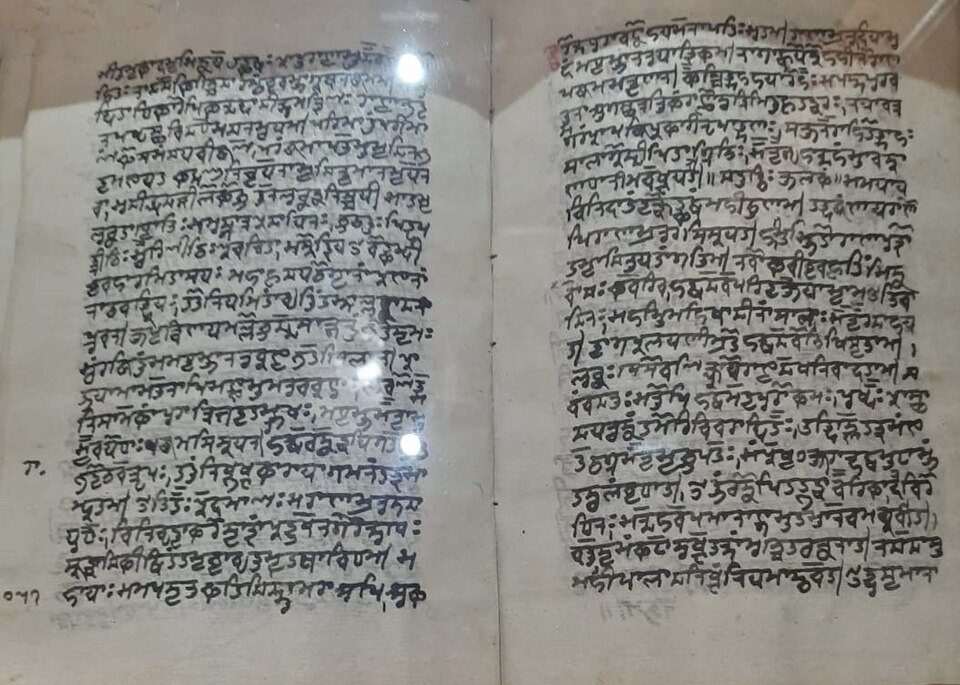
Manuscript of Kalhana's Rajatarangini in Sharada script, Jammu and Kashmir Department of Archives, Archaeology and Museums, public domain, via Wikimedia Commons
UNESCO's Memory of the World committee for Asia and the Pacific met in Jakarta this week and added three Indian manuscript traditions to its regional register: the Mahabharata, Kautilya's Arthashastra and the Rajatarangini. India's culture ministry announced it on Thursday. The first two are famous everywhere. The third is the one I have been waiting for someone to notice.
The Rajatarangini, "the river of kings", is a long Sanskrit poem about the rulers of Kashmir. Its author, Kalhana, finished it around 1148 or 1149. It runs to some 7,826 verses in eight books, which he called waves. It is usually described as the first work of history written in India, and for once the cliché holds up reasonably well.
A minister's son with a grudge against bad sources
We know almost nothing about Kalhana except what he tells us. His father, Canpaka, served at the court of King Harsha of Kashmir, who ruled from 1089 until his own men killed him in 1101. Kalhana grew up close enough to power to see how it worked and far enough from it, by the time he wrote, to say so. He was writing under King Jayasimha, a generation after Harsha's fall.
He opens with a complaint about his predecessors. Older chronicles of Kashmir, he says, had been lost or condensed into something muddled. A poet named Suvrata had made a version that was hard to follow, and Kshemendra's list of kings was full of errors. So Kalhana went to other evidence: eleven earlier works, the Nilamata Purana, the inscriptions on temple foundations and land grants, and written records of royal gifts. Modern historians would add coins to that list, and he seems to have used them too.
He also states a principle. A good poet writing about the past, he says, should be like a judge, setting aside love and hatred. Plenty of chroniclers have said something similar and then flattered their patron for three hundred pages. Kalhana mostly kept his word.
Kings who come out badly
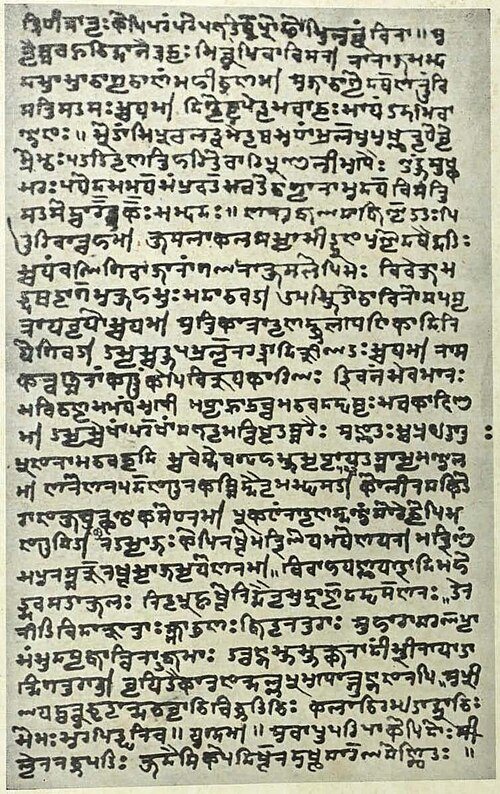
A single page from a Rajatarangini manuscript in Sharada script
The early books are not reliable. Kalhana inherited legends, and he stretched reigns to fill centuries he could not account for, so his chronology for the first millennium is a mess. Scholars have matched some of his early kings with figures known from elsewhere (his Ashoka seems to be the Mauryan emperor, and a Toramana in the text looks like the Huna ruler of that name), but the dates around them drift badly.
From around the 7th century the poem gets firmer. Kalhana's account of the Karkota kings is where most modern histories of early Kashmir begin, including his portrait of Lalitaditya Muktapida, the 8th-century king who built the sun temple at Martand. Kalhana credits him with conquests across half of India and beyond, which historians tend to cut down to size, but the temple ruins are real enough, and so is the sense that Kashmir was briefly a power and not a prize.
By the last two books, which cover the hundred years before Kalhana wrote, it becomes something close to a court memoir.
That is where the kings start to come out badly. Queen Didda, who ran Kashmir as regent and then in her own name from 980 to 1003, gets a portrait as a ruthless operator who removed her own grandsons from the throne, one after another. Harsha, the king his father served, is described as gifted and cultured at the start, then ruinous: failed campaigns, crushing taxes, and temples stripped of their metal images to pay for it all. Kalhana says Harsha even appointed an official whose job was the removal of gods from temples. He wrote this about a king his own family had worked for.
Folio of a Rajatarangini manuscript in Sharada script, unknown scribe, public domain, via Wikimedia Commons
Sequels, a sultan and a Persian translation
The book did not stop with Kalhana. In the 15th century Jonaraja picked up the story from about 1148 and carried it to his own day under Sultan Zain-ul-Abidin, the Muslim ruler of Kashmir who also had the Rajatarangini translated into Persian. Jonaraja's pupil Srivara continued it to 1486. Another sequel, by Prajyabhatta, is lost; a writer named Shuka continued from where that one ended and brought the story to the Mughal conquest at the end of the 16th century.
So a Sanskrit chronicle written by a Brahmin under a Hindu king was extended, and translated, under Muslim rulers for four hundred years. That is not the usual picture people have of medieval Kashmir, and it deserves to be better known than it is.
How a 17th-century copy reached the rest of us
No manuscript in Kalhana's own hand survives. The text came down through copies in Sharada, the old script of Kashmir, written on birch bark and later on paper. The most important is a copy made around 1648 by a Kashmiri scholar, Rajanaka Ratnakantha.
The man who put the poem in front of the wider world was Aurel Stein, a Hungarian-born scholar in British India, better known now for the caves at Dunhuang. Stein published a critical edition of the Sanskrit in 1892 and an English translation with long notes in 1900, built largely on Ratnakantha's copy. He did much of the work, by his own account, in a camp on a high meadow above the Sind valley. In 1935 Ranjit Sitaram Pandit, a nationalist politician, published another English version with a foreword by his brother-in-law, Jawaharlal Nehru.
What the listing does and does not mean
The regional register is a step below UNESCO's international Memory of the World list, and it does not come with money or legal protection. Officials say the Indira Gandhi National Centre for the Arts prepared the nomination files, and that India now has six entries on the regional register. The reports I have seen do not say which physical manuscripts were nominated, which is a little odd for a register of documents.
Kashmir is also not a neutral subject, and this book will be read politically, as it always has been. Every party to the region's arguments can find something in it to quote, usually by leaving out the next few hundred verses.
Why I like him
Kalhana was not a modern historian, and pretending otherwise does him no favours. He believed in curses and portents, and he padded the early centuries with kings who may never have lived. But he named his sources, he said where they were weak, and he was rude about rulers his family had served. Nine hundred years on, I think most of us who write about the past would be glad to be judged by the standard he set himself, even if he didn't always meet it either.
Enjoyed this story?Get a new one every day on social.