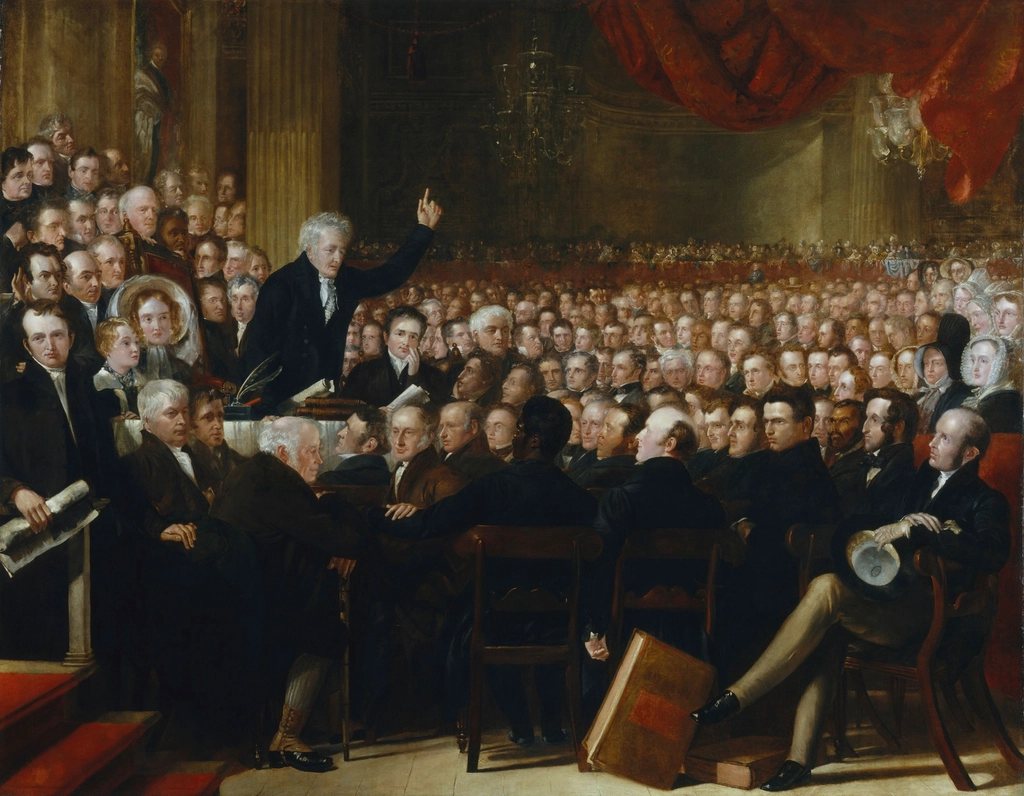
Benjamin Robert Haydon, The Anti-Slavery Society Convention, 1840, public domain, via rawpixel
£106,769. That is what the British state paid John Gladstone, a Liverpool merchant, for the 2,508 people he held on nine plantations when slavery ended in its colonies. By the usual count it was the biggest sum any one claimant collected. His son William would go on to be prime minister four times.
The figure is worth having to hand this week. Prime Minister Andy Burnham went to the Commonwealth summit in Antigua saying he is open to a formal apology for Britain's part in the transatlantic slave trade, and he has ruled out reparations. His foreign secretary, Ed Miliband, says payments are not the "right or feasible answer" and that today's British taxpayers should not be asked to make them. What rarely gets said in London is that the country has already been through this exercise. It worked out what slavery was worth, borrowed the money and paid, and the money went to the wrong side.
What the 1833 Act bought
The Slavery Abolition Act passed in August 1833 and took effect on 1 August 1834. It is usually taught as a moral high point. The text is more commercial than that. It promised "a reasonable Compensation" to the people entitled to the services of the enslaved, and it set the sum at £20 million. Total government spending in 1833 was £48.8 million, so this was about 40 percent of it.
The people freed got no money at all. They didn't even get freedom on the day. Anyone over six became an "apprentice," tied to the same estate and working without wages, and the system lasted until 1838. Planters therefore received the cash and then several more years of unpaid labor on top. If you wanted to design a settlement from the owners' side of the table, you would not change much.
Forty thousand forms
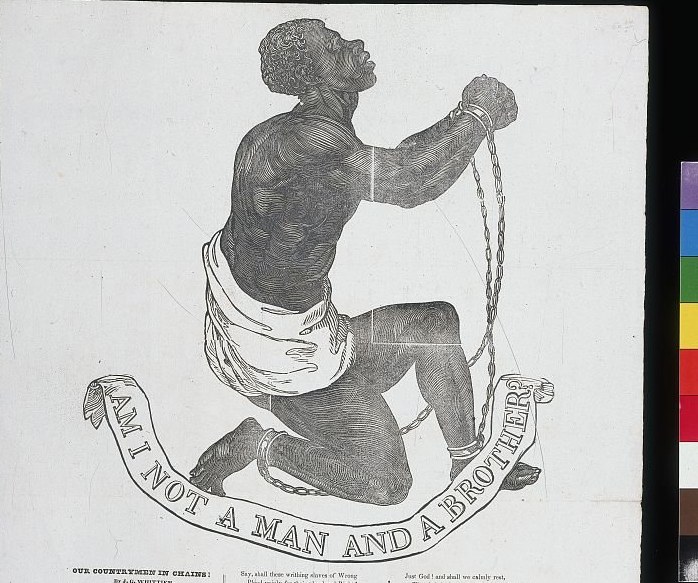
The kneeling figure from an 1837 American antislavery broadside, a design first made popular by British abolitionists. American Anti-Slavery Society, 1837, Library of Congress Prints & Photographs Division, no known restrictions
The money went out through a bureaucracy, and the bureaucracy is the part I find hardest to read. Owners filled in printed returns listing the people they held, grouped by the work they did, with a value attached, and a skilled man was worth more than a field hand. The forms make it plain that nobody involved thought of this as an unusual kind of accounting. Compensation Commissioners checked the claims. Payments were entered in registers kept by the National Debt Office, and those registers survive in the National Archives.
There were more than 40,000 awards. Roughly half the money stayed in Britain, going to absentee owners, merchants and mortgage holders, many of whom never saw a cane field. The claimants were a fair cross-section of respectable society. A University College London search found 96 Anglican priests among them. Henry Phillpotts, Bishop of Exeter, appears as an executor on claims for three Jamaican plantations and 665 people, though no evidence shows he owned anyone himself.
Historians at UCL have put all of this in a public database, the Legacies of British Slavery project. You can type in a surname. I'd recommend it, with the warning that some readers will not enjoy the results.
Who lent the money
The Treasury did not have £20 million spare. A syndicate led by Nathan Mayer Rothschild and Moses Montefiore underwrote a loan. According to the historian Nicholas Draper, £15 million was raised through new securities and the other £5 million was paid straight to claimants in government stock. About a quarter of the compensation went out in Reduced Annuities, a stock many recipients sold quickly, and the proceeds often left the country. One account blames this for making the financial crisis of the mid-1830s worse, which would mean the settlement also landed on British workers who had never owned anyone.
The paperwork on the state's side has held up less well than the paperwork on the slave owners. When the Tax Justice Network asked in 2018, neither the Debt Management Office nor the Bank of England could produce the loan's terms or the names of the banks involved.
A Friday fact
It was the same year as a small disaster on Twitter. On 9 February 2018 the Treasury's account posted one of its weekly #FridayFacts: "Millions of you helped end the slave trade through your taxes." It went on to say that the loan had not been paid off until 2015, "which means that living British citizens helped pay to end the slave trade."
Whoever wrote that thought it was a nice story. Readers, some of them descended from the people on those forms, pointed out what it actually said: that Black British taxpayers had been helping to compensate their ancestors' owners. The tweet was gone within hours.
It wasn't quite accurate either, as the fact-checkers at Full Fact later showed. The original debt was folded into another gilt, and that gilt was what the government redeemed in 2015 during a wider restructuring.
The Gladstones, again
William Gladstone used his early speeches in the Commons in 1833 to defend conditions on his father's estate at Vreedenhoop in Demerara, now part of Guyana. In August 2023 his descendant Charles Gladstone went to Guyana and apologized on the family's behalf, calling slavery a crime against humanity. Parts of the audience rejected the apology and called for reparations.
That exchange is a fair preview of what awaits Burnham. Tony Blair expressed "deep sorrow and regret" in 2006, which fell short of an apology, and Kemi Badenoch now calls the whole debate a "navel-gazing distraction". King Charles spent last week in the Bahamas and Guyana before reaching Antigua. Burnham's alternative is to lead a debt restructuring program for the Commonwealth's poorest countries, which has the advantage of not using the word reparations. Miliband has said an apology would not add costs for taxpayers, and that is probably why it can be offered. In Antigua, Dorbrene O'Marde, who heads the national reparations support commission, said an apology is "essentially the agreement to repair the damage." I can't see those two definitions meeting.
The number nobody has
There is one question left about the 1830s money, and it has no answer. Investors could convert or redeem their holdings at any point between 1833 and 1927. The Treasury says it has no record of how many did, or of how much was still outstanding in 1927.
Depending on how you measure, the £20 million is worth somewhere between £2.4 billion and well over £100 billion today. Nobody knows what share of it was still on the nation's books when the final gilt was redeemed in 2015, so nobody can say how long British taxpayers were really paying.
Enjoyed this story?Get a new one every day on social.