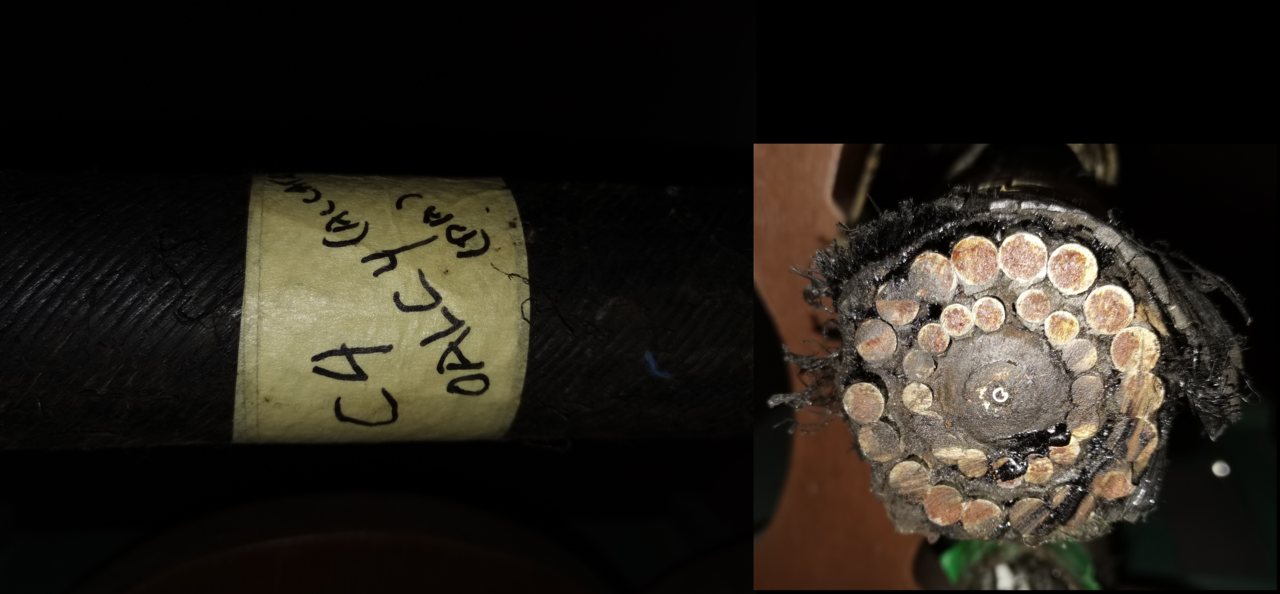
Submarine telegraph cable of the early 1900s, Cerevisae, CC BY-SA 4.0, via Wikimedia Commons
Britain's ultimatum to Germany ran out at eleven o'clock on the night of 4 August 1914. A few hours later a small cable ship slipped out of Dover harbour without an escort. She was called Alert. She belonged to the General Post Office, she was 43 years old, and almost nobody on board knew where she was going. The only man who did was the superintendent in charge of the operation, a Post Office superintendent named Bourdeaux.
By morning Germany had lost almost every direct telegraph line it had to the world outside Europe.
Five cables in the Channel
In 1914 the world's long-distance communication ran through copper wires on the sea floor, wrapped in gutta-percha and armoured with steel. Britain owned most of that network and had spent decades building it. Germany owned a smaller share, and its most important lines left the North Sea coast near Emden and ran down the English Channel: to France, to Spain, and out to the Azores, where they connected onward across the Atlantic.
There were five of them in the Channel. They lay in water that the Royal Navy controlled and that a Post Office crew had spent years learning to work in. The British plan was not complicated. A ship would drag a grapnel along the bottom until it caught a cable, haul it up, and cut it.
Alert had been built in Dumbarton in 1871 as the Lady Carmichael for the Submarine Telegraph Company, and taken over by the Post Office in 1890. She was a repair ship. Her crew's whole job, until that night, had been to find broken cables and mend them. Now they were asked to do the reverse.
The French destroyers
The work went faster than anyone could have hoped. The first cable to come up was the one to Spain, and by the small hours four of the five had been cut. The fifth was harder. The weather was turning, and Alert lost grapnel after grapnel on the bottom.
While she was still working at it, a group of destroyers came out of the dark towards her. Nobody on board could tell whose they were. Alert had no guns and no escort, and a German destroyer could have sunk her in minutes. The crew cut the fifth cable as the ships arrived. They turned out to be French, and when their crews learned what the old ship had been doing, they cheered her. (It is one of the few scenes in the whole history of the war I would happily have watched.)
Germany talks over the air
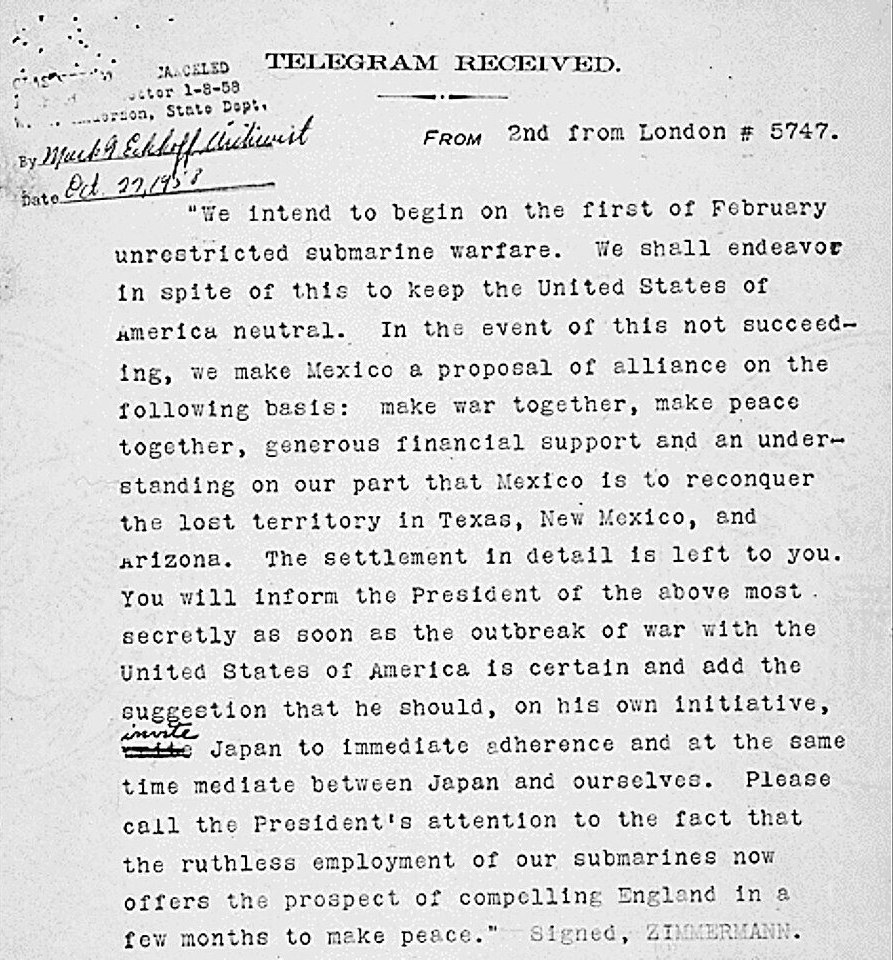
Typed page headed Telegram Received, the English text of the Zimmermann telegram proposing a German alliance with Mexico, with handwritten declassification notes in the upper left corner
With the cables gone, Germany had two ways to reach the rest of the world. One was to borrow other people's wires, which meant neutral countries' cables, most of which also touched British territory at some point. The other was radio, above all the giant transmitter at Nauen outside Berlin, which could reach the United States.
Radio could be heard by anyone with an aerial, and the British were listening. By the end of 1914 the Admiralty had set up a codebreaking office in Room 40 of its Old Building in Whitehall, and much of what it read came from German traffic that had been pushed onto the air or onto routes Britain could tap. Room 40 was not set up because of the cable cutting, though the cutting sent a great deal of work its way.
English text of the Zimmermann telegram as received by the US State Department from London, 1917, via Wikimedia Commons (Abervid21, CC BY-SA 4.0)
A telegram sent on someone else's wire
The most famous result came two and a half years later. In January 1917 the German foreign secretary, Arthur Zimmermann, sent a coded message to his ambassador in Mexico. If the United States entered the war, Mexico should be offered an alliance and the chance to recover Texas, New Mexico and Arizona.
Germany had no cable of its own to send it on. Instead it used, among other routes, the American diplomatic cable, which Washington had let Berlin use for messages about peace. That cable passed through Britain. Room 40 copied the message and broke it, and the British then faced the awkward job of telling the Americans without admitting they had been reading American diplomatic traffic. They obtained a second copy in Mexico and let it be understood that this was where the text came from.
The telegram was handed to the US government in February and published on 1 March 1917. Zimmermann, to the astonishment of almost everyone, confirmed it was genuine. The United States declared war on Germany on 6 April. Historians argue about how much the telegram itself did, given that unrestricted submarine warfare was already sinking American ships. It certainly did Germany no good.
The Telconia problem
A small warning about the sources. For most of the last century, books on the subject, including some good ones, said that the Channel cables were cut by a different ship, the CS Telconia. More recent archival work on the Post Office records points to Alert, and that is the version I have followed. If you have read the Telconia story somewhere, you were not imagining it. It was simply the accepted account for a long time.
From Dover to the Gulf of Finland
The difference between 1914 and now is that the Alert's crew knew exactly what they were doing and did it in the open, as an act of war. The cases that have reached Finnish courts since 2023 have turned on whether anyone meant anything at all.
On Thursday the Helsinki District Court jailed the Russian captain of the cargo ship Fitburg for three and a half years for aggravated criminal damage, and his deputy, an Azerbaijani national, for two years and ten months. Finnish authorities seized the ship on New Year's Eve after damage to telecoms cables running from Helsinki to Estonia, and investigators believe its anchor was dragged along the seabed for several kilometres. An earlier prosecution of the crew of the tanker Eagle S, over the Christmas 2024 cable breaks, failed when a court ruled it had no jurisdiction. Both men denied wrongdoing, and the captain has said he will appeal.
Anchors do drag by accident, which is what makes these cases so hard to prove. Nobody in 1914 had to argue about intent, since a grapnel lowered on purpose to hook a cable is not something a ship does by mistake.
Alert herself did not last much longer than the war she started in. She was taken out of service as unseaworthy in 1915, sold in 1918, renamed twice, and wrecked at Redcar on 17 July 1932.
Enjoyed this story?Get a new one every day on social.