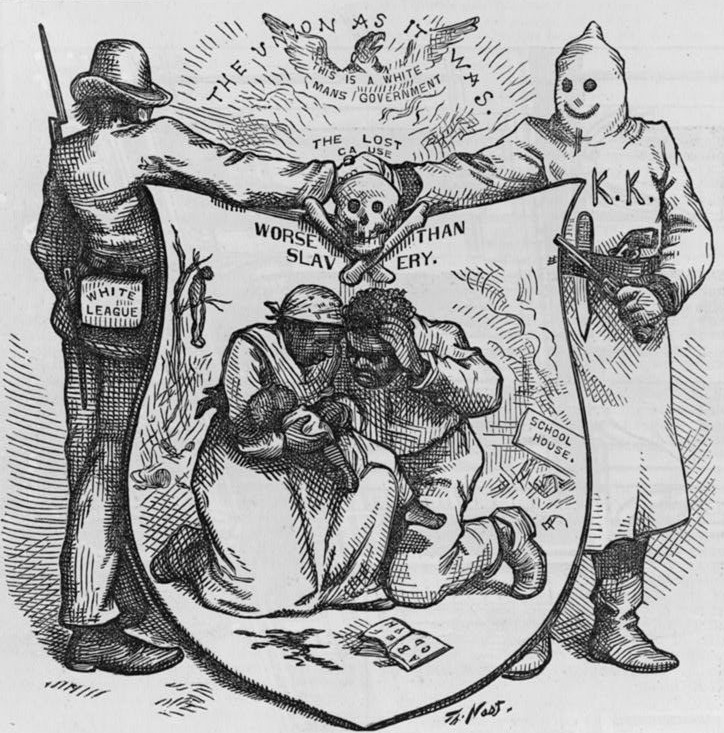
Engraving: Thomas Nast, The Union As It Was, Harper's Weekly, 1874, Library of Congress, no known restrictions
At about six o'clock on the evening of 3 November 1874, Elias Keils was inside a polling place at Spring Hill, Alabama, trying to count votes behind a bolted door. Keils was a white Republican, a judge at Eufaula and the federal election supervisor for the box. His 16-year-old son Willie was with him. The polls had closed an hour earlier and Keils had locked up to protect the ballots, because roughly 50 armed Democrats had spent the afternoon parading outside.
Somebody on the inside drew the bolt. It was an election official, according to the account in the Encyclopedia of Alabama. Armed men came through the door, put out the lights and fired in the dark. Willie Keils was hit four times, probably by shots meant for his father, and he died two days later. The ballot box, with more than 700 ballots from a mostly Black district, was carried off and burned.
Americans are voting today in the same kind of election, a midterm, with all 435 House seats and 35 Senate races on the ballot. It falls on the same date as this one, and that coincidence is why I am writing about Barbour County today instead of the polls.
A county the Republicans should have won
Barbour County sits in southeast Alabama, on the Chattahoochee River, and in 1874 it had a clear Republican majority. Black men had been voting for seven years and they outnumbered white Democrats at the polls by a wide margin. The Democrats of Eufaula, the county's main town, had an answer to that, and it went by names like the White Man's Club. Employers promised jobs to Black men who voted Democratic and threatened the jobs of those who did not.
In August, armed Democrats broke up the Republican convention at Clayton, the county seat, and the delegates had to finish their business on the edge of town. Keils asked for martial law and did not get it. He also asked the US marshal for help, and that produced 20 soldiers and two officers, under orders from General Irvin McDowell that sharply limited what the army could do at an election.
I keep coming back to that order. There were soldiers in the county, in other words, and they had been told to stay out of it.
What happened on Broad Street
On election eve, as many as 1,000 Black men camped outside Eufaula so they could vote together in the morning (accounts of the number vary). White residents talked about an invasion. Keils and Black leaders told the men to come unarmed, and a federal inspection found no weapons.
Voting began quietly. Then came an argument over a Black voter said to be underage, and a Republican named Milas Lawrence was stabbed by a man named William Dowdy. Shooting followed almost at once. Democrats pulled rifles out of a militia store, and most of the gunfire came from white men. The crowd of Black voters, unarmed and packed into the street, ran. Many of them never got to the ballot box.
The numbers are uncertain and I would be wary of anybody who is confident about them. Army records list seven or eight Black men killed or fatally wounded and 70 to 80 hurt. Other estimates put the dead at 15 to 40. Fewer than a dozen white men were injured.
At Spring Hill that afternoon, Keils sent Willie to find Lieutenant William Turner, who had ten men close by. Turner said he was forbidden to intervene.
Who won, and who paid
The Democrats declared victory across Barbour County and took its offices. Keils was arrested in Eufaula for carrying a concealed weapon and resisting arrest, and when he went to the federal court in Montgomery he was told the matter belonged to the new Democratic governor, George Houston. By the middle of December he had resigned from the bench.
A county grand jury blamed "militant" local Black residents. A special committee of the US House took testimony, including from Keils, and split on party lines: the Republican majority blamed the Democrats, and the Democratic minority blamed the Republicans and the army. Nobody was punished. A later local story claimed Keils had held his son up as a shield, which tells you something about how the county wished to remember the evening.
Witnesses named two wealthy landowners as leaders of the Spring Hill mob, the brothers Wallace and Braxton Bragg Comer. Testifying was not safe. One man who named Comer was charged with perjury, a charge historians regard as false, and some Black Republican witnesses were reportedly auctioned off as labourers at a maximum of $2 a month. I have seen that last detail in only a few accounts, so treat it with some care, though it would be a strange thing to invent.
The midterm around it
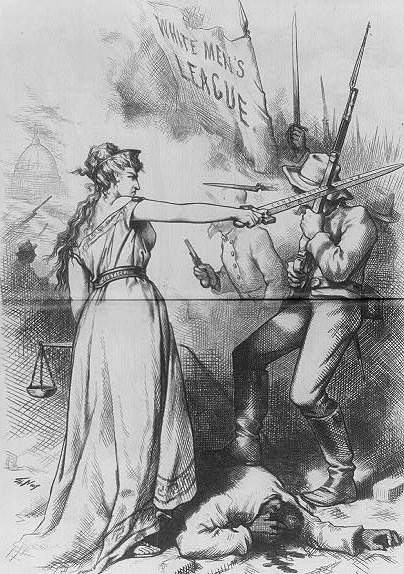
Engraving: Thomas Nast, "Halt!", Harper's Weekly, 1874, Library of Congress, no known restrictions
Alabama was one small part of a national wreck. The Panic of 1873 had thrown people out of work, the Grant administration was stained by scandal, and Northern voters were tired of the South. Republicans lost about 90 seats in the House, going from 195 to roughly 103 by the usual count, and in Alabama the Democrats took six of the eight seats. It is still the party's worst House defeat, and only the 1894 elections have produced a bigger swing.
So the Democrats who took the House had little reason to look hard at Barbour County, and they did not. The following year Mississippi Democrats used the same methods on a statewide scale. Rutherford Hayes took the White House in the settlement of 1877, the troops left, and Reconstruction was over. By one count, only ten Black Republicans went to the polls in Eufaula in the presidential election of 1876.
Where the names are now
Braxton Bragg Comer became a textile magnate and, from 1907 to 1911, governor of Alabama. Alabama's 1901 constitution, written to strip Black citizens of the vote, was still the state's governing document for more than a century, and its segregation clauses survived on paper until voters approved a recompiled version in November 2022, with about 76 percent in favour.
Comer Hall still stands at Auburn, where it houses the agriculture school, and there is a B.B. Comer Hall at the University of Alabama too. Near the community of Comer, at US 82 and County Road 49, a state marker put up in 1979 tells the visitor about Old Spring Hill and says that a mob broke in and that Willie Keils was mortally wounded. It does not mention Eufaula, which is a few miles down the road.
Enjoyed this story?Get a new one every day on social.