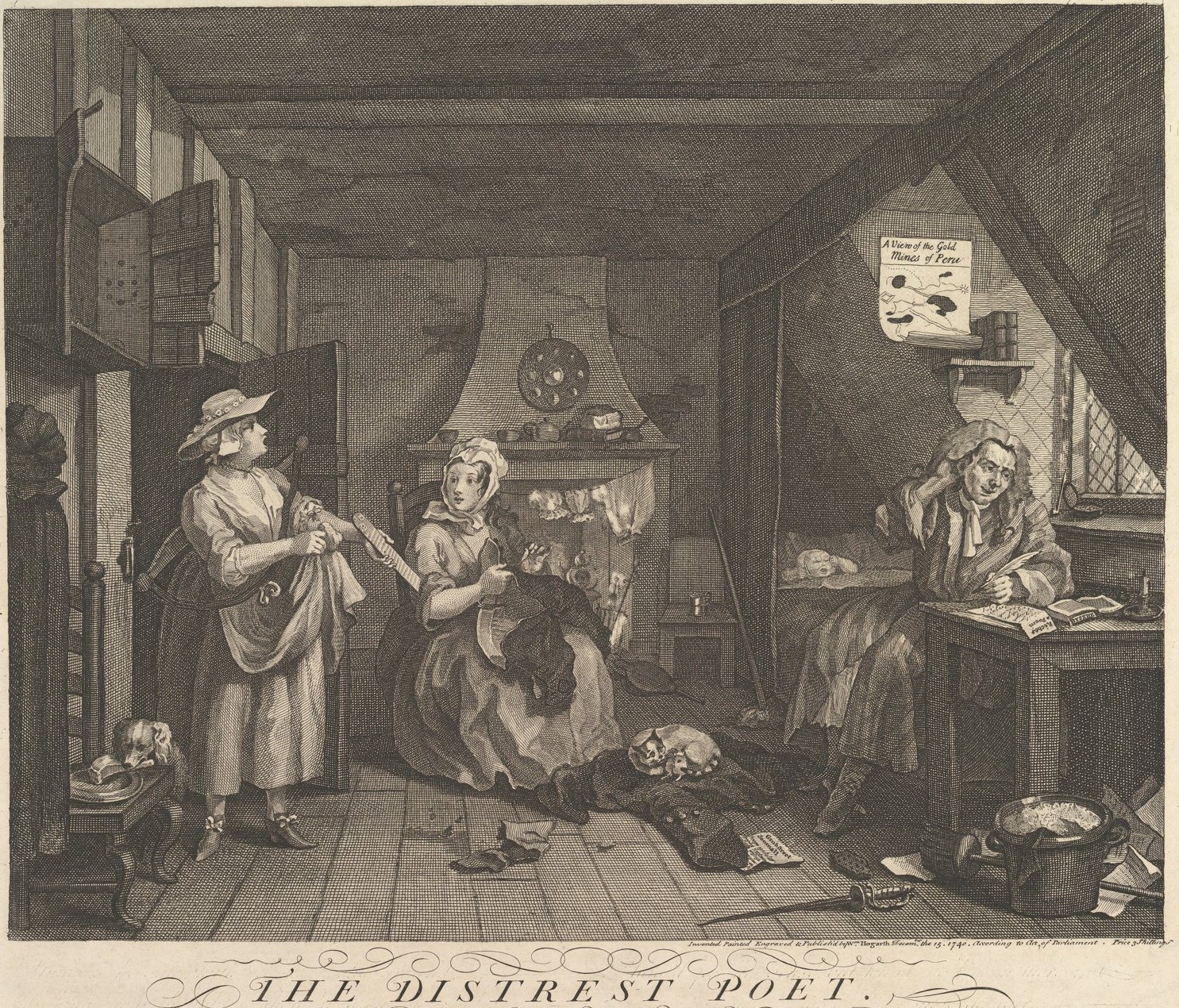
Engraving: William Hogarth, The Distrest Poet, 1740, The Metropolitan Museum of Art, CC0
The young man at the table asked for his meat raw, with plenty of spice, and the bishops and gentlemen of London watched him eat it. He slept upright in a chair. At sunrise and sunset he turned his face to the light and chanted in a language nobody in the room had heard. He was, he told them, a native of Formosa, the island we now call Taiwan, and he had been kidnapped from it by Jesuits.
He had never been within several thousand miles of the place. He was probably a Frenchman from the south, born around 1680, and he had got as far as Germany and the Netherlands on nerve and good Latin. Before Formosa he had tried being an Irish pilgrim, with a forged passport and a stolen cloak, and he dropped that when he kept meeting people who knew Ireland. Then he tried being Japanese. Formosa was the better idea, since almost nobody in Europe could check it.
In 1702 he met a Scottish army chaplain in the Netherlands named Alexander Innes, who either believed him or, more likely, saw what could be done with him. Innes "converted" the heathen to the Church of England, gave him the name George Psalmanazar after an Assyrian king, and took him to London.
An island written from scratch
London in 1703 wanted him badly. He was a pagan who had refused the Jesuits and chosen the Anglicans, and that flattered everybody who mattered. Henry Compton, the Bishop of London, took him up. In 1704 he published An Historical and Geographical Description of Formosa and it sold well enough for a second edition, plus translations into French and German.
It is a wonderful book. The capital is a city called Xternetsa. People live in round underground houses, which conveniently explained his pale skin. They eat serpents, which they hunt with branches. A husband may eat a wife who has been unfaithful. Every year the priests sacrifice the hearts of 18,000 boys (some retellings say 20,000). That is nearly 50 boys a day, and I cannot find that it cost him a single invitation.
There was a language too, with a working alphabet, a grammar and a Lord's Prayer. It was good enough that German grammarians were still reprinting the alphabet in the nineteenth century, long after everyone knew it was invented. Linguists today file it among constructed languages. I would like it noted that a man in his early twenties did this for dinner invitations.
The crooked chimneys
There were doubters from the start. On the night of 2 February 1704, Psalmanazar debated a Jesuit named Jean de Fontaney, just back from China. It should have ended him. It did not, partly because Fontaney knew little about Formosa itself, and partly because a Jesuit calling a man a liar was, in Protestant London, a point in that man's favour. Asked why he was so pale, Psalmanazar said nobles there kept out of the sun.
Edmond Halley, of the comet, tried arithmetic. He brought along a 1667 map of East Asia that did not match Psalmanazar's, and then he asked about chimneys. Formosa sits on the Tropic of Cancer, so at the summer solstice the sun should shine straight down a chimney. Psalmanazar said it did not. Told that it must, he replied that Formosan chimneys were crooked.
That answer is my favourite thing in this whole affair, and it worked. You cannot easily refute a witness who is the only person in the room claiming to have been there. A Dutch pastor, Georgius Candidius, had described the island's real people in 1628, and his report was reprinted in Britain in 1704. A former East India Company man, Samuel Griffith, had been on Formosa in the 1670s and said the book was wrong. The Royal Society rejected Psalmanazar's account on 20 June 1705, and then never published its verdict.
A confession nobody asked for
The fashion wore off on its own. Innes left for Portugal as a chaplain-general, a scheme to sell "Formosan" fans came to nothing, and the believers got fewer every season. In 1706 Psalmanazar began admitting the fraud, first to friends and then more widely.
And then, and this is the part I find strangest, he stayed. He did not change his name again or leave for another country. He kept the fake name for 57 more years, learned Hebrew, and became a hack in Grub Street, writing for printers by the sheet, on the sort of attic floor Hogarth drew in the print at the top of this story (note the map on the poet's wall, of the gold mines of Peru). He worked on the huge Universal History. In 1747, in A Complete System of Geography, he wrote an honest entry on Formosa and said outright that the earlier account was his own imposture.
The best man Johnson ever knew
He ended his life as an old man in Ironmonger Row, off Old Street, famous among his neighbours for his piety. Samuel Johnson, then a young writer, sought out his company. Asked who the best man he had ever known was, Johnson named Psalmanazar. On arguing with him, Johnson said, "I should as soon think of contradicting a Bishop."
He died on 3 May 1763. His will calls himself a poor, sinful, worthless creature, asks for the cheapest possible burial, and declares his history of Formosa a fraud. His Memoirs, published the next year, confess everything in detail, except the one thing a reader wants. They do not say who he was. The name he was born with has never been found.
The people he displaced in the European imagination are still on the island. Taiwan's government recognises 16 Indigenous peoples, and the plains peoples, including the Siraya whom Candidius described in 1628, can now apply for national recognition under a 2025 law. I have looked for a satisfying way to connect those two facts and have not found one, so I will leave them next to each other.
Enjoyed this story?Get a new one every day on social.