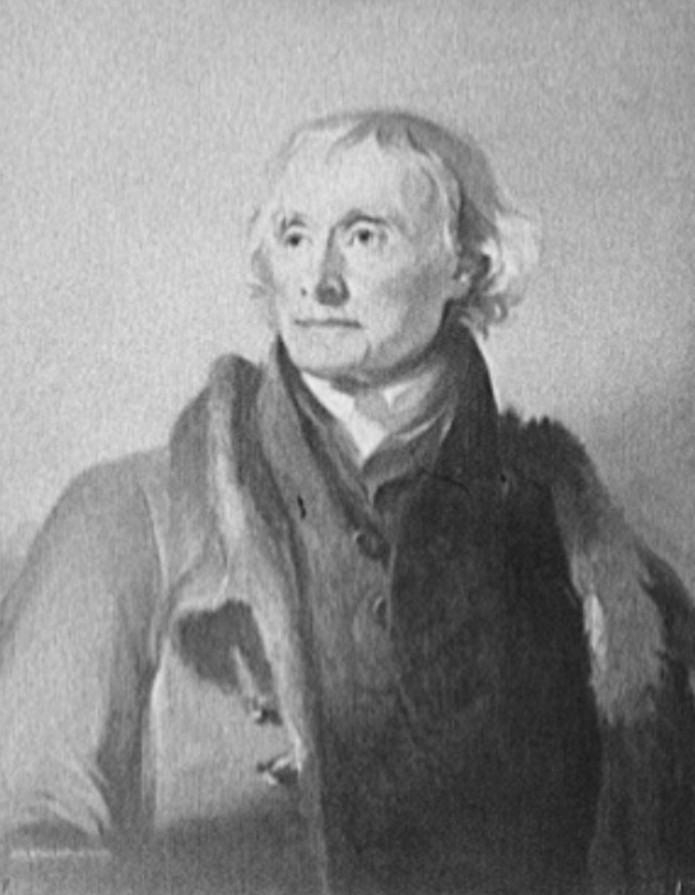
Thomas Jefferson, after the portrait by Thomas Sully, photograph between 1900 and 1920, Library of Congress Prints & Photographs Division, no known restrictions
On 4 January 2007, in a room in the Capitol, a congressman from Minneapolis posed for the cameras with his hand on two small, worn volumes. The official oath had already been taken on the House floor, where members swear together and nobody holds a book. This was the ceremonial photograph, the one families frame. Keith Ellison, the first Muslim elected to Congress, had borrowed the books from the Library of Congress across the street. They were Thomas Jefferson's copy of the Quran.
That copy is being talked about again this week. On Tuesday Michigan elected Abdul El-Sayed, a Democrat, to the U.S. Senate over Mike Rogers, which makes him the first Muslim elected to that chamber. He takes his seat in January. Whether he will ask the Library for the same books, I have no idea, and I have seen no report that he has.
A law student's purchase
Jefferson's Quran is not an Arabic manuscript. It is the English translation by George Sale, a London lawyer, first published in 1734. Jefferson's set is the second edition, printed in London in 1764 in two volumes.
He bought it in 1765 in Williamsburg, where he was reading law. We know because the daybook of the Virginia Gazette, which sold books as well as printing the paper, records the sale. He was 22.
Why he wanted it is a matter of guesswork. Sale's long introduction, the "Preliminary Discourse", covers Islamic law as well as religion, and historians such as Denise Spellberg have pointed out that a young man studying the laws of nations had reasons to read it beyond curiosity. Sale was also unusually fair for his time. He still called the Prophet an impostor, as an English Protestant of 1734 was expected to, but he warned readers against the cruder Christian polemics and used Muslim commentators to explain the text.
It should probably have burned twice
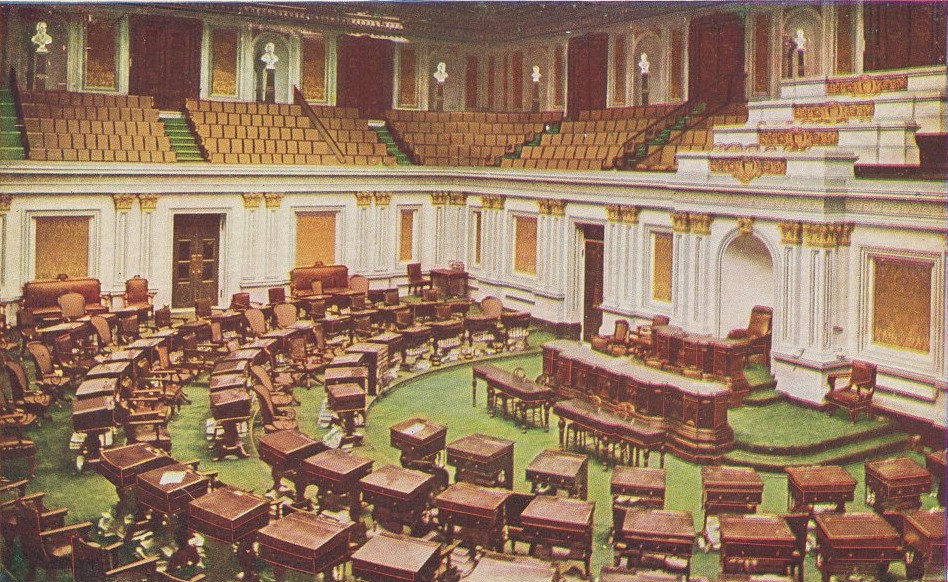
Postcard of the U.S. Senate chamber in the Capitol, empty, with rows of wooden desks and the public galleries above
In 1770 Shadwell, the Jefferson family house, burned down and took most of his books with it. There is no record of him buying the Quran again, which suggests this set came through the fire. (Monticello's researchers say "may have", and I'll leave it there.)
Then came the British. In August 1814 they burned the Capitol, and with it the small library of Congress. Jefferson, retired and short of money, offered his own collection as a replacement. Congress bought it in 1815, 6,487 volumes for $23,950, after a fair amount of grumbling that some of the books were in foreign languages or were otherwise unsuitable for legislators. Sale's Quran went to Washington in the wagons with the rest.
In 1851 a fire in the Library destroyed about two thirds of the books Jefferson had sold. The Quran survived that too.
Senate Chamber, Capitol, Washington, D.C., postcard, between 1908 and 1948, Library of Congress Prints & Photographs Division, no known restrictions
What Jefferson actually thought
It would be easy to make Jefferson into something he wasn't. He did not admire Islam; he wrote very little about it, and some of that was hostile. In 1786 he and John Adams met the envoy of Tripoli in London to ask why the Barbary states were seizing American ships, and Jefferson's report says the envoy cited the Quran as justification. As president he went on to fight the First Barbary War against Tripoli.
But on the narrower question of whether a Muslim could be a full citizen, he left a paper trail. In notes he made on John Locke around 1776, he copied out Locke's point that neither "Pagan nor Mahamedan nor Jew" should be shut out of the civil rights of the commonwealth because of religion. Years later, in his autobiography, he described the passage of his Virginia Statute for Religious Freedom. Someone had proposed inserting the words "Jesus Christ" into the preamble. The amendment was rejected, Jefferson wrote, "in proof that they meant to comprehend, within the mantle of its protection, the Jew and the Gentile, the Christian and Mahometan, the Hindoo and Infidel of every denomination."
The argument in 2006
Ellison's choice was not quiet. In late 2006 the conservative columnist Dennis Prager argued that a congressman should take his oath on the Bible or not serve. Virgil Goode, a Republican congressman from Virginia, wrote to constituents that unless immigration was restricted, more Muslims would be elected and would want to use the Quran. Ellison, asked about it, said he wanted to show that a belief in religious freedom went back to the founders. Picking a Virginian's book to answer a Virginian was, I think, the neatest move anyone made in that whole episode.
Since then the phrase "Jefferson's Quran" has turned up whenever a Muslim American wins high office, and this week has been no exception.
Where the books are now
The two volumes are in the Rare Book and Special Collections Division of the Library of Congress. They are not the bindings Jefferson knew, because the Library rebound them in 1918. What survives of Jefferson's set is the paper and the print: the title page with Sale's name and the London imprint of 1764, and the long Preliminary Discourse that a law student may have read more closely than the translation itself. It is a pair of plain small books in a rare book stack, and it leaves only when a curator carries it out for an occasion like Ellison's.
Enjoyed this story?Get a new one every day on social.