Photo: Andrew Milligan sumo, CC BY 2.0, via Wikimedia Commons
Volodymyr Zelensky has signed a decree giving Melania Trump the Order of Princess Olga, first class, for her part in arranging a short truce that let several hundred civilians leave the Russian-occupied town of Oleshky. It is Ukraine's highest honor for women. Russian and Ukrainian delegations are due at the White House on Thursday at the first lady's invitation, so a lot of people have spent this week reading the name of the award.
Fewer have asked who she was. The woman behind the medal is honored for statecraft and for Christianity, and fairly. The oldest chronicle of her own country also says she buried 20 men alive in a boat and set a town alight with its own pigeons.
A tax collector who went back for more
In 945 Olga's husband Igor, prince of Kyiv, rode out to collect tribute from the Drevlians, a Slavic people in the forests northwest of the city. He got it and started home. Then he turned back with a small escort to ask for more.
The Primary Chronicle, put together in Kyiv in the early 12th century, gives the Drevlians' reasoning in one line: "If a wolf come among the sheep, he will take away the whole flock one by one, unless he be killed." They killed him. The Byzantine writer Leo the Deacon adds that Igor was tied to two trees and torn apart, although at least one modern scholar suspects Leo borrowed that from the Greek myth of the robber Sinis, which is the kind of thing a well-read Byzantine would do.
Igor's son Sviatoslav was a child, so Olga held power for him. The Drevlians then made what must be one of the worst-judged offers in medieval diplomacy. They sent 20 envoys down the river to suggest she marry their prince, Mal, the man who had just had her husband killed.
Three funerals for one prince
Olga told the envoys to go back to their boat and insist on being carried to court in it the next morning, as a mark of honor. They did. Her men carried them up in the boat and dropped them, boat and all, into a trench already dug by the palace. The chronicle has her lean over and ask if the honor was to their taste. They said it was worse than the death of Igor. Then the trench was filled.
She sent to the Drevlians asking for their best men as an escort. When those arrived she offered them a bath, locked the doors and burned the bathhouse. Then she traveled to Igor's grave to hold a funeral feast, got the Drevlians drunk and had them cut down. The chronicle says 5,000 died.
Before anyone reaches for the word psychopath, there is a good argument that we are not reading a police report. Aleksandr Koptev, writing in 2010, reads the boat, the bath and the feast as stages of a pagan prince's funeral, turned into incidents as the story passed from oral tradition into a monk's manuscript. I find that persuasive. The chronicle was compiled about 170 years after these events, and it is a very tidy massacre.
The pigeons of Iskorosten
The next year Olga took an army to the Drevlian capital, Iskorosten, and sat outside it, by the chronicle's account, for a full year without taking it. Then she offered terms. She wanted no heavy tribute, only "three pigeons and three sparrows from each house."
The town paid. Her men tied sulphur wrapped in cloth to each bird and let them go at dusk. They flew home to their nests under the eaves and thatch, and the town went up. Those who ran were killed or enslaved, and the rest were put under tribute.
Did it happen? I know of no historian who takes the birds literally, and anyone who has tried to get a pigeon to do anything will share the doubt. The same trick turns up in the saga of Harald Hardrada, set in Sicily, which suggests a good story traveling with the Norse, Olga's own people by descent. That Iskorosten was taken and the Drevlians broken is much easier to believe.
The reform nobody paints
The part of Olga's reign that matters most is the dullest. After the war she went around the country fixing what was owed and where. She set up collection points called pogosti, some of them as far north as the Msta and Luga rivers, and turned the old raid for tribute into something closer to a schedule. Igor had died because a prince could decide on the day how much he felt like taking. His widow ended that. It may be the first recorded legal reform in Eastern Europe, and it is certainly the least exciting thing in this article.
She also went to Constantinople, where Constantine VII described her reception in his Book of Ceremonies, and at some point she was baptized under the name Helena. The date is disputed. Church tradition says 957, and Byzantine sources hint she may already have been Christian when she arrived. The chronicle's tale that she tricked the emperor out of proposing to her can be set aside, since he already had an empress.
She died in 969, and her last instruction, according to the chronicle, was that there should be no funeral feast. She knew what those were for.
One saint, two countries
The Russian Orthodox Church formally recognized her in 1547 as "equal to the apostles," a rank held by very few women. The usual answer to the obvious objection is that everything she did to the Drevlians came before her baptism. Russia and Ukraine both claim her, as they both claim Kyivan Rus, and that argument about who inherits the medieval state now has an army attached to it.
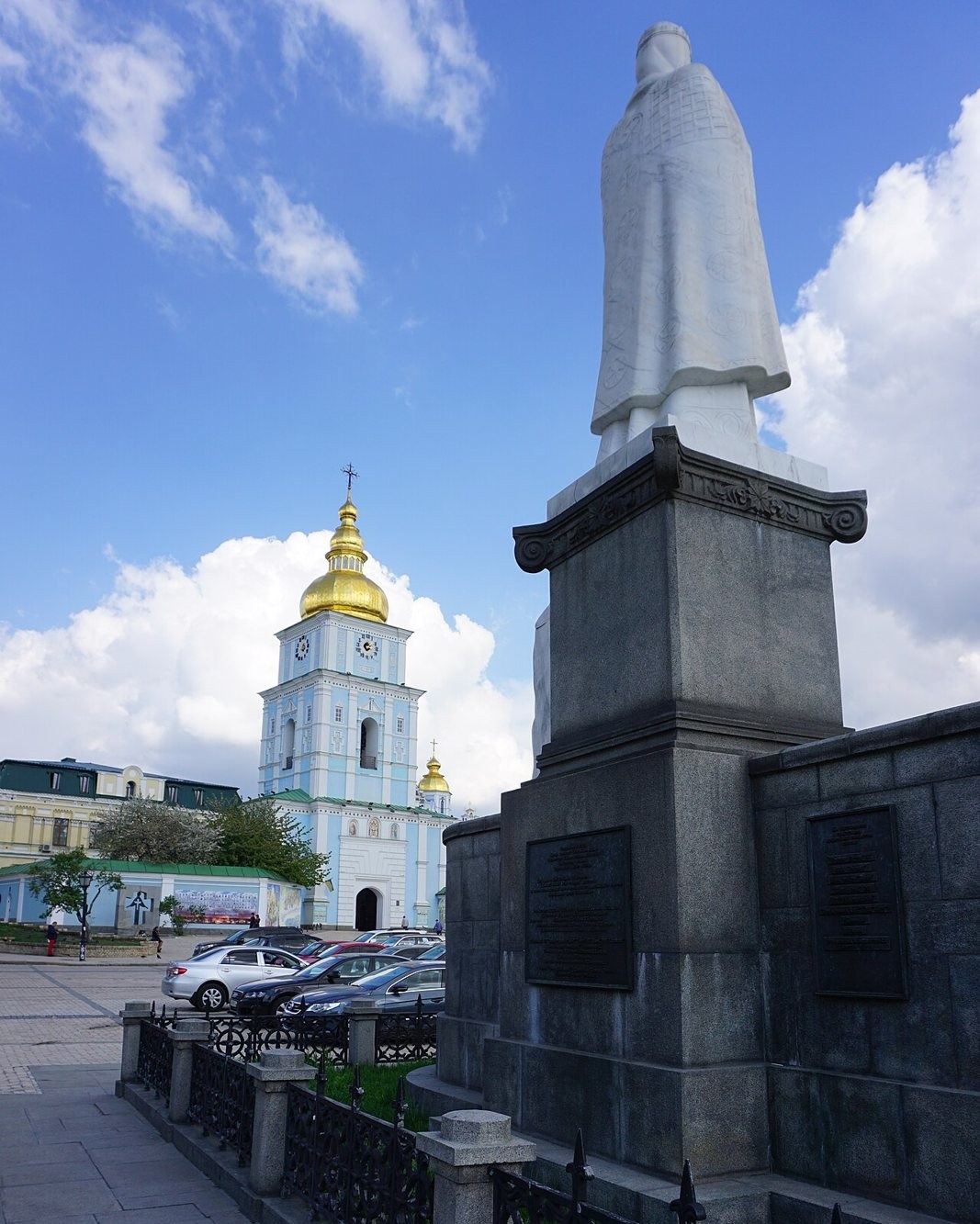
Kyiv's monument to her went up in 1911, was pulled down under Soviet rule and was rebuilt in 1996, the year before independent Ukraine created the order.
Iskorosten is now Korosten, a railway junction in Zhytomyr region with about 60,000 people before the war, roughly 90 kilometers from Chornobyl. Its park on the River Uzh has a spot called the Bath of Princess Olga. Since 2008 the park has also hosted a potato pancake festival on the third Saturday of September.
Enjoyed this story?Get a new one every day on social.